











































Multisectoral Action Framework for Malaria
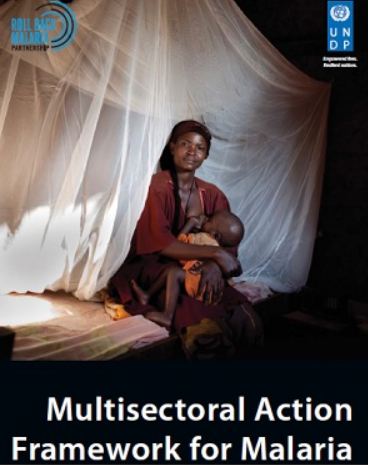
This publication outlines a framework for re-structuring the way countries address malaria. It presents a menu of concrete, implementable processes and actions to transform malaria responses from being a concern of the health sector only towards a coordinated multi-pronged effort that harnesses expertise across a range of sectors and institutions. It is intended as a guide for policymakers and practitioners and a stimulus for innovation. According to the publication, bednets and better medicine are essential for countering malaria, but alone they are not enough. A development approach to malaria that harnesses multiple sectors is needed.
This framework was the result of a collaboration between the Roll Back Malaria (RBM) Partnership and the United Nations Development Programme (UNDP), guided by a Steering Committee composed of the United Nations Environment Programme (UNEP), the United Nations Human Settlements Programme, the United Nations Children's Fund (UNICEF), the World Health Organization (WHO), and the World Bank - with inputs from governments at the frontline of the malaria response, development banks, the private sector, and academia.
The report explains that Europe, North America, and, more recently, countries such as Iran and Sri Lanka have eliminated or are eliminating endemic malaria by acting on broader socio-economic determinants. Such action includes improving living conditions, promoting smarter agricultural practices, and addressing barriers to accessing health services. Advancing gender equality, improving education, and protecting the environment are also important. Malaria has the greatest burden among economically poor women and children, and studies show that households where women are educated and earn an income are more likely to use bednets to prevent malaria. Environmental factors can complicate malaria control and elimination. For example, climate change affects the geographical distribution of the malaria parasite, and population movements increase vulnerability where people with low immunity move to high-transmission areas.
The framework analyses the social and environmental determinants of malaria at four levels: society, environment, population group, and household and individual. The conclusion of the analysis is that the current strategies for malaria control need to be continued, but that they alone are unlikely to lead to sustained control and elimination in the countries with the highest malaria burden. They need to be complemented with a developmental approach, addressing key social and environmental determinants. The framework encourages a "Try it, test it" approach in pathfinder countries to be applied immediately, with mechanisms for sharing information about what works and what doesn't.
According to the framework, there is a rich experience of individual interventions that have been tried over the years by countries and organisations; the document provides a list of examples with links to where more information can be found. For such interventions to have lasting effects, however, they need to be scaled up and implemented in a concerted manner. This requires the involvement of multiple actors. The challenge is that these actors often have different value bases, success criteria, constraints to participation, and management cultures, often making collaboration difficult.
The report makes the point that there is a vast pool of knowledge and data available on malaria and nearly 100 years of international malaria programme experience to draw on. Nevertheless, the RBM-UNDP consultation held in Geneva in July 2013, with the participation of malaria programme managers and experts from multiple sectors, as well as other work in preparation of this document, found important knowledge gaps that need further exploration and research. Firstly, many of the promising interventions and ideas are not new, but management innovation is required to apply them in the concerted large-scale and sustained effort needed for a lasting impact on malaria. Important would be "learning cycles", with near-real-time digestion and sharing of experiences locally, nationally, and internationally, taking advantage of the borderless information and communication technologies (ICTs).
Furthermore, in a world that calculates investments and returns, the question of the cost of sectors doing things differently will be raised. It is expected that these costs, in most cases, will be marginal to the core operations of the sectors. However, little is actually known about these costs and the short- and long-term returns on investment for the individual sectoral actor. Therefore, researchers are encouraged to generate evidence on economic return and value for money of multisectoral action where the health and malaria outcomes are additional benefits to sector-specific outcomes. Finally, there is a need to better understand causality, including identifying those multisectoral interventions that have the greatest impact on malaria. This could be done through learning from outlier countries - i.e., countries that have done better in elimination than their economic indicators predicted: What did they do right?
Five processes are outlined as critical first steps:
- Sustainable Development Goals: the process for their definition is already well underway. Malaria elimination should be seen as an end in itself, as well as a measure of development. Malaria as a specific target (currently MDG#6) should be maintained.
- Global Malarial Action Plan (GMAP2): The integration of the Multisectoral Action Framework for Malaria into the GMAP2 will start with its endorsement by the RBM Partnership Board in November for it to be fully integrated into the GMAP2 that will be launched in 2014.
- The UN Platform on Social Determinants of Health: An agreement between UN agencies to work together on social determinants of health to reduce health inequities and promote development, and support countries to implement the Rio Political Declaration (2011).
- The Libreville Declaration on Health and Environment in Africa (Third Interministerial Conference): The conference provides an opportunity to unite ministers behind the Multisectoral Action Framework for Malaria, to facilitate the adoption in countries across the African continent.
- "Try it - test it" in real-life situations in pathfinder countries: the proof of the framework will be in its implementation, and, to get early learning results, it will be essential that some countries are willing to try it out at the local or national levels.
RBM Website on February 18 2014.
- Log in to post comments