











































Don't Shoot the Messenger! Journalists as Human Rights Defenders in the East and Horn of Africa
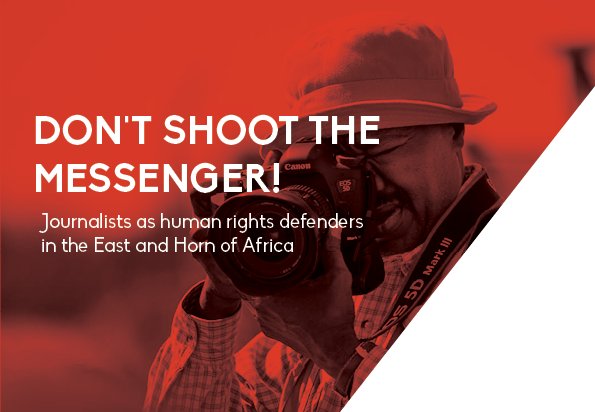
”…amid growing restrictions on civic space in the sub-region, journalists play a critical role in exposing human rights violations and providing vital information and analysis of current events. Simply documenting and sharing information can simultaneously place them at risk and at the forefront of human rights defence.”
This report examines the role journalists play as human rights defenders in the current political context of the East and Horn of Africa. It explores the challenges journalists face, both online and offline, and assesses the advances and gaps in protection mechanisms for them. Looking at trends, legal frameworks, and case studies from 11 countries, the ultimate aim of the report is to promote an improved working environment for journalists working as human rights defenders (HRDs). It offers concrete solutions to online and offline challenges and makes key recommendations to governments and civil society to ensure that a free media environment in the region is protected and promoted. The report is based on interviews from over 60 journalists, bloggers, and media professionals from the sub-region, in addition to significant input from civil society organisations dedicated to free expression and the protection of journalists.
Central to the report is the question of whether journalists, by nature of their work, should be considered HRDs. As stated in the report, “While not all journalists act as human rights defenders (HRDs), many do so through investigative reporting, exposing human rights violations and abuses, or providing vital information and analysis of current events. They act as important witnesses and alert the world to human rights violations. However, in the increasingly repressive context of the East and Horn of Africa, journalists have found that simply documenting and sharing information can simultaneously place them at risk and at the forefront of human rights defence.”
The report outlines the context and some of the main challenges faced by journalists in the subregion, which have evolved and diversified as the media - and particularly the online media - have developed and broadened their reach. The Executive Summary provides the following brief overview: “In recent years, controversial elections and highly charged political contests in Kenya and Uganda have created serious challenges to independent reporting and free expression, although these countries normally boast relatively open media landscapes. In Tanzania, journalists and civil society are extremely concerned by the use of new laws to shutter or ban critical outlets and target online communications. Newspapers in Sudan are often harassed by the National Intelligence Security Services (NISS) who confiscate print runs or prosecute journalists on spurious charges, while constant intimidation and threats have left almost no independent journalists working freely in Rwanda. The government of Ethiopia lifted the ten-month State of Emergency in August 2017, but draconian restrictions on communications and free expression remain, while fear of prosecution has forced many journalists and critics to self-censor or to leave the country. Eritrea and Djibouti remain two of the most repressive regimes in the sub-region, and with no independent media able to function effectively, exiled journalists struggle to fill the gaps left by state-owned outlets. In Burundi and South Sudan, documenting grave and systematic human rights violations represents a real risk for journalists attempting to report from the ground, forcing many to do so from the relative safety of exile. Somalia has made some gains in media plurality, but authorities in south-central Somalia, Puntland and Somaliland routinely detain reporters, often without charge, while non-state actors like Al Shabaab continue to target journalists.”
Overall, “[J]ournalists are increasingly faced with new threats to their work and security, including harassment, arbitrary detentions, and imprisonments and prosecutions under spurious laws, both online and offline. These threats intensify amid violent conflicts and political crises, and often force journalists into exile, where they face new challenges.”
Some of the strategies journalists can use to continue their work securely are highlighted in the report. These include reporting in exile using radio and social media. In addition, various initiatives are available that provide protection and support mechanisms to encourage journalists to report on human rights issues, which include training, legal aid, financial assistance, and the provision of safety equipment.
The report concludes with a list of recommendations for journalists, media houses, civil society, governments in the East and Horn of Africa, the African Union, and the United Nations. The following are a few examples intended for journalists, media houses, and civil society:
Journalists:
- Seek out trainings to improve security and professional knowledge and contacts;
- Understand rights and responsibilities in accordance with media laws;
- Respect ethical reporting standards in order to combat restrictions of freedom of expression, using reliable fact-checking methodology.
Media houses:
- Ensure the security of staff by providing protective equipment, insurance, security courses, and psychosocial support for journalists, including freelancers and fixers;
- Develop security guidelines for journalists and office security plans.
Civil society:
- Collaborate with journalist unions and media houses to provide physical and digital security trainings to journalists;
- Ensure that protection mechanisms are available to journalists at risk and can be quickly implemented in cases of emergency;
- Provide psychosocial support for journalists suffering from post-traumatic stress disorder.
Defend Defenders website on November 8 2017.
- Log in to post comments