










































Tsha Tsha
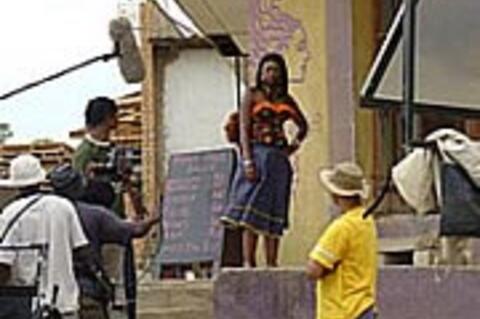
The series, comprising a total of 78 half-hour episodes, was broadcast between 2003 and 2006 during prime-time on television station SABC1.
Tsha Tsha explored the lives of a group of young people living in a small fictional rural town called Lubusi. The rural context was chosen as it allowed for the exploration of issues relating to community life including the marginalisation of youth, and this created an appropriate setting for a character-based drama dealing with personal and social transformation. The setting was also uniquely different from the predominantly urban orientation of most South African television youth dramas.
The drama revealed the complexity of the world of youth and explored their capacity to reflect on problems, to engage in problem-solving, to develop solutions, and to become important social actors in their own lives and in the world of their communities.
Tsha Tsha was about coming of age in South Africa, the choices that young South Africans are faced with, and the consequences of those decisions. While set in a world unfamiliar to many urban viewers, it spoke to all young South Africans (according to organisers) because it captured the ordinary lives and times of ordinary people.
Video and DVD copies of Tsha Tsha series one, two, and three – and a 20-minute promo tape - are available to organisations involved in HIV/AIDS training and education. A Facilitator's Guide to series one was developed to encourage reflection, debate, and discussion of HIV/AIDS and related issues after watching clips or episodes of Tsha Tsha.
The series has been distributed to higher education institutions through CADRE's partner organisation, DramAidE. On some of these campuses big screen viewings have been held and have been supplemented by facilitated discussions, where themes, students' opinions, experiences, and feelings were shared.
Tsha Tsha has also been piloted in correctional facilities as an HIV/AIDS educational resource. The incorporation of Tsha Tsha into the HIV/AIDS Programme in over 200 correctional services facilities across South Africa is currently underway.
The videos and guide are aimed at non-governmental and community-based organisations, institutions, government departments, and groups that support HIV/AIDS education and training.
Youth, HIV/AIDS.
Although produced for a youth target audience, the series drew viewers across age and language groups, and achieved an audience share of around 50% for the broadcast timeslot.
Curious Pictures, Centre for Aids Development, Research and Evaluation (CADRE), SABC Education, SABC 1, USAID.
SABC Education site, March 24 2004; and CADRE website, July 15 2008.
- Log in to post comments