










































System Effectiveness of a Targeted Free Mass Distribution of Long Lasting Insecticidal Nets in Zanzibar, Tanzania
Karolinska Institutet (Beer, Källander, Björkman); Zanzibar Malaria Control Programme (Ali, Al-mafazy, Abass, Omari); Swiss Tropical and Public Health Institute (Savigny); Research Triangle Institute (Ramsan); Makerere University School of Public Health and Malaria Consortium Africa(Källander).
Published in the Malaria Journal, this article shares findings from a study evaluating outcomes of a mass distribution of insecticide-treated nets (ITN) and long-lasting insecticidal nets (LLIN) in Zanzibar and Tanzania, four to nine months after implementation. The evaluation found that focused free mass distribution of LLINs can result in high and equitable bed net coverage among children under five. However, in order to sustain high effective coverage, there is need for complimentary distribution strategies between mass distribution campaigns. Considering the community's preferences prior to a mass distribution and addressing the communities concerns through information, education, and communication, may improve the LLIN usage.
The study was conducted during May-June 2006 in the Micheweni (MI) and North A (NA) districts of Zanzibar. Previously the area had high transmission of Plasmodium falciparum malaria, but in recent years malaria prevalence has decreased because of implementation and reinforcement of artemisinin-based combination therapy (ACT), ITNs, and indoor residual spraying. ITN interventions included sensitisation campaigns, small-scale social marketing efforts, and re-treatment campaigns. In May 2005, the overall ITN use in children under five in Zanzibar was documented at 40%, with MI district having the lowest under-five ITN use of less than 10%. As a result of these low figures, retreatment campaigns were carried out in MI district during 2005.
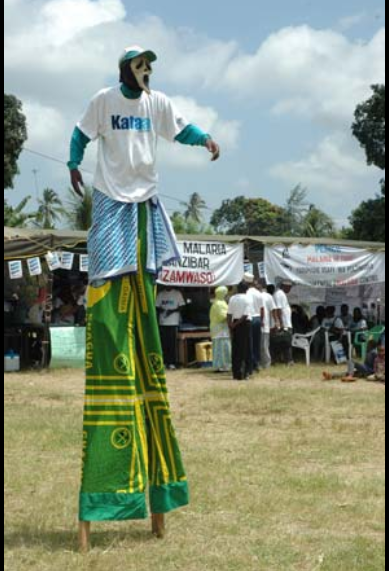
The LLINs given during the trial phase did not include any instructions or information for the users and there was an insufficient number of LLINs for all registered children to receive a net. In the distribution scale-up, improvements were made, including information and instructions with simple written and pictorial illustrations of how to use the net, increasing the amount of nets available and, in addition to the household registration, using an under-five population projection to estimate the need. The information, education and communication (IEC) strategies were also improved in the distribution scale-up, which was part of the President’s Malaria Initiative’s "Kataa Malaria" (Reject Malaria) campaign. Four steps of the LLIN distribution process were analysed: 1) child being registered, 2) caretaker of the child arriving at the distribution point, 3) caretaker of the child receiving an LLIN and 4) child sleeping under an LLIN.
This study shows that the overall effective use of ITNs among children under five years, 4-9 months after the free mass distribution, was 83.7% in Micheweni (MI) and 91.8% in North A (NA) district. The ITN use in children under five years observed greatly exceeds the rates previously found in Tanga region in Tanzania, where usage was at 36% in 2003-2005 when net distribution was ongoing under routine conditions by the private sector and non-governmental organisations (NGOs), and at 54% in 2008 after a voucher scheme was introduced. In another study that evaluated the impact of the voucher scheme in different regions of Tanzania, the ITN usage among children under five still remained at a low 26% in 2007, one to three years after its initiation.
The research articles states that the high coverage of ITNs observed in the study may have been due to prior exposure of the population to community sensitisation and information, education, and communication (IEC) strategies advocating for ITN use. Additionally, as social marketing, small-scale distributions, and re-treatment campaigns took place in Zanzibar prior to this distribution, most (69%) households already owned at least one bed net, and were familiar with the concept of sleeping under a bed net. Other reasons for high usage rates could be due to the short duration between the distribution and the evaluation and the fact that the surveys were carried out during the rainy season, when bed net use tends to increase.
The findings also showed that children who received an LLIN were significantly more likely to use the net compared to children who did not receive an LLIN. This finding indicates that the community accepted the concept of using the nets for the specific child who it was intended for, in contrast to another study which showed that priority of sleeping under a bed net is given to older people. In addition to the child receiving an LLIN, caretakers who perceived the LLINs to be better than conventional nets were also significantly more likely to use them for their children. The increase in usage due to the perception that LLINs are better than other nets emphasises the importance of considering the community's preferences prior to a mass distribution and addressing the communities concerns through IEC campaigns.
Malaria Journal on April 3 2012.
Image credit: Chris Thomas/USAID.
- Log in to post comments