










































The Alliance for Malaria Prevention: A Toolkit for Mass Distribution Campaigns to Increase Coverage and use of Long-Lasting Insecticide-Treated Nets (Second Edition)
Image
SummaryText
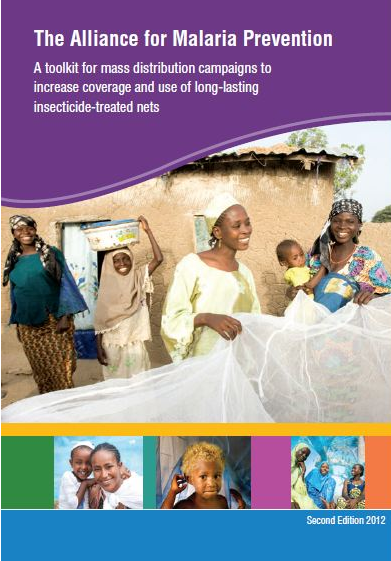
Published by Alliance for Malaria Prevention (AMP), this toolkit provides a step-by-step guideline for the planning and implementation of mass long-lasting insecticide-treated net (LLIN) distributions, whether for specific population groups or for universal coverage. It includes information on coordination, planning and budgeting, procurement, logistics, communication, implementation, monitoring and evaluation, reporting results, and sustaining gains. The toolkit is accompanied by a CD with reference documents and examples that have been collected from campaigns carried out in different countries. The reference documents, such as campaign plans of action, logistics and communication plans, training guides, communication materials, evaluation protocols, supply chain management tracking tools, and data collection templates can be modified to local situations and contexts.
The first edition of the AMP toolkit (see under Related Summaries below) complemented the Roll Back Malaria (RBM) Toolbox and the work of the RMB Harmonization Working Group (HWG) by providing detail on the development of integrated campaigns to encourage the distribution and use of long-lasting insecticide-treated nets (LLINs) by children under five years of age. This second edition of the toolkit supports the planning and implementation of scale-up campaigns for LLINs to universal coverage for the entire population at risk of malaria in a country.
According to AMP, this LLIN scale-up toolkit is designed for use by National Malaria Control Programmes (NMCP) and partner organisations involved in planning and implementing mass distribution campaigns for universal coverage. The toolkit is primarily focused on central level planning, but also contains information on regional or district planning, as the same lessons apply on a smaller scale.
The toolkit provides guidelines for planning and implementing mass LLIN distributions. Each chapter in the toolkit provides a narrative accompanied by a series of references or tools that are included on the CD.
The first edition of the AMP toolkit (see under Related Summaries below) complemented the Roll Back Malaria (RBM) Toolbox and the work of the RMB Harmonization Working Group (HWG) by providing detail on the development of integrated campaigns to encourage the distribution and use of long-lasting insecticide-treated nets (LLINs) by children under five years of age. This second edition of the toolkit supports the planning and implementation of scale-up campaigns for LLINs to universal coverage for the entire population at risk of malaria in a country.
According to AMP, this LLIN scale-up toolkit is designed for use by National Malaria Control Programmes (NMCP) and partner organisations involved in planning and implementing mass distribution campaigns for universal coverage. The toolkit is primarily focused on central level planning, but also contains information on regional or district planning, as the same lessons apply on a smaller scale.
The toolkit provides guidelines for planning and implementing mass LLIN distributions. Each chapter in the toolkit provides a narrative accompanied by a series of references or tools that are included on the CD.
- Chapter 1: Introduction - gives the background to LLIN scale up and move to universal coverage, together with an assessment of the impact it may have on reduction of the malaria burden.
- Chapter 2: Coordination - stresses the importance of good coordination for planning and implementing mass distribution campaigns.
- Chapter 3: Planning for mass distribution campaigns - advises on the planning of mass distribution campaigns, involving all partners and beginning early enough to identify any gaps in resources with sufficient time to fill them before implementation. It describes the planning requirements for different kinds of mass distribution campaigns, both integrated and stand-alone, targeted, or universal coverage.
- Chapter 4: LLIN procurement and pipeline monitoring - details the procurement of LLINs, usually internationally, separating the purchasing process from the main logistics operations, including LLIN storage, control, and distribution.
- Chapter 5: Logistics - gives a detailed breakdown of the vital role of logistics in a successful mass distribution campaign.
- Chapter 6: Communication - focuses on the key role of communication, a vital activity before, during, and after a campaign.
- Chapter 7: Implementation - details the steps required to achieve successful implementation of a mass distribution campaign.
- Chapter 8: Monitoring and evaluation - discusses a monitoring and evaluation strategy that is vital to determine optimal use of resources during a mass distribution campaign, together with an analysis of results in order to inform future campaigns. The chapter provides a basic framework of the measurable inputs, processes, outputs, outcomes and impacts that can be used to track key elements of the campaign and to assess results.
- Chapter 9: Campaign reporting - focuses on the importance of preparing a final report on LLIN mass distribution campaigns, giving an objective assessment of the strengths and weaknesses of each campaign, and proposing recommendations for future campaigns. The chapter gives suggestions for the content of the report, detailing the key elements of implementation, logistics, communication and finances, and analysing results and gains.
- Chapter 10: Sustaining gains - moving beyond scale-up: discusses how countries can move beyond scale-up activities and sustain gains made in recent mass distribution campaigns.
Publication Date
Languages
English
Number of Pages
268
Source
The Alliance for Malaria Prevention website on April 10 2012.
- Log in to post comments