










































Radyo Bakdaw ("Rise")
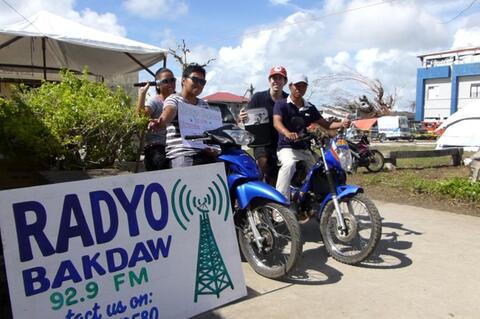
"Radyo Bakdaw has helped bring a sense of normality back to the lives of many in the Guiuan area by bringing the community together to take part in events such as the much loved kareoke sessions."
When typhoon Haiyan hit the Philippines on November 8 2013, Internews' Humanitarian Team was deployed to Guiuan, Eastern Samar, to set up Radyo Bakdaw ("Rise"), which provided emergency information to the citizens of Guiuan. The station went live on November 26, providing news and information to people in the aftermath of the typhoon until May 2014.
A 4-day assessment of information needs and access to communication channels through direct interviews with survivors, local journalists, and humanitarian aid workers, as well as visits to local media outlets, revealed an acute, urgent need for information and documented the destruction endured by local media outlets. Based on this analysis, Internews built up a team of local journalists and trained them to provide acutely needed humanitarian information via Radyo Bakdaw. The local reporting team was supported and mentored on emergency humanitarian broadcast by two specialists from Internews' humanitarian media roster. Operating on 92.9 FM, the emergency station was designed to enable public service broadcasting to the most affected, disconnected areas in the Leyte region, reaching 10-20km from its location. Internews initially distributed 200 wind-up radios among community halls and other public places, turning Sundays into "Radio Repair Day", with two local technicians present to help.
Radyo Bakdaw worked as a two-way communication channel, bridging the information gap between affected population, local actors, and aid professionals. Listeners were encouraged to send text messages to the station with requests for information or vital messages they would like to communicate. Even when the emergency situation had abated, this philosophy continued. On the morning of January 29 2014, Radyo Bakdaw had its first broadcast of "Maupay nga Pruy-anan" (A Good House). The show focused on everything to do with the home, from waste disposal to a segment on rebuilding better homes with the International Organization for Migration (IOM). Each day, the radio station chose a question of the day to engage with listeners, such as what they use to light up their homes. "One of our texters asked us where they can get a solar lamp and someone else texted in that they are available for 300 pesos in the Guiuan public market....We ask, and people answer, and we have people joining and participating, that makes me feel efficient," said the radio presenter. The station received around 500 text messages a day (with peaks of over 1,200 texts).
Risk Management
"It is always heartbreaking to see people who may have lost everything feel completely disconnected," said Jacobo Quintanilla, Internews Director of Humanitarian Communication Programmes, who conducted the assessment in Tacloban. "This confusion only serves to further disempower, and further traumatize, already fragile communities. People rely on word of mouth and have no means to find additional, accurate information. Restoring the communication networks, including mobile phone and radio, must be a humanitarian priority as people are literally left in the dark in most areas."
April 2015 update from Project Director for Radio Bakdaw, Stijn Aelbers (personal correspondence): "we had a fairly solid reach of about 45 kms, with stretches along the coastline up to 85 kms (but inland, beyond the 45 kms, it definitively got sketchier). It matters, since the coastline was the most affected area, so it was especially fortunate - we honestly hadn't expected it - we could reach so many of the affected population. The best thing, if you ask me, that happened with that radio station, is that people from the community started using it to help each other: one listener texts us she's bed-ridden because her wheel-chair got trashed in the storm. We broadcast her story, and another listener donates a wheel-chair from his late mother. Because we broadcast that story, we got 6 more messages from listeners who lost their wheel-chair, one of which - again - got helped by another listener and because of the other ones, we informed Handicap International who sent over a mission to do an assessment in the region as a result of our email." Click here for a 3-page document [PDF] that shares additional impact information.
Funded by the Department for International Development (DFID).
Internews Europe website, accessed on September 9 2014; and emails from Stijn Aelbers to The Communication Initiative on April 8 2015.
- Log in to post comments