










































Promoting Malaria Prevention through Primary Schools. Communication Guide for Teachers
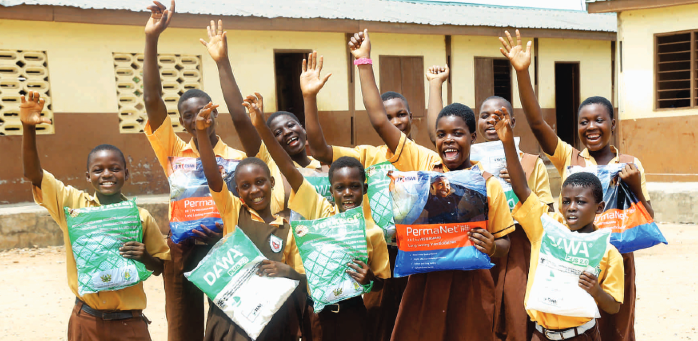
This guide is designed to be used by teachers to educate their students on malaria control and correct use of insecticide-treated mosquito nets (ITNs). It was published by VectorWorks in collaboration with the National Malaria Control Program of the Ghana Health Service and the Schools Health Program of the Ghana Education Service. VectorWorks is a five-year (2014-19) global project funded by the US President’s Malaria Initiative (PMI) to increase access to and use of ITNs and other proven vector control interventions for malaria prevention. School-based ITN distribution campaigns are one way that the project adopts to provide access to free mosquito nets for families. To ensure that the distributed mosquito nets are used properly by the students and their families, teachers are trained to regularly engage in promoting malaria control strategies through education sessions. This guide was produced to support this process.
The guide is designed to help teachers to do the following:
- Give out the right information about malaria, the way it is transmitted and how to prevent it.
- Teach essential skills such as how pupils can stay protected from malaria.
- Answer questions and correct mistaken beliefs about malaria and mosquito nets.
- Build pupils ability to communicate with their families and peers.
- Cultivate pupil's sense of civic duty by promoting their role in making malaria prevention a family and community responsibility
- Increase self-confidence of pupils and their families by recognizing and celebrating their efforts in practicing malaria prevention behaviours.
- Invigorate and add diversity to everyday school activities.
The content of the guide offers various behaviour change communication activities (designed for the class, school, and community) that will help teachers to successfully climb the following five critical steps to achieving malaria-free schools and communities:
- Step 1: Knowledge - the school child and family should know what to do to protect themselves from malaria;
- Step 2: Approval - the school child and family should like the malaria prevention behaviours and appreciate their importance;
- Step 3: Intention - the school child and family should plan to keep their nets in good condition and sleep under the net every night and all through the night;
- Step 4: Practice - the school child and family should take care of their nets and sleep under them every night and all through the night; and
- Step 5: Advocacy - the school child and family should talk about malaria prevention with other family members and friends.
The guide consists of the following sections:
- Special Note for Teachers
- Five Steps to Achieving Malaria-free Schools and Communities
- Section One: The Disease Malaria
- Section Two: Symptoms of Malaria
- Section Three: Impact of Malaria
- Section Four: Prevention of Malaria
- Section Five: Benefits of Preventing Malaria
- Section Six: Malaria Prevention Key Messages for Key Audiences
- Section Seven: Activities for School Assembly Sessions
- Section Eight: Activities for Classroom Sessions
- Section Nine: Activities for Community Level Events
- Basic Schools Health Activity Planning Template
28
VectorWorks website and VectorWorks Exposure website on June 28 2017, and email received from Emmanuel Fiagbey on June 30 2017.
- Log in to post comments