










































Mapping Coalitions: Mapping Out Coalitions, Collaborations, Partnerships and Networks for Media and Civil Society in Sub-Saharan Africa
"The more civic freedoms and human rights are annihilated, the more democracy cedes the higher ground, the more and the stronger are the forces of coalition required to defend these spaces."
This study focuses on mapping out coalitions, collaborations, partnerships, and networks for media and civil society in sub-Saharan Africa. It seeks to engender a deeper understanding of the architecture, relevance, and needs of media organisations and civil society organisations (CSOs), as well as their institutional capacity, level of influence, powers, and limitations. The study has been published as part of The Consortium to Promote Human Rights, Civic Freedoms and Media Development (CHARM) project in sub-Saharan Africa, which seeks to protect and expand the civic space for CSOs and human rights defenders and to nurture and enhance the effectiveness of independent media and journalism in the region.
As explained in the report, "Despite their centrality in societies where civic space and freedom of expression are increasingly narrowing, the few civil organisations and independent media groups in sub-Saharan Africa work in silos, where their effort and energy are not harnessed to focus on pressing issues, and they often find themselves duplicating efforts and resources. They are therefore unable to address critical issues of human rights abuses, or contribute to guarding and expanding the freedom of expression necessary for democracy and social progress. Further, most of these organisations lack the capacity, skills and knowledge to focus on their agenda, because they have no space or forum to interact with similar organisations in the region and beyond who would inspire them to persevere. They lack space and a forum to exchange the knowledge and information necessary to tackle human rights issues and media development." In response, this report seeks to explore how the efforts and capacity of CSOs and media organisations can be strengthened, particularly through collaborations and partnerships.
Specifically, the report seeks to answer the following questions:
- Under what circumstances do media and civil society coalitions arise?
- What are the various categories of media and civil society coalitions and networks in various countries in the sub-Saharan region, and what are their areas of focus?
- What is the mode of collaboration between civil society and media actors?
- What are the institutional, networking, capacity, and collaboration needs of media and civil society actors?
- To what extent do political, legal, economic, regulatory/legal, technological, and societal issues affect the effectiveness of such coalitions in the region? What would be the priority ranking for interventions?
- What are the main financial and organisational vulnerabilities, challenges, and opportunities facing media and civil society coalitions, including censorship, state interference, sustainability, and viability?
- What frameworks and modes of collaboration between media actors and civil society exist in various countries and the region?
- What is the ideal model that media and civil society coalitions could take?
- What would be the ideal framework for building such coalitions, and what would be the process?
The study looked at 17 countries in southern, eastern, and western Africa whose civic space was categorised as "obstructed" and who were chosen because of unique characteristics in the way their media or civil society operated. The study covers independent media, CSOs, and other actors involved in civic freedoms and media development, operating at both country and regional level, and taking into account the specific nuances of each context. All the countries reviewed had at least one coalition, or were in a network advocating for human and civil rights that manifested as either intra-coalitions and networks, inter-coalitions and networks, or inter-human coalitions. The report also includes five case studies (from Kenya, Zimbabwe, the Gambia, Equatorial Guinea, and Uganda) that exhibit successful media/civil society coalition and network models that could be replicated in other sub-Saharan African countries.
The following are a selection of findings as highlighted in the report:
- There are diverse patterns and structures of collaborations between media and civil society, with the strength, effectiveness, and sustainability of collaborations and coalitions varying with the regions. East Africa, particularly Kenya, has a tradition of establishing formal and deliberate engagement between the media and civil society. In West Africa, collaborations are extremely informal, but their regional and international networks are well-knit.
- There are no frameworks, standards, or rules for how coalitions, collaborations, and even partnerships between the media, civil society, and human rights defenders are formed.
- New technology, creative art, data, and content creation distributed on social media and attendant platforms are driving coalition movements between the media and civil society, particularly among youthful civil society leaders who also happen to be tech savvy.
- There is extensive duplication of effort and competition among CSOs and media organisations.
- The current "programmatic" funding model by donors - where funds are earmarked for specific purposes and activities, with no room for adjustment or variation to respond to emerging challenges and realities outside the programme - is a deterrent to building coalitions and collaborations.
- Collaboration and coalitions between national-level media outlets, media development and professional associations, and civil society tackling national issues tend to exclude smaller grassroots community movements.
- Most media and civil society collaborations lack the vision to effect lasting societal change.
The report offers a list of recommendations that in brief include, but are not limited to:
- Build the capacity of parties in informal coalitions to engage, rather than insisting on formal coalitions.
- Formulate and motivate for the formation of coalitions around broad but specific key themes.
- Prioritise training based on case studies and best practice to diffuse skills and knowledge on collaboration and coalitions.
- Donors and development partners should motivate collaborations.
- Make a sustained effort to create and defend civic spaces conducive to the formation of media and civil society coalitions.
- Support should go beyond the more elite-driven coalitions often prevalent in urban areas and extend to more community-driven movements and collaborations with local and community media at grassroots level.
- Build the capacity of civil society and media coalitions to envision the ideal and desired change beyond the "here and now".
- Develop the skills of civil society and media to manage disinformation and misinformation, which could give impetus to the formation of coalitions based on facts and data.
- Give more support to the networks increasingly using digital technology and communication, considering the increasing politicisation of traditional media, as well as financial constraints and sustainability challenges.
- Coordinate regionally to prevent donors' duplication of effort and competition between civil society and media organisations.
The report concludes by proposing a model and framework for establishing media and civil society coalitions - the "intereffication model". This model argues that for collaboration to work more effectively, there should be mutual interdependence between civil society and the media that goes beyond the common, conventional relationship where the media treats civil society as a source of news, and civil society treats the media as a publicity tool.
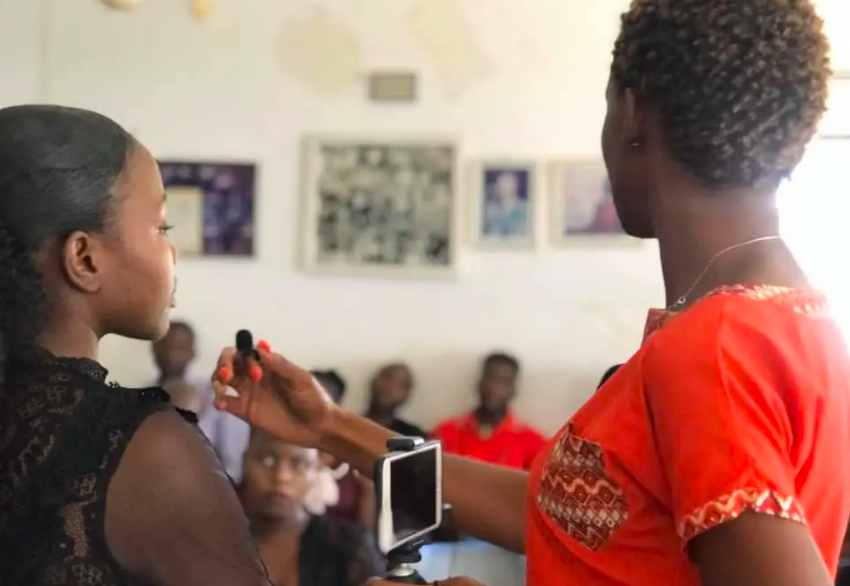
Fojo Media Institute website on July 16 2021. Image credit: Magamba Network
- Log in to post comments