










































The Global Expression Report 2022: The Intensifying Battle for Narrative Control
"The suppression of freedom of expression is not just a symptom of autocracy: it creates the environment for autocracy to flourish."
The Global Expression Report, published annually by ARTICLE 19, looks at the rights to freedom of expression and information across the world. It measures the freedom of everyone, not just journalists or activists, to express themselves and communicate. This includes how free a person is to post online, to march, to research, and to access the information they need to hold those with power to account - without fear of harassment, legal repercussions, or violence. The 2022 report also explores score changes over time across three time periods: the preceding year (2020-2021), the last five years (2016-2021), and the last 10 years (2011-2021).
Using the Global Expression Report's metric (the GxR Metric), researchers tracked freedom of expression across 161 countries. They used 25 indicators to create an overall freedom of expression score for every country on a scale of 1 to 100, which places countries in an expression category that ranges from: open, less restricted, restricted, highly restricted, or in crisis.
The report begins with a global overview of the major shifts in expression. As stated in the report, "Freedoms are more precarious than ever, and scores are plummeting at higher rates than ever before....We are seeing more dramatic downward shifts than at any time during the last two decades. Many of these occur as the result of power grabs or coups, but many are more of an erosion than a landslide - often under democratically elected populist leaders. Myanmar and Afghanistan both dropped two categories in just one year - the two biggest drops the metric has measured since it began in 2000."
The report emphasises the link between democracy and freedom of expression, showing how autocratic and repressive governments increasingly crack down on freedom of expression in order to gain control - "control the media and silence civil society by censorship, harassment, and arrests and the public narrative will be safely under control". These tactics are being applied through digital repression and control as well as through other means of repression.
The following are some of the global trends highlighted in the report:
- The global score has declined over the last decade: All regional scores are either falling or stagnant.
- 80% of the global population have less freedom of expression now than a decade ago.
- 35% of the global population now live in a country in crisis. It is now the largest category, both by population and number of countries: There are 40 countries in crisis. Five new places dropped into crisis this year: Myanmar, Afghanistan, Sudan, Hong Kong, and Chad.
- Only 15% of the world's population live in open countries, which is as low as it has been during this decade.
- Freedoms are more precarious than ever, and scores are plummeting at higher rates than ever before. The data shows bigger one-year decreases in scores than the GxR has ever recorded - and in more countries: 19 countries saw shrinking freedom of expression environments from 2020 to 2021, compared to only one country between 2010 and 2011. In 2011, the combined decrease in scores for countries in decline was 9; in 2021 it was 195.
- Many of the countries that made advances over the last decade have quickly regressed: Sudan, Myanmar, Afghanistan, and Sri Lanka.
Following the global overview, the report focuses on 5 different regional contexts for expression and, in particular, looks at where progress and downward trends are visible.
Highlights from Africa:
- For the third year running, there are no open countries in Africa: Nearly half of the continent's population live in restricted environments.
- The population living in crisis doubled in 2020-2021 and is now at 11%, though it remains smaller than a decade ago.
- In 2021, there were 4 military coups in Africa, plunging countries like Sudan into crisis. Political opposition faces major hurdles, and protests are met with violence in many places - as well as internet shutdowns, an increasingly favoured addition to the autocrat armoury.
Highlights from the Americas:
- While half of the region lives in open environments for expression (driven by the United States and Canada), the autocracies remain strong: Nicaragua, Venezuela, and Cuba are at the bottom of the scale, and Colombia's and El Salvador's environments for expression are seeing a severe decline.
- Communicators and activists in this region, particularly in Latin America, face extreme levels of physical violence and threat: More than 70% of murders of human rights defenders occurred in the Americas - the three countries with the most murders were all in the Americas: Colombia, Mexico, and Brazil.
Highlights from Asia and the Pacific:
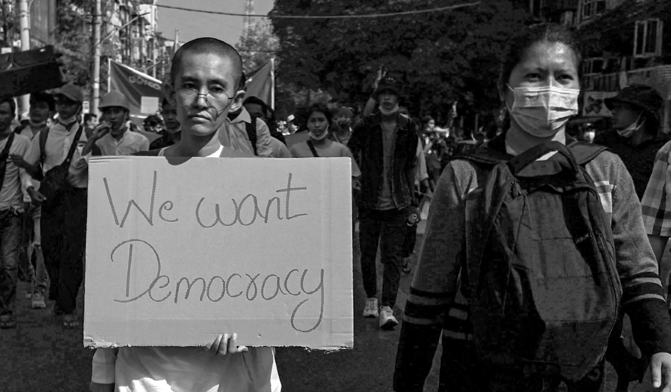
- Two of the most dramatic one-year score declines in the history of this data occurred in this region in 2021. A military coup in Myanmar and the Taliban retaking control in Afghanistan were followed by immediate and severe restriction of the environment for freedom of expression by the new regimes.
- Nearly 90% of the population of the region live in highly restricted or in-crisis environments. In 2011, the region was dominated by countries in the less-restricted category (28%); there are now only 3 countries in that category, holding less than 1% of the population. The highly restricted category has grown from 7% of the population to 43%, while the population in crisis has been constant at around 40%.
Highlights from Europe and Central Asia:
- The region now has 8 countries in crisis, holding one-third of its population, and 2 countries in the global bottom 10. Belarus suffered a steep decline over the last 2 years and dropped into the in-crisis category in 2020 and the global bottom 10 in 2021.
- Countries in Central Asia are showing a serious decline, but the European Union (EU) is not immune: Human rights in some EU countries are deteriorating, including Hungary, Poland, and Slovenia.
- Attacks on journalists have increased, particularly those reporting crime and corruption.
Highlights from the Middle East and North Africa (MENA):
- There are no open countries in the MENA region. 72% of the population live in countries in crisis - far more than in any other region and twice the proportion living in crisis in 2011.
- Many countries in the region show little movement in their scores, but only because they have no further to fall. Dictatorships with no respect for freedom of expression and brutal response to dissent or discussion are entrenched across the region, often using national security narratives as a pretext to silence voices and bypass justice.
- A decade after the Arab Spring, many of the catalysts for that movement remain unchanged: economic issues (deepened by the COVID-19 pandemic), unaccountable and undemocratic governments, and routine violations of the right to freedom of expression, especially protest.
Despite the grim statistics, the report states that there is cause for hope, in large part due to civil society activism:
- There are clear attempts to increase corporate transparency and to regulate the power of social media giants.
- Despite the continued threat to activists' lives, specific protections are being put in place for the people who work to save our planet.
- Globally, 91% of people are now guaranteed the right to information by law.
- Innovation also continues, including the mushrooming use of universal jurisdiction: the creative use of international court systems to bring repressive regimes to justice.
- People are resisting, and demonstrations are growing in strength. For example, protests in Chile led to the constitution being written with a participatory process. Farmers' protests in India forced the Modi administration to repeal laws that would have allowed private companies to control the planting, storage, and price of crops and denied farmers guaranteed prices for their produce.
Click here to view the Headlines and Highlights in PDF format.
Click here for the individual country rankings in PDF format.
ARTICLE 19 website on December 29 2022. Image credit: Reuters/Stringer
- Log in to post comments