










































Factors and Misperceptions of Routine Childhood Immunization Service Uptake in Ethiopia: Findings from a Nationwide Qualitative Study
Jimma University (Tadesse, Getachew, Birhanu, Hailemichael); United Nations Children's Fund, or UNICEF (Assefa, Simireta); World Health Organization, or WHO (Ababu)
"[W]hile immunization of children might be affected by several factors, its identification using qualitative evidence collected from children's caretakers is generally minimal and narrow addressing aspects of the possible factors, often based on global reviews..."
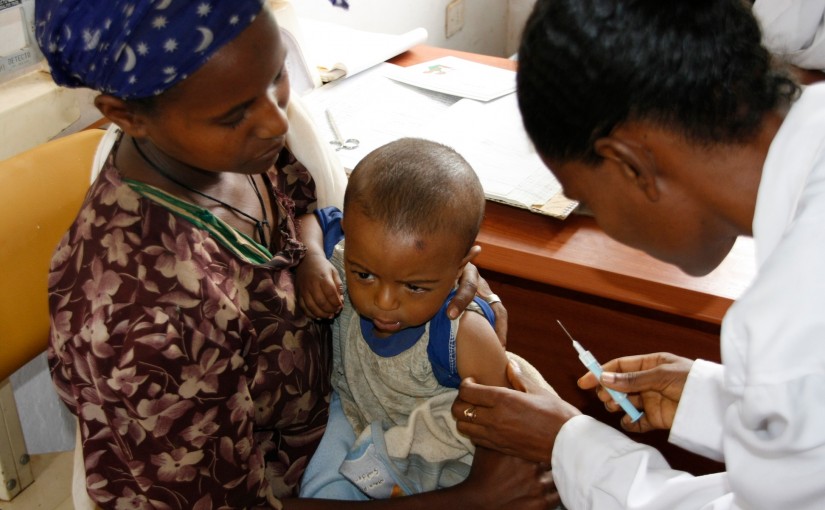
This article explores the various factors and misperceptions of routine childhood immunisation service uptake in Ethiopia and provides possible recommendations to mitigate them. The study explored caretakers' behaviour, information and communication, and family characteristics, as well as the immunisation service system, through a qualitative multiple case study approach. The results may have a number of practical implications for Ethiopia and other health systems in sub-Saharan Africa and in particular for health institutions and programmes working on childhood immunisation services at the national and sub-national levels.
The study was conducted in all 9 regional states and 2 city administrations in Ethiopia via employing a qualitative case study design. In total, 63 focus group discussions (FGDs) were conducted. Study participants (n = 630) were caretakers clustered into two: those whose children (aged 12-23 months) were vaccinated and those whose children were not vaccinated or who dropped out of the immunisation schedule.
The results reveal that non-immunisation and dropout are commonly found across the different regions. Caretakers of immunised children have the opinion that all or most children in their community have been immunised; in contrast, caretakers of unimmunised children across the different regions had the opinion that few children were fully vaccinated in their respective communities. They also explained that the majority of children in their respective communities at least started vaccination so the problem was more of discontinuity or defaulting.
Key factors of childhood immunisation (not in order of importance) are shown in Table 2 in the article. Discussants cited inaccessible health facility, lack of immunisation service, poor motivation, unfavourable attitudes, and incompetence and bad treatment on the part of health workers (HWs). Other shared factors include lack of resources/logistics, restricted vaccine open policy, inconvenient immunisation times, lack of information at times of vaccination day, and prolonged waiting times. Some caretakers said that immunisation service utilisation in the outreach and house-to-house visits are not adequate (Oromia). Likewise, other discussants reported that HWs' lack of commitment to help the community and mistreatment of clients by HWs are the reasons for people's dissatisfaction with the immunisation services (Afar, Gambela, and Somali). However, other discussants in most administrative regions highlighted that the inability of HWs to provide information on childhood immunisation during the services was ascribed to inadequate communication skills. Besides, some discussants said that failure to provide the service for children who lost their immunisation card hampered some caretakers from getting the service (Afar, Oromia, and Somali). Mishandling, poor reception, and disrespect of caretakers from the HWs are common during immunisation in some of the regions, though some participants acknowledged good reception and services of the HWs.
The analysis revealed that there were significant misperceived benefits of immunisation in the community. For instance, the feeling that a single-dose vaccine is enough has a negative rhetoric potentially obstructing caretakers to reap the benefits of full immunisation.
As the results show, childhood immunisation was affected by several complicated factors, often involving a combination of interacting factors. Understandably, certain factors put children at risk of missing immunisation - for example, place of residence, family income - but it is the interaction of multiple factors, in a very personal way, that lead to a particular family's decision to have its children fully immunised or not. In some cases of incomplete immunisation, the explanation may be one simple factor. For example, the father prohibited the caretaker to return after the child experienced a fever following immunisation (Afar), or the caretaker cannot be away from work during immunisation hours (Dire Dawa, Harar, and Oromia). In other instances, the cases might be a combination of beliefs, perceptions, knowledge, and experiences (Afar and Somali).
"For immunization of children's coverage to improve sustainability in Ethiopia, investments and efforts will be required in multiple areas targeting caretakers regardless of their children immunization status and location in some form and yet it will need to be tailored to the specific needs of caretaker groups and individual regions." The researchers make a number of suggestions; for example, HWs should be empathetic, build relationships, and treat caretakers with dignity and respect. Likewise, they should welcome caretakers even when they lost their immunisation card. HWs should take advantage of other platforms beyond the one-on-one encounter to deliver basic information and facts on immunisation - for example, at social, religious, and cultural gatherings and events.
The Pan African Medical Journal. 2017;28:290. doi:10.11604/pamj.2017.28.290.14133. Image credit: Owen Barder
- Log in to post comments