










































Communication and Complex Emergencies: A Resource Guide
"Without question, communication is playing an increasingly important role within complex emergencies. New information and communication technologies and burgeoning social media use are combining with the extensive reach and use of traditional media to provide crucial lifeline information resources for vulnerable people."
This guide assesses the broad role and use of communication in complex emergencies, cutting across all forms of communication - from interpersonal to mass media to new communication technologies. It provides a range of examples of situations in which communication supports humanitarian relief, conflict reduction, and recovery. It also highlights a number of guiding principles that are designed to ensure communication effectiveness in crisis situations and offers links to external resources developed by bilateral and multilateral agencies. "A central goal of the guide is to direct desk officers and communicators to high quality 'how to' resources that can be used to further inform decision-making and practice. The guide is one of the outputs of the Communication and Complex Emergencies Project, which is a collaboration between the University of Adelaide's Applied Communication Collaborative Research Unit (ACCRU) and the Australian Civil-Military Centre (ACMC). The guide:
- Discusses emergency communication phrases;
- Examines 4 communication frameworks: acute responses (divided into: rapid-onset disasters and open conflict) and long-term responses (divided into: civil unrest and recovery);
- Explores a range of communication principles and practical steps that can be taken to increase the effectiveness of communication;
- Collates relevant case study material, as follows:
- Rapid-onset disasters case studies: Typhoon Bopha (Philippines): NetHope; Uttarakhand Floods (India): DHNetwork; Mahasen cyclonic storm (Bangladesh): BBC Media Action
- Open conflict case studies: Centre Lokolé (Democratic Republic of Congo): Search for Common Ground; Radio Erena (Eritrea): Reporters Without Borders; Radio for Peacebuilding Africa: Search for Common Ground
- Civil unrest case studies: Radio Abyei (South Sudan): Internews and USAID [United States Agency for International Development]; Socially Responsible Media Platforms for the Arab World: BBC Media Action and Misr International Films; Salam Shabab (Iraq): US Institute of Peace; Speak-to-Tweet (Egypt): Google, Twitter and SayNow
- Recovery case studies: Sada Voice Players (Afghanistan): Voice for Humanity; Radio Okapi (Democratic Republic of Congo): MONUSCO and the Hirondelle Foundation; Open Jirga (Afghanistan): BBC Media Action; PakVotes (Pakistan): Byte for All
- Identifies useful external resources; and
- Provides supporting audiovisual resource and web links for case study material.
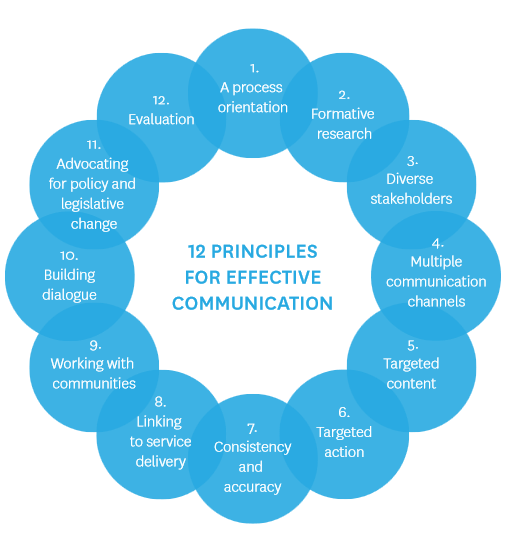
To look at one section in more detail, the "Core communication principles" portion of the resource "looks at a number of fundamental practice principles of relevance to ensuring effective communication in crisis situations....Where possible, potential constraints to effective communication practice are identified and options for offsetting them are suggested. The section also looks at the scope of crisis communication messaging and examines the differences between messaging in acute crisis or conflict situations and in longer term situations. Additionally, it looks at how to ensure the development of content that targets behavioural or social change." Lessons shared include:
- Be process-oriented.
- Conduct formative research.
- Engage diverse stakeholders.
- Use multiple communication channels.
- Create messages that are tailored to specific audiences.
- Develop messaging strategies based on whether the situation is acute or long-term.
- Ensure that messages are consistent and accurate.
- Link messages advocating an action to service delivery so that communities can gain access to that service and make effective use of it.
- Work with communities through strategies such as holding community meetings, connecting with community leaders, mobilising communities through community events and performances, and encouraging participation in communication design (through formative research) and participatory evaluation.
- Promote community dialogue that is inclusive and reflects multiple voices.
- Advocate for policy and legislative change in order to: help regulate the media and communications sector, encouraging restraint and responsibility; lead to improvements in the quality of journalism and reduce bias and defamation; help increase the diversity of voices in the media; open channels of communication for the excluded and vulnerable; and increase the preparedness of communicators and improve their response to disaster.
- Evaluate, because "[i]t allows for impacts to be understood and helps to highlight problems with program delivery - including aspects of communication that are not working or that cause confusion. For example, a misunderstood message can cause panic, can be harmful if advocating a certain type of action or can inflame an existing conflict."
Various tables and figures throughout the resource illustrate the steps practitioners can undertake.
63
Email from Andrew Skuse to The Communication Initiative on November 29 2014.
- Log in to post comments