










































Brief Evaluation Report of the Puppets for Good Governance (PGG) Project
Executive Summary
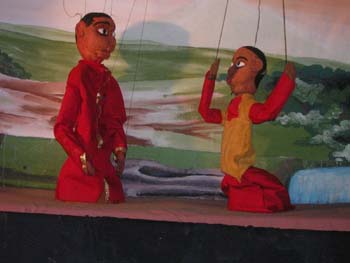
"The Family Planning Private Sector (FPPS) programme introduced puppetry for health education to Kenya in 1994. The FPPS programme, Community Health Awareness Puppeteers (CHAPS), unlike other puppetry programmes in Africa, requires that the puppeteers it trains and assists are community-based.
Over 480 puppeteers have been trained since 1994. More than 48 CHAPS puppet troupes have been based in urban and rural communities all over Kenya. Their original and community-tailored scripts reflect local custom, belief and rumour and are performed in the local language.
FPPS through its puppetry programme, CHAPS has been involved in a number of programme activities that relate to various aspects of good governance. These include:
- Anti-corruption awareness advocacy
- Environmental conservation
- Gender issues, human and women rights
The approach adopted is the innovative use of performing art forms and in particular puppetry for purposes of community education and empowerment.
The puppetry program has in the past focused on the broad theme of corruption. Through interactive community puppetry performances, the more than twenty community based puppetry troupes advocate for among other things, transparency and integrity, responsible governance, protection of public property and resources and environmental conservation to name a few.
The project, Puppets for Good Governance, (PGG) Project is an expansion of the Puppets against Corruption (PAC) Project. The goal and overall purpose of the program was to use puppetry to increase community awareness on what constitutes good governance. The project also aims to highlight and increase awareness on electoral education, constitution building and human rights.
The program areas of the Puppets for Good Governance project included:
- Integrity, leadership and good governance
- Individual and community participation, empowerment and action against corrupt practices
- Civic and voter electoral education at the grass roots rural and urban areas
- Gender, women and children rights education
- Human and legal rights awareness
FPPS/CHAPS had proposed to implement this programme in phases, initially limiting its operation to selected urban and rural communities. The PAC project, which was much wider in geographical scope was to continue receiving support where puppet troupes already existed with a view to eventually absorb as part of the Governance project.
The reason for adopting this approach was based on the strategic need to concentrate on areas where an effective, well-monitored and integrated impact can be achieved. Partnerships will be developed in those areas with government, [non-governmental organisations] NGOs, churches and the private sector.
The objectives of the puppets for good governance project were to:
- develop awareness of governance issues at the community level through puppetry performances, discussions and community meetings
- create forums, through interactive community puppetry performances, to enable Kenyans discuss governance related issues e.g. basic rights, economic governance, electoral rights, gender and human rights among others.
- stimulate community participation in identifying solutions to governance problems in Kenya.
The strategies that were to be used in pursuance of the project objectives included:
- Participatory intervention/education puppet theatre
- Sustainable partnerships with collaborating organizations through: Joint development and dissemination of [information, education, and communication] IEC materials
- Community organizing and mobilization general program support
- Improvement of training content through
- Development of training curricula
- Facilitation of advanced training in puppetry, participatory Educational theatre (PET), issues of governance, corruption and human rights
- Puppetry skills development and training of trainers and facilitators
- Supply of equipment and materials
- Enhancing the capacity of puppet groups through training and regular advisory visits by FPPS/CHAPS trainers.
- Local regional coordinators who have been selected were retrained as [Training of Trainers] TOTs so that they can assist groups assigned to them with message development, planning of activities, improvement of their acting technique and reporting. Their work was backstopped by FPPS/CHAPS trainers/coordinators assigned to each region.
- Improvement of reporting, monitoring and evaluation instruments both at the national and grassroots levels.
- Collaboration with FPPS/CHAPS trained and supported puppetry and folk-media troupes that:
- Are active and result oriented
- Have an interest in governance and human rights advocacy
- Enjoy community support
- Have a sustainable infrastructure"
To request the full evaluation, send an email to Phylmon Odhiambo (see contact information below).
Email from Phylmon Odhiambo to The Communication Initiative on July 6 2005; and FPPS website, November 12 2010.
- Log in to post comments