










































How Close Should We Get? Media and Conflict
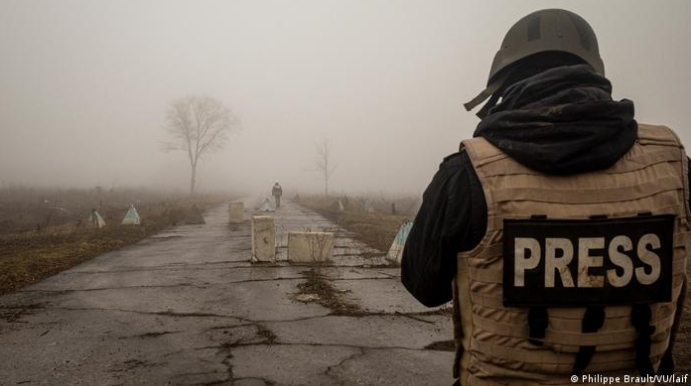
"In this publication, media professionals from all over the world show how, regardless of their working environment, they aim to present conflicts so as to encourage reflection rather than feed the frenzy." - Peter Limbourg, Deutsche Welle Director General
This Deutsche Welle (DW) Akademie publication consists of contributions from around the world that look at how media workers can improve the way they cover and deal with conflict. Intended for media professionals, journalists, citizen journalists, bloggers, YouTubers, lecturers, and students of journalism, it consists of case studies, personal reflections, interviews, and practical tools that seek to encourage and inspire new solutions in conflict reporting.
As explained in the opening editorial, "Dealing with conflicts is part of the everyday life of journalists the world over. Too often, the media stokes conflict with one-sided or sloppy reporting. Sometimes, it's because they don't see the conflict or don't wish to see it. Other times, the media take sides in a conflict or think they can attract more attention by sensationalizing or simplifying what's happening. On the other hand, the media can also help create understanding, empathy or willingness to compromise - like the journalists featured in this publication."
The contributions cover a range of issues related to conflict reporting, including media initiatives that counter hate speech and celebrate diversity, projects that highlight commonalities instead of differences, ideas for practising conflict-sensitive photography, and guidance on how to deal with trauma, amongst others. As the editor states, "It is not intended to be just another textbook for conflict-sensitive reporting - there are already quite a few of them, and the suggestions and advice given there are useful. Unfortunately, however, they are often not easy to implement, so included here are some positive examples from around the globe where media companies or individual media activists have found ways to address conflicts without inciting hatred, and to initiate debate without polarizing."
The publication includes the following chapters:
- The Myth of the Lone Wolf: Why War Reporting Is a Profession Like Any Other: This chapter looks at some of the difficulties of being a war reporter and the importance of creating a balanced picture that does not distort reality.
- Reporting on Conflict in the Global South: Through the eyes of a journalist from Chad, this chapter explores how much more difficult it is being a journalist reporting on conflict in the Global South than in the Global North.
- Fighting for Resources: This chapter examines the conflict between Sudanese refugees and host communities in Uganda and how the Cross Border Network has brought together local radio stations from Northern Uganda and Southern Sudan to exchange information, check rumours, and work together to ensure peaceful coexistence.
- The Threat of the Other: In the context of conflicts on the Bangladesh and Myanmar border, this chapter describes the work being done by a local radio station to move away from emphasising differences towards emphasising what the two populations have in common.
- White and Male? The Media Makers of the Global North: This chapter highlights the need for diversity in the newsroom in order to ensure that the diversity of a population is reflected in the news. It takes as an example how the headscarf is used in the media to portray Muslim women in a certain way and also introduces the "New German Media Makers" (Neue Deutsche Medienmacher) initiative, which brings together German journalists with foreign backgrounds to make German reporting more diverse.
- The Power of the Net: Featuring examples from Brazil and Serbia, this chapter discusses fake news in social media and how it can lead to polarisation. It showcases a fact-checking initiative in Brazil and describes how a group of YouTubers in Serbia has responded to some popular YouTubers' toxic masculinity and use of hate speech.
- Capturing Conflict: Photography and Its Effect: A photographer who has intensively followed the Israeli-Palestinian conflict in his photography explains what he aims for with his pictures and what he does not depict, and why.
- Static Society, Shifting Identities: Taboos and the Power of Bollywood: The author of this chapter reports on the struggle of individuals against discriminatory social conventions - for example, in relation to homosexuality or physical disabilities, and on a TV show with a touch of Bollywood that is creating change.
- The Power of the Past: This chapter describes how a media project in Medellín, supported by DW Akademie, helped open up a dialogue about the past and encouraged hostile neighbours to begin speaking to each other again. An example from Belarus illustrates how the Belarusian magazine ARCHE countered a false narrative that concealed the Belarusian collaboration with the Nazis during World War II.
- What to Do against Hate? When Media Makers Become Targets: This chapter tells of how a German journalist and author responded to emails from readers who insulted him because of his Indo-Pakistani background. Instead of remaining silent, he decided to answer the emails and subsequently publish the exchanges - in the process exposing open racism, hatred, Islamophobia, and ignorance.
- When Journalists Suffer: Dealing with Trauma: A Pakistani journalist working in one of the most dangerous areas in the world for journalists - the Pakistan-Afghan border area - details how the terrible events he reported on have affected him. This chapter also offers practical advice on how to deal with trauma and how to interview a traumatised person.
- Should Journalists Be Impartial? Pros and Cons: Two journalists, working in contexts such as Lebanon and Syria, reflect on this question and find that there are no clear-cut answers.
The publication is also interspersed with practical advice for journalists in the form of three analytical tools that are designed to make it easier to dissect a conflict, identify the various people involved, and then make the reporting itself more diverse:
- The conflict tree, which is presented using examples from Rohingya refugees in Bangladesh;
- Conflict mapping, which is presented using Brazil as an example; and
- Needs and fears mapping, which is explained using an example from Colombia.
104
DW Akademie website, May 6 2021. Image credit: © Philippe Brault/Agence VU/laif
- Log in to post comments