










































Jungala Radio
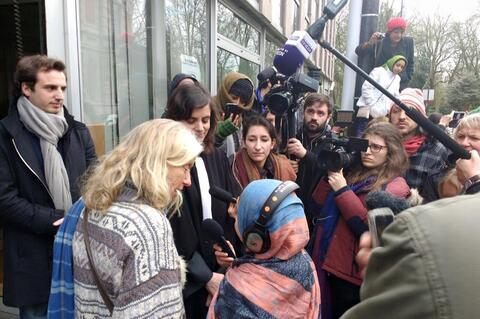
"Refugees travelling to and across Europe have limited or no access to media platforms, digital tools and the Internet. This makes it difficult for these communities to challenge the negative mainstream media narratives and public attitudes that surround them."
Founded in November 2015, Jungala Radio is a digital community-led radio station based in an informal refugee camp in Calais, France, which the media refers to as "The Jungle". Organisers provide training for refugees in digital community broadcasting, with the hope that they will grow and develop to a level where they can control, facilitate, and operate a digital community radio station. Through Jungala, camp residents can become the narrators of their own political realities and offer an alternative representation to that which is being depicted in mainstream media (charity, sympathy, and criminality narratives). The digital content is streamed using social media tools such as Facebook, Twitter, Soundcloud, YouTube, and the Jungala Radio website.
Using group work theory and participatory action research (PAR), the initial outreach exercise extended to 5 participants. After 5 days of intense training, the group had created a sense of identity and community. This was evidenced by their commitment to naming the station, setting out a group contract and rules of engagement, and turning up for training sessions. The camp is extremely active at night, with many refugees choosing to sleep during the day when it is warmer and quieter. The training sessions therefore revolved around people's sleeping patterns, and took place between 3pm - 6pm. The sessions focused on communication skills, confidence building, community participation and engagement, story and content development, interview techniques, presentation and editing, and post-production skills. Tasks were divided into group work and technical training.
Specifically, group work was an integral part of creating a community that would engage and commit to digital learning and creating digital content. Group decision making was based on democratic practice, which was influenced by PAR, the ethos of community radio, and group work theory. McIntyre (2007) discusses 3 prominent characteristics of PAR: the active participation of both the researcher and participant in co-constructing knowledge; the acknowledgement of self and critical awareness that leads to individual, collective, or social change; and the building of rapport between researcher and participant throughout the process. The traditional power dynamic of researcher and participant is removed, as the development and engagement of the researcher integrates into the community setting. PAR was designed to allow facilitators to become an integral part of the Jungala Radio community so that an authentic culture of knowledge and skills sharing between participants and facilitators could emerge. In the group, decision-making was based on democratic practices, which organisers claim also contributed towards creating a healthy and trusting working environment. It was important that participants felt a sense of belonging to the group for the future success of the project, they explain.
As participants developed new skills, their style of creating digital content evolved. They progressed from densely scripted programmes to being able to critically assess and challenge their interviewees while continuously thinking about technical aspects of recording such as gauging ambient sound and ensuring a suitable environment for recording.
In terms of why audio was used for this type of storytelling, radio provides a space where anonymity is respected. The Jungala reporters keep their ears to the ground, getting information from community leaders every morning, so that they were ready to brief organisers on the expected unfolding of the day. They have reportedly became known within the community as the camp's own journalists and are offered suggestions for what to cover in their reportage. One show focused on protesting Iranian hunger strikers who had sewn their mouths shut. However, the idea was not that camp residents would simply come in to tell stories about their personal experiences of war and trauma, which could risk contributing towards a model of disempowerment and a "sympathy" narrative. The focus was, rather, on supporting all types of digital creativity and skills development.
Technological decisions were made by considering their relative simplicity, accessibility, and affordability; for example, organisers needed to use open source materials so participants could access the various digital tools and software needed should they decide to continue their work if they move away from the Calais Refugee Camp and the Jungala project. The Jungle has 2 Wi-Fi hotspots installed and maintained by the "World Wide Tribe". The 4G data signal is captured and transmitted back out to 2 other spots within the camp: Alpha's school and Jungle Books Library. The internet operates using phone sim cards, drawing on a 50 GB allowance every 2 days, using 3 or 4 sim cards a week for each point of transmission. The electricity for the devices is drawn from a 12v mobility scooter battery that must be charged by a generator for at least 2 hours a day. Internet connectivity is reliant on a generator. Quite often, the generator runs out of fuel, and it can take up to 2 hours to get fuel. During the winter, this is problematic.
Having a centralised point for podcasts on a social sound platform was a crucial part of the online strategy. Organisers selected Soundcloud due to its downloading and integration capabilities. This made the shows more accessible to wider audiences. Once they uploaded an mp3 file to Soundcloud Jungala Radio, the file would automatically be linked to Jungalaradio.com, Facebook Jungala Radio, and Twitter JungalaRadio. Click here to listen to Jungala Radio.
Refugee Communication, Community Media Development
Jungala Radio faces environmental, economic, cultural, legal, political, and technological challenges. These challenges must be understood in the context of the refugee camp environment. The camp has minimal access to water, sanitation, food, healthcare, and education. A report from Birmingham University indicates that the camp is well below the United Nations sanitaion and water access standards. The legitimacy and status of this camp is determined by the French government's adaptation of the Dublin Regulation (2003), which stipulates that refugees must claim asylum in their first country of arrival. Under this regulation, the French Government does not recognise the camp as a formal refugee camp.
There are 2 organisations onsite that provide internet to the 10,000 people living in the camp. Only a very small number of refugees can access the internet, and no downloading is available. Approximately 30-40 people at one time can access social media sites such as Snapchat, Viber, and Facebook from smartphones. The internet connection is extremely poor, and connectivity is limited. While facilitators had experience with using most of the social and digital tools used, managing the communicative platform proved to be challenging in terms of learning how to approach and maintain facilitators' digital presence while participants developed their editing and communication skills in through English.
On October 24 2016, French authorities began the final eviction phase of the camp in Calais. The Jungala Radio team "will continue to provide support and training in community radio for refugees, individuals, and communities with an interest in learning how to participate and will continue to support those who decide to further their community radio training in the Calais region and beyond. This means that we will be adapting our training programmes to suit people who are going through a transitory phase whilst applying for asylum in Europe. We are broadening our geographical area of work, and we are also refining how we provide support for those who want to work and create content within the community radio sector. We now see this project developing as a global collaborative initiative involving a wide network of diverse people that can be utilised by facilitators, content creators, and listeners."
"Creating a Digital Community Radio Station in an Informal Refugee Camp in Calais, France", by Kathy O'Hare, DHCommons; Behind the Scenes with Jungala Radio, Third Coast International Audio Festival; Jungala Radio website; and Jungala on Facebook - all accessed on June 6 2017. Image credit: Jungala Radio
- Log in to post comments