










































The Role of Communications in a World in Crisis - SBCC Summit 2016 Keynote
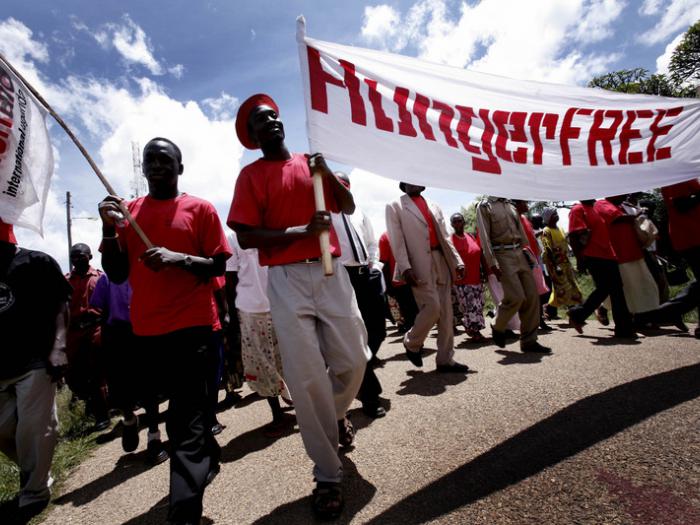
This Keynote Speech by Kumi Naidoo was presented at the First International SBCC (Social and Behaviour Change Communication) Summit in February 2016 in Addis Ababa, Ethiopia. The summit brought together over 700 practitioners representing 50 countries to advance SBCC as a domain of scholarship and practice and link SBCC to positive health outcomes and impact. Kumi Naidoo, current launch director at the African Civil Society Initiative, was the second keynote speaker with a talk on: The Role of Communications in a World in Crisis.
Kumi starts off his talk by pointing out that we currently find ourselves in a “convergence of multiple crises”. Over the past 10 years we have experienced financial crises, climate crises, terrorism, a refugee crisis, economic justice crises, and an increase in violence against women. This situation is causing many of the previous development gains to be reversed. Political leaders responses to this has been “timid, half-baked and lacking in moral courage”, and he stresses that “What is needed is not incremental baby steps change to make the world safer, more just and more sustainable, what is needed is fundamental structural and systemic change”.
He then goes on to ask what the critical role of communications is within this context and what constitutes good communication. He argues that in trying to implement good communication, practitioners should take care not to focus too much on communication and its outcomes (communications is necessary but it alone does not bring about social change), but to also look at, and question, the wider context within which we all operate. There seems to be too much pressure on communications outcomes and impact, in a context where other more structural changes may also be required. He supports this by quoting Albert Einstein: “Not everything that counts can be measured and not everything that can be measured counts.”
Naidoo talks about where we are in the world today and draws on a Martin Luther King speech to make the point that there are unacceptable levels of inequality in the world, which are presenting a major barrier to social change. This situation is also eroding democracy, as governments and democracies are being bought by those with money and power, fuelling the growth of inequality. So, irrespective of the work we are doing - whether it is promoting condoms or good nutrition - we cannot make proper progress unless we address the fundamental inequalities that exist.
With this in mind, he examines how he sees change occur with the help of a PowerPoint slide. Looking at social change from a civil society point of view there are three levels: Macro level- governance level that requires structural, fundamental change Meso level - policy change Micro level - delivery of projects and programmes.
He compares the time it takes for change to happen at each level, as well as the current levels of investment for each stage: 5% of resources go to macro change, 15% goes to civil society to support policy related activism, and 80% of funds are going to projects. He calls for more to be done at the meso and macro levels in order to ensure fundamental social change.
Naidoo goes on to say that people who work in communication have a lot of power. Drawing on theory from Althusser, he explains that it is not really the government structures that control society, but the ideological framework within which we live - the schooling system, social norms and customs, and the media and communications environment. Even though social media is becoming more powerful, the majority of penetrative media still shapes national political consciousness. The media has the power to influence peoples choices, and as communicators we have a critical role to play here.
He calls on communicators and people working for social change, especially those who work in the developed world, to also look at their own backyards. He points out that, at conferences like this, we seem to think that work needs to be done only in the developing world to bring about social change and a more just society. However, he stresses that “we need to also recognise that the progress of the developing world is fundamentally linked to the choices and policies and practices that the most dominant countries in the world pursue. Unless we address that, we will not get to where we need to.” In order to bring about social change for all, communicators should examine and challenge their own positions in their own societies and their positions in the world. The more privileged especially, need to look at their own policies, practices, and behaviour. Most of all, one of the biggest behaviour changes that needs to happen is around consumption patterns, which need to be urgently addressed to ensure a sustainable future for ourselves and our children.
- Log in to post comments