










































Using Mobile Phones for Polio Prevention in Somalia
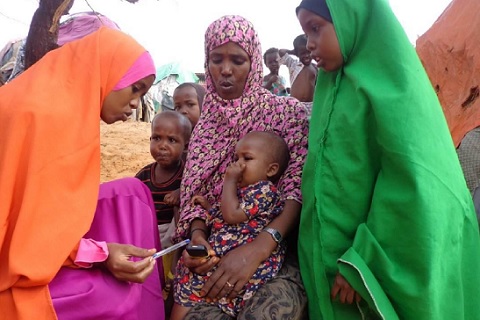
"...the widespread penetration and use of phones in Somalia meant that it was appropriate for reaching hard-to-reach communities and represented a relevant mechanism to deliver health and water, sanitation and hygiene (WASH) information."
This 34-page report discusses evaluation findings of a mobile-phone-based health promotion project in Somalia to improve awareness as well as sanitation and hygiene practices to support polio prevention and control. Beginning in November 2013, Oxfam, the United Nations Children's Fund (UNICEF), and local partner Hijra implemented a mobile-phone-based project with two complementary components: pre-emptive community education delivered through interactive SMS (text messaging) on polio prevention and the distribution of water and sanitation items through SMS voucher redemption. The evaluation found that mobile phones offered significant potential to access hard-to-reach communities, although the mVoucher system operated far below projections.
The project was implemented when, after previously being polio free, Somalia faced a polio outbreak in May 2013. The outbreak was "exacerbated by large-scale population movements, persistent immunity gaps and lack of immunisation activities in insecure areas; 193 cases of Polio were recorded in Somalia in 2013." There was an identified need for community education to improve awareness of polio prevention and control, as well as to provide items (such as soap, water containers, and household water treatment) to support safe hygiene practices, which play a key role in polio prevention.
Polio education was undertaken through four daily interactive SMS sessions. They integrated key community-based disease prevention approaches (focusing on faecal oral transmission) that include hand washing and safe water chains. The mVoucher system allowed people to access the required sanitary items to facilitate implementation of the behaviours being promoted. Communities received a code (mVoucher) on their phones via SMS which they then redeemed at appointed pre-qualified traders, receiving the specified Non Food Items (NFI) package in exchange for the mVoucher.
This evaluation set out to document the process of what happened in the project, evaluate the results, and, most importantly, capture learning that can inform improvement of subsequent phases of the project. It was undertaken between mid-December 2014 and mid-January 2015, comprising three core components: stakeholder interviews, focus group discussions with participants in the mobile-based initiative, and qualitative household survey with random populations in the districts where the project was implemented.
The report covers the following issues: relevance in terms of the use of mobile phone and the voucher system; efficiency and cost effectiveness of the project; effectiveness in terms of impact on knowledge, attitudes, and practices; and scalability and sustainability.
In terms of relevance of the mobile phone platform, the report states that, "Given the widespread use of mobile phones, coupled with limited alternative ways to reach people, a mobile phone based public health promotion approach is appropriate in a context like Mogadishu." In addition, the benefit of using mobile phones is that conventional approaches for delivering education involve face-to-face gatherings, which can entail security risks, whereas delivery of education messages through SMS made use of a widely available resource and offered the ability to transmit information where people already are. This also allowed people to read and reply to messages in their own time. The mVoucher system was considered to be relevant, as it had security and logistical advantages - community members did not have to go to distribution points at predetermined times and instead could visit local traders when convenient for them.
In terms of impact on knowledge, the evaluation found that community members showed an increase in knowledge about causes, signs and symptoms, and prevention of polio as compared to the baseline, although there were still some concerning gaps in knowledge around what causes polio. There was also evidence that people had applied this knowledge, most significant being taking family members to vaccination centres and increased hand washing with soap. However, as stated in the report, "given the number of ongoing Polio prevention interventions, it is difficult to isolate where knowledge came from so no direct correlation can be assumed with interactive SMS project."
Related to this, the evaluation also showed that there were some challenges in terms of content and message design. The assessment found that, in some cases, the interactive messages comprised too many steps and questions before the caller could access the key information being sought. Frequency of too many messages was also highlighted, as well as the need for more consultation in message development and translation.
With regards to the mVoucher system, the report acknowledges that there was a very high number of people who received the voucher but did not pick up the items. People interviewed cited distance and being too busy as key reasons. The report also outlines challenges related to trader capacity and logistical supply chains. However, as the report states, "mVouchers show huge potential for making distributions more convenient for beneficiaries. Eventually, if the model works in the way it is envisaged; it would be game changer for the way conditional distributions take place. Vendors could be responsible for doing work typically done by NGOs [non-governmental organisations] with knock on benefits to livelihoods as they profit from distributions."
The last section of the report offers a number of conclusions and recommendations related to the different components of the programme: interactive messaging and mVoucher, as well as general recommendations. To mention just a few: One recommendation was that "complementary communication should be explored to mobilise and engage people through other channels like radio and elders so they build trust in this service from other sources." Other ideas include combining educational messages with other news or alerts (i.e., sports), as well as improving monitoring and evaluation to better understand what works and what doesn't. In terms of the mVoucher, given the very high number of people who received the voucher but did not pick up the items, there is a need to better understand the challenges behind the low conversion rate. General recommendations include greater attention to capacity building and building relationships, as well as improved technological systems.
Oxfam Policy and Practice website on June 5 2015.
- Log in to post comments