










































Afar Malaria Prevention Project
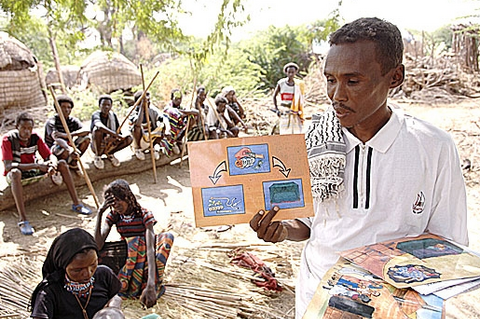
Launched in 2005, the Afar Malaria Prevention Project was a 5-year malaria intervention working towards prevention, control, and elimination. Led by the African Medical and Research Foundation (AMREF) Canada, and funded by the Canadian International Development Agency (CIDA), Addax Petroleum Foundation, and AMREF Netherlands, the primary objectives were to increase coverage of insecticide-treated nets (ITNs), develop and utilise participatory communication tools to ensure high ITN retention and utilisation rates, improve the ability to recognise the signs and symptoms of severe and uncomplicated malaria, and to prompt treatment-seeking behaviour. AMREF supported the distribution of 145,000 ITNs in the region, training on the proper use of bednets to prevent malaria, public education through "mother coordinators", public information sharing events, and information materials.
One of the project’s strategies to bring about behavioural changes in the community related to malaria prevention and treatment was the use of "mother coordinators" as community-based health promoters. Mother coordinators educate community members on the importance of prevention and control by visiting households door-to-door. According to AMREF, as of 2012 454 Mother Coordinators in Afar have been trained, who each visit 30 households in the region every month.
AMREF also provided training to 62 health workers working at local clinics in Afar on improving the quality of diagnosis and management of malaria cases, as well as to 40 health extension workers in administering “Rapid Diagnostic Tests” in order to help diagnose malaria quickly and accurately.
The Afar Malaria Prevention Project also undertook public education through the following activities:
Malaria Prevention Toolkit: A toolkit was designed for Mother Coordinators to use when educating their community members on malaria prevention and treatment. The toolkit is made up of a series of pictures in order to make the information accessible to everyone regardless of their education level.
Information Materials: Numerous information materials about malaria prevention and treatment including posters, brochures, and billboards were produced in Afarigna (the local language) and distributed to health offices across the district. AMREF also printed health messages on t-shirts, hats, and umbrellas (mother coordinators use umbrellas to protect themselves from the sun).
Public Events: AMREF organised public events to share information and mobilise larger groups of people on malaria prevention and control. AMREF gathered 112 people, including members of the District Council, Ministries of Health, Education and Women's Affairs and representatives from the local elementary and secondary schools, at the Gewane District Administration's Meeting Hall to commemorate World Malaria Day. The event was the first time World Malaria Day was celebrated in Afar and included a panel discussion and "Question and Answer" session. In addition, to celebrate Malaria Week, AMREF held a one-day workshop in the town of Awash involving 33 participants from six districts and focused on epidemic preparedness.
AMREF also distributed 145,000 insecticide treated nets reaching 72,500 houses. Almost 90% of the nets were distributed to pregnant women and children under five, as they are most vulnerable to malaria.
Malaria
According to AMREF, independent researchers found that 350,000 people have benefitted from the Afar Malaria Prevention Project. In addition, the study found that malaria cases have been reduced from 62% to 41%; malaria deaths have reduced from 25% to 2%; and the Head of the Amibara Health Office said that while malaria accounted for 90% of total outpatient visits before AMREF distributed malaria nets, it currently stands at 30%. Treatment-seeking behaviour for children under five has also improved with the percentage of sick children taking anti-malaria drugs rising from 9% to 53% over the course of the project. In total, AMREF was able to reach more than 27% of the total population of Afar (350,000 people) and decrease morbidity and mortality due to malaria by over 20%.
African Medical & Research Foundation (AMREF), Canadian International Development Agency (CIDA), Addax Petroleum Foundation, and AMREF Netherlands
AMREF Case Study and AMREF website on April 30 2012.
- Log in to post comments