










































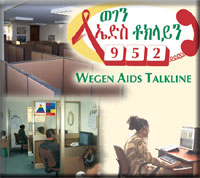
Wegen AIDS Talkline

The HIV/AIDS telephone hotline system is accessed free-of-charge both from landlines and cell phones. Designed for reaching youth, people living with HIV, their families, and the public at large, Wegen AIDS Talkline objectives include:
- empowering Ethiopians to know their HIV status
- protecting those who are HIV-negative from contracting HIV;
- promoting healthy, positive living among those infected and affected by HIV/AIDS;
- providing up-to-date information on HIV/AIDS, including voluntary counselling and testing (VCT), prevention from vertical transmission, anti-retroviral therapy (ART), tuberculosis (TB), and care and support;
- referring callers to appropriate services across the country; and
- tracking and disseminating collected data.
According to the organisers, dissemination of information through the talkline equips individuals with the necessary knowledge to protect themselves from HIV, practice positive living if already HIV-positive, encourage greater uptake of VCT, and access and adhere to ART. The referral component enables individuals to find help in the complex network of HIV/AIDS service providers and access the information, care, and support services they need. By providing ongoing counselling services, the talkline aims to create an enabling environment for those infected and affected by the virus to live positively, manage undue stress, find ongoing support through referrals, and realise their overall emotional well-being. By providing information related to HIV/AIDS through an anonymous and confidential channel, the talkline hopes to encourage greater dialogue and reduce stigma and discrimination.
Wegen AIDS Talkline has 24 lines and operates with 74 counsellors and 5 supervisors providing services to callers from across Ethiopia from Monday to Saturday, 8:00 am till midnight and from 8:00 am till 2:00 pm on Sunday (dial "952"). Counsellors are connected to the hotline by means of a PABX telephone system and fitted headset. The PABX supports call centre operations with features including automatic call distribution (ACD) and real-time calls/agents monitoring. The system also keeps call records and reports call statistics and other features. Specifically, information is recorded on 2 separate databases. First, all incoming call statistics (number of calls each agent/coordinator answers, call duration, etc.) are recorded by the PABX/ACD computer. Callers' IDs are not recorded. The second database is filled by each counsellor using an intranet web page back-ended on an MS SQL server. This database records specific information about each call's counselling content.
The programme has 61 full-time paid counsellors working 40 hours a week and 18 volunteer counsellors for provision of services. All talkline staff received training on basic talkline counselling techniques and additional on-the-job training prior to providing services to callers. The counsellors also obtain information from compiled electronic information from the intranet database, hard-copy reference materials, and the internet.
HIV/AIDS, STIs, TB.
According to the organisers, the talkline receives a huge volume of calls daily, 3,000 to 4,000 to the average, mostly from Oromia (38.04%). In October 2010, the talkline served 130,735 people. The majority of callers (81.9%) are male and aged 20-29 years (56.6%). Most callers ask for general information on HIV and its transmission, followed by counselling and prevention interventions. Also, 36.61% of callers have not yet been tested for the virus.
Recognising the vital role talklines play in bringing about behavioural change, organisers say that a considerable number of developing countries have adapted this innovation. Talklines are also used in South Africa, Nigeria, Mozambique, Ghana, Uganda, Kenya, Zambia, Guatemala, Trinidad and Tobago, the Philippines, India, and others in their fight against the HIV pandemic. All these countries have reported a significant enhancement of their HIV/AIDS efforts.
According to organisers, Ethiopia is one of the sub-Saharan African countries hardest hit by the HIV pandemic. The 2010 single point estimate shows that about 1.2 million out of approximately 72 million Ethiopians were infected with HIV, 58.97% of which were women and 79,817 were children under the age of 15. Ethiopia's Ministry of Health (MoH) statistics estimates the HIV prevalence at 2.4%, with the highest percentage among the ages of 15-49. The urban and rural areas HIV prevalence rates are 7.7% and 0.9%, respectively.
The talkline is supported by United States through the President's Emergency Plan for AIDS Relief (PEPFAR), along with Ethiopia's HIV/AIDS Prevention and Control Office (HAPCO), and the Ethiopian Telecommunication Cooperation (ETC).
Wegen page on the AIDS Resource Center website, July 26 2007 and July 22 2009; and email from Gashaw Mengistu to The Communication Initiative on November 19 2010.
- Log in to post comments