











































Uptake of the Human Papillomavirus Vaccine in Kenya: Testing the Health Belief Model through Pathway Modeling on Cohort Data
International Centre for Reproductive Health, Ghent University (Vermandere, Michielsen, Degomme); University Medical Centre (van Stam); Moi University (Naanyu); University of Amsterdam (Oort)
"It is generally agreed upon that there is a need to further test health behavior theories as to justify their use in promotion and vaccination interventions and to verify their applicability in different settings."
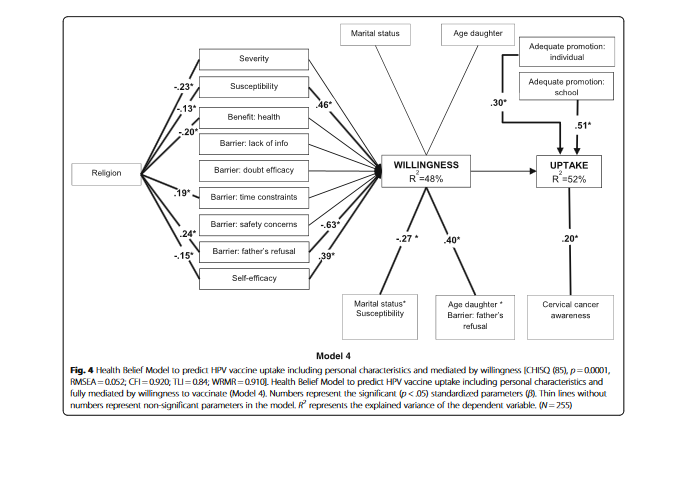
This longitudinal study investigated the utility of the Health Belief Model (HBM) in predicting human papillomavirus (HPV) vaccine uptake in Kenya, where HPV vaccination was not part of the national immunisation scheme at the time of this writing. The study's general aim is specified into three underlying research objectives: (i) to examine whether the HBM constructs predicted vaccine uptake, including a subjective evaluation of promotion; (ii) to evaluate the validity of adding willingness to vaccinate to the HBM as mediator of uptake; and (iii) to examine the direct and modifying effects of personal characteristics on the (associations between the) HBM constructs.
The HBM is a theory often used as framework to develop health interventions. In this model, constructs concerning severity, susceptibility, benefits, barriers, and self-efficacy are considered important determinants of the health-related behaviour. The background section of the article lays out the model's components. In brief, the original HBM indicates that in order for an individual to take action (e.g., to vaccinate his or her daughter), this person would have to (1) perceive the disease at least as moderately severe; (2) perceive a susceptibility or vulnerability to the disease; (3) believe there are benefits in taking the preventive action; and (4) not perceive major barriers obstructing the action. According to the theory, the likelihood to action increases when the perceived benefits outweigh the perceived barriers. The HBM is often extended with two more constructs: (5) self-efficacy, indicating expectations about competence to perform the behaviour; and (6) cues to action (CTA), i.e., the specific stimuli necessary to trigger the decision-making process.
For the present study, longitudinal data were collected before and after a pilot HPV vaccination programme in Eldoret, Kenya, among mothers (N=255) of eligible girls (ages 9-13). Through the Gardasil Access Program (GAP), Moi Teaching and Referral Hospital (MTRH - Eldoret) received 9,000 doses of the HPV vaccine. Promotion was organised at the 10 (of 42) public primary schools in Eldoret Municipality that were randomly selected to participate. Health care providers informed the teachers, who then passed on the information to students and parents. Implementation of such promotional activities differed from school to school, from parents meetings at school to teachers asking their pupils to notify their parents about the vaccination opportunity at MTRH. The baseline and follow-up study took place in March 2012 and May 2013 respectively, i.e., right before and after the pilot program, which ran from May 2012 till March 2013.
Through pathway modeling, associations between vaccine uptake and the HBM constructs, willingness to vaccinate and adequate promotion, were examined. Adequate promotion was defined as a personal evaluation of promotional information received. Finally, baseline cervical cancer awareness and socio-demographic variables were added to the model - verifying their direct, mediating, or moderating effects on the predictive value of the HBM.
All constructs were measured at baseline. Perceived severity, susceptibility, and 3 barriers (foreseeing father's refusal, doubting vaccine efficacy, and perceiving lack of information) were assessed directly, while other HBM constructs (self-efficacy, trusting the health benefit of the vaccine, and the 2 barriers (having safety concerns, and foreseeing time constraints) were measured through several items.
Of the 255 participants included in the analyses, the average willingness to vaccinate was 4.4 (range 1-5). Perceiving yourself as adequately informed at follow-up was the strongest determinant of vaccine uptake. HBM constructs (susceptibility, self-efficacy, and foreseeing father's refusal as barrier) only influenced willingness to vaccinate, which was not correlated with vaccination. With regard to the direct and modifying effects of personal characteristics on the (associations between the) HBM constructs, cervical cancer awareness was found to be significantly (p<.01) related to uptake. Also, religion clearly affected the HBM constructs: Muslims were more likely to agree with the barriers "father's refusal" and "time constraints", were less likely to perceive cervical cancer as severe, thought their daughter was less susceptible, had lower self-efficacy, and were less driven by the fact that the vaccine would protect their daughter's health.
The discussion section of the report sheds light on some of these findings. For instance:
- Adding adequate promotion, at both personal and school level, to the HBM increased the predictive value from 8% to 49%. That is, whether or not the daughter received the vaccine was highly associated with obtaining sufficient information. Furthermore, it is important to mention that before adequate promotion was added to the model, self-efficacy was the only HBM construct found to have a positive correlation with vaccine uptake. This shows that besides an external trigger, participants still need to perceive themselves capable in performing the action (i.e. taking their daughter for a vaccination), which therefore justifies addition of this construct to the HBM.
- The 9 baseline HBM constructs, which only explained 8% of the variance of uptake explained 41% of the variance of willingness. Also, adding willingness to vaccinate as mediator of uptake lowered the predictive value of the HBM from 49% to 47%. Moreover, willingness had no effect on vaccine uptake, while adequate promotion remains highly associated. These results raise the issue of control, i.e., to what extent are people truly in control of vaccination behaviour if they are depending on providers' motivation and initiation?
- Personal characteristics increased the explained variance of willingness from 41% to 48% and of uptake from 47% to 52%. The results suggest that personal characteristics influence vaccination differently in different circumstances, demonstrating the complexity of the decision-making process regarding cervical cancer vaccination. Further research is necessary, the researchers suggest, to define whether or not some of these variables would have an added value to the HBM.
In short, this study found little support for the HBM in the context of HPV vaccination in Kenya; neither was willingness a good predictor for uptake. The association between adequate promotion and vaccination reveals the importance of triggers beyond personal control. Thus, adoption of new health behaviours might be more determined by organisational variables, such as promotion, than by prior personal beliefs. The researchers "hypothesize that supportive important others, motivation by health providers and general trust in the health system may be of extreme importance to counteract knowledge gaps and doubts. Therefore, we recommend to further study whether interpersonal variables and variables at the level of community or health system are (more) important determinants of new (preventive) health actions as opposed to personal beliefs....By monitoring future HPV vaccination programs and by assessing users' and non-users' perspectives these variables could be more explored and if deemed appropriate added to the HBM."
This type of future research "could help identifying specific components of promotion interventions necessary for the target group to perceive promotion as adequate." Finally, the researchers conclude, their results "encourage the examination of modifying effects of personal characteristics since they might boost the predictive value of the HBM. Identification of such determinants might then help to increase the efficacy of future promotion campaigns and as such, create awareness, consensus and support for HPV vaccination at the community level."
Globalization and Health 2016 12:72. https://doi.org/10.1186/s12992-016-0211-7
- Log in to post comments