











































Triggering For Positive Behaviour Change in Nutrition - Insights from Sustainable Nutrition for All in Uganda and Zambia
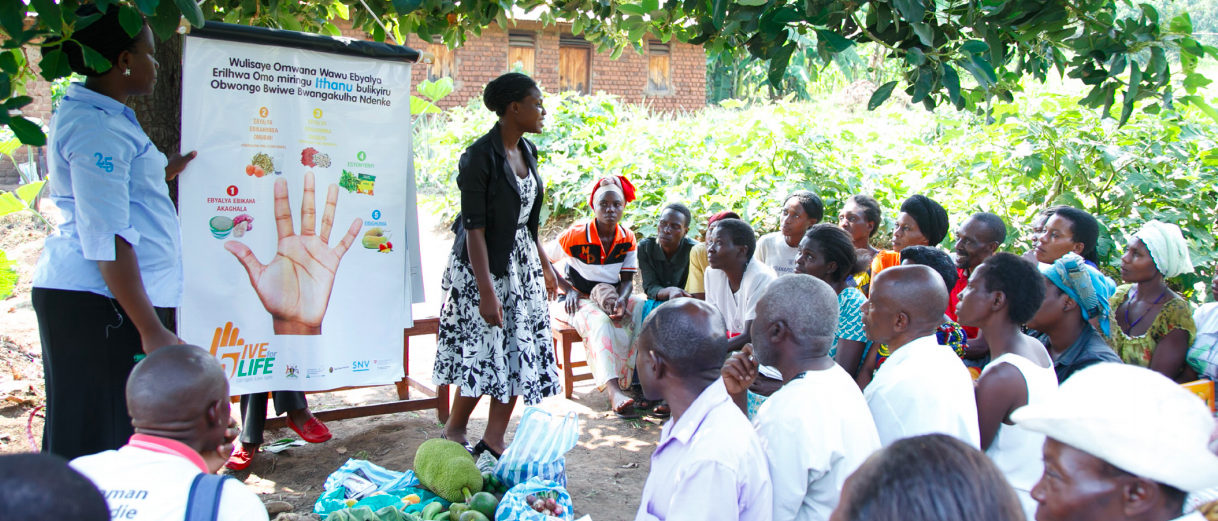
"The potential of millions of children can be unlocked with good nutrition. Inadequate care and feeding practices, food insecurity, inequitable gender relations, an unhealthy household environment and inadequate health services are all leading contributors to early childhood malnutrition."
This technical brief provides key insights and findings from the Sustainable Nutrition for All (SN4A) programme, with a focus on the programme's use of social and behaviour change communication (SBCC) and triggering in promoting positive nutrition and hygiene behaviours. Implemented in Zambia and Uganda, SN4A is an integrated community-focused programme that seeks to enhance availability and access to nutritious food, improve dietary diversity, and improve the health and nutritional status of households, particularly children under two years of age. Currently in its second phase of implementation (2018-2020), SN4D was developed by SNV Netherlands Development Organisation, together with the Centre for Development Innovation of Wageningen UR (CDI) and the Royal Tropical Institute (KIT), and is funded by the Swiss Agency for Development and Cooperation (SDC). The brief is designed to assist policymakers, practitioners, and researchers in understanding the SBCC approaches and tools used and to guide their investments in demand triggering and SBCC.
The SN4A programme was implemented between 2015 and 2017 in four districts in Zambia and Uganda, reaching over 15,000 households. The triggering and overarching SBCC strategy are described in detail in the report, providing insight into some of the successes and challenges - for both the overarching strategy and the triggering component of the strategy in particular. Insights are based on findings from focus groups and interviews with governance staff, nutrition action groups (NAGs), and community members.
In brief, the overarching multi-sectoral SBCC strategy has three key components: interpersonal communication (IPC) between households and the NAGs who are mentored by the Nutrition Champion (usually a respected community member) and district teams; community sessions, involving cooking demonstrations, demonstration gardens, role plays, drama sessions, and school competitions; and a wider mass media campaign using mainly radio. Guiding all of this and critical to the SBCC strategy development is the formative research and community mapping exercise, where intrahousehold dynamic (IHHD) factors related to nutrition were identified.
The triggering process is key to the strategy, as it is designed to mobilise the whole community towards taking action. As stated in the report, "Triggering aims to give an emotional kickstart to community mobilization and to enhance long-term pre-existing motivations. It taps into communities' and parents' aspirations for their children to be successful in school and in life." The process emphasises how nutrition is related to everyone in the household, how poor nutrition during the critical years can affect the child's education, and how it is important to eat a diversity of food in order to grow and develop. A "triggering tool" is used to prompt discussion and raise awareness.
The report describes the SN4A model as consisting of several pillars: multi-sectoral governance, the supply of nutritious foods through agrobiodiversity, and SBCC and triggering. The model "induces behavioural change by triggering an understanding of the critical factors for improved nutrition, including production, consumption, care and sanitation practices. The triggering activities facilitate communities to undertake their own appraisal of how their nutrition habits impact their lives, particularly the physical and cognitive development of their children and their future education and employment prospects. Communities are supported to understand what they can do to improve the situation. They formulate their own solutions which are locally available i.e. strengthen year round access to nutritious agricultural food, by increasing household agro-biodiversity, as well as market development to generate income for improved food expenditure. To ensure sustainability and scalability of the approach, SN4A works with local and district level authorities, building their capacity to plan and implement nutrition sensitive strategies."
To mention two examples of what worked for the overall SBCC strategy, the report highlights the IPC strategy, which included household visits and one-on-one conversations between NAGs and households. These were important for continuing the nutrition dialogue and promoting doable steps that had been identified by the community. In terms of community engagement, the active involvement of schools and school children was also highlighted. Initiatives involved plays, music, and poetry competitions with messaging around nutrition.
Related to challenges, findings from the focus groups and interviews caution against a one-size fits all approach. "...the SBCC strategy warranted adaptation and contextualisation before adoption in the two countries, but also across districts. Community members have differing needs depending on their stage of behaviour change. Some of the barriers to improved practices may include a lack of conviction about the health practice, lack of familial support, and/or the pressure of household chores mainly for women in the household." In addition, in some districts, the radio spots/interviews did not reach as many people as planned due to the fact that in some districts, very few people listen to the radio. Radio was most successful in generating interest when it was used as a platform to broadcast interviews of community/district team members and/or provide a forum for questions from the public.
Insights related specifically to triggering highlight how triggers vary with different cultural contexts and that understanding what motivates people is key to any triggering process. For example, a common thread for parents is the desire for their children to succeed in life, at school, and in future careers. This desire for success and fear of failure in their children is also related to the child being financially comfortable in the future, and in turn, represents security for the parents as they age. Overall, it was found that this community-driven approach works well to promote ownership, social solidarity, cooperation, and collective action. "The triggering process is a powerful community mobilisation approach that generates awareness that undernutrition is a problem and stimulates an appetite to know what can be done to address it. By involving the community and the district teams as facilitators of the process, there is potential to create greater accountability at the local level, increased transparency, greater trust and programme acceptance. The approach is locally relevant and socially acceptable and these factors are highly valuable in nutrition programmes which are dependent on BC [behaviour change] to succeed."
In addition, the use of visual and emotive illustrations, tools, and messages was considered successful, as these resonated with people in the village. For example, in Uganda, different stories were used to convey that what a child eats today contributes to what they will be tomorrow - I am a doctor, because as a child I was fed the right food.
The report discusses a number challenges experienced around triggering. One of them is the difficulty in mobilising certain groups of people, such as younger couples. Moving forward, the suggestion is to explore other venues as meeting points to reach these groups. Challenges were also cited related to how to talk about stunting with communities in a way that does not stigmatise children who are stunted.
Based on the success demonstrated by the SBCC strategy, the brief concludes with a number of recommendations for policymakers. In summary, these include:
- Support the scalability of community-driven SBCC nutrition strategies in different contexts as part of nutrition programming, without compromising on the effectiveness of the approach - approaches should include mapping to identify nutrition issues, a gender analysis of barriers and opportunities, and a range of complementary communication channels.
- Support the capacity building of district and sub-district frontline staff from different sectors to implement SBCC strategies.
- Involve the communities themselves in the planning, implementation, and review of the nutrition programme and ensure involvement of all members - male, female, young people, and the elderly.
- Support the development, activation, implementation, and review of national food-based dietary guidelines (FBDGs). These tools can play an important role in promoting principles and practices to support healthy diets.
- Target emotional drivers of improved nutrition behaviours in a sensitive manner. This is a promising avenue for increasing the effectiveness of behaviour change interventions, particularly amongst the more vulnerable members of a population.
- Use existing resources at community level to implement nutrition interventions. For example, using schools proved to be a natural and effective way to reach children and their parents.
- Leverage and expand the existing programmes to break down gender barriers to practising optimal nutrition behaviours over time. Programming needs to address underlying IHHD factors, which affect many of the agriculture nutrition pathways.
SNV website on November 25 2019; and email from Deirdre McMahon to The Communication Initiative on November 25 2019. Image credit: © Dorah Egunyu/SNV
- Log in to post comments