










































Talking Man-to-Man: The Story of Brothers for Life
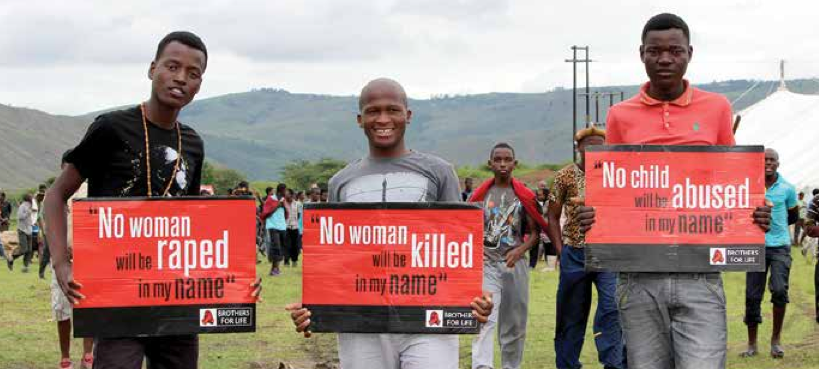
"B4L [Brothers for Life] was a visually striking and, at times, emotionally powerful mass media campaign supported by the most extensive community mobilisation initiative to date. It took the bold step of talking about widely accepted male practices that expose men and their female partners to HIV infection. And, evidence suggests, it found an acceptable way of doing so by framing these issues in a 'brotherly' discourse that focused on the positive alternatives, on doing the right thing."
Brothers for Life (B4L) is a multi-faceted mass media and social mobilisation campaign in South Africa designed to positively impact on men's knowledge and practices in HIV prevention. As outlined in this report, B4L sought to influence social norms and encourage behaviour change especially among men over 30 years, by getting men to speak to men as "brothers". Launched in August 2009, B4L was conceptualised as a social movement seeking to reach broad sectors of the population around HIV prevention, with specific initiatives related to gender violence, multiple concurrent partnerships, prevention of mother to child transmission (PMTCT), and medical male circumcision.
The report outlines the social change theories and process for developing the campaign. B4L is based on the social ecology model, which recognises the combined effect of individual responses, the influence of social networks, community resources and processes, and society-wide developments on individual behaviour and social change. The community mobilisation element of B4L sought to involve and equip local organisations to play leadership roles in the campaign and bring B4L into the homes, clinics, religious congregations, work places, taxi ranks, and sports clubs of many communities. At the same time, the mass media component "harnessed all domains of change identified in the social ecology model, from the individual, through social networks and community structures, to the national society." B4L media outreach - national radio and TV, community media, and print materials - were designed to deliver both individual and social experiences involving family interactions, community structures, and specially convened community dialogues.
B4L was also based on social learning theory, which looks at how we learn by observing the experiences of others. The mass media campaign featured television and radio adverts in which a range of men - some famous, some unknown - each took on board one or more of the practices advocated by B4L. Framed by the tagline line "Yenza kahle!"("Do the right thing!"), each of the role models stood up to be counted as a representative of a positive norm such as testing for HIV, using condoms without fail, or choosing a single partner over multiple sexual relationships.
The report outlines the process of developing the campaign, such as the consultative processes, developing tools for mobilisation, and creating the mass media messages. It also explains how the campaign evolved to include two new sub-campaigns around PMTCT and multiple partners, and harnessed opportunities such as the spirit of the Soccer World Cup 2010 in South Africa. The Game of Life sub-campaign, which was flighted during World Cup 2010, focused on the primary message that HIV prevention is the responsibility of every sexually active person, and secondary messages addressing knowing your HIV status, using a condom, choosing one partner over multiple chances with HIV, and using alcohol responsibly.
The report also discusses processes for evaluating the B4L programme, as well as its impact, which has been established through various studies. A key finding from focus groups of peer educators and interviews with B4L community mobilisation coordinators was the vital interlinkages between the complementary purposes served by mass media (radio and TV), print materials (posters and pamphlets), and outreach activities. The reach of Brothers for Life has been found to be extensive. For example, between October 2009 to September 2010, adverts reached more than 30 million TV viewers and nearly 25 million radio listeners. These messages were reinforced by hundreds of community dialogues and capacity-building sessions using the B4L toolkit, which reached into communities across the country.
According to the report, qualitative evaluation suggests that B4L achieved a number of its objectives towards beginning to transform social norms, particularly norms relating to masculinity and the tolerance and perpetration of gender-based violence. By framing these issues as "brotherly" messages that focused on the positive alternatives, B4L was able to effectively reach men to influence attitudes and behaviours. Analysis of data suggests that "exposure to this campaign was directly associated with gains in some HIV risk-reduction practices and that it also led to changes in perceptions, attitudes and social interactions that resulted in risk reduction behaviours. In this sense, B4L had both a direct and indirect effect on such behaviours."
Johns Hopkins Health and Education in South Africa website on June 27 2016.
- Log in to post comments