











































Stories-Without-An-Ending: An Adult Education Tool for Dialogue and Social Change
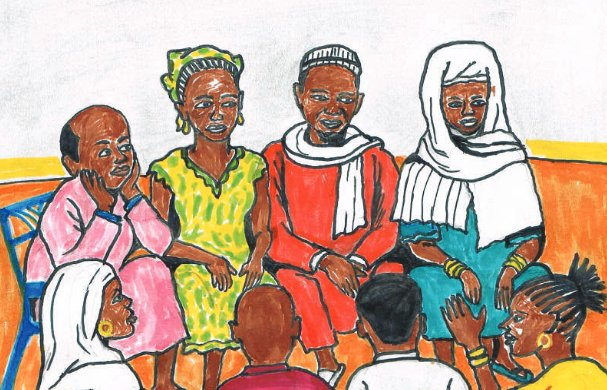
"The 'story-without-an-ending' is a method that makes everyone participate. With these stories, we are actively involved from the beginning to the end. We are actors of our own development. No one imposes their point of view. The stories motivate us to be together, to reflect, to discuss our problems. So we prefer the stories-without-an ending." - Young girl from Sare Yira village
The adult learning tool presented in this guide, stories-without-an-ending (SWE), catalyses community discussion of priority issues that can contribute to community-wide support for social change. Developed by the Grandmother Project (GMP) - Change through Culture, SWE is an adult education method that promotes transformative learning by eliciting collective reflection on both past attitudes and behaviour and on new ideas.
The purpose of this guide is to help organisations develop SWE and use them to actively engage community groups of all ages in discussion of priority issues presented in the stories and to foster discussion of those issues in the wider community.
The guide is intended for use by organisations that are committed to encouraging dialogue, critical thinking, and empowerment of communities, rather than to disseminating message to persuade people to change. The SWE methodology can be used to address a variety of issues dealing with nutrition, health, early childhood development, adolescent health and well-being, education, child protection, agriculture, etc.
Development of the SWE methodology by Judi Aubel, Executive Director of Grandmother Project - Change through Culture, was directly inspired by the work of the Brazilian adult educator Paolo Freire. Freire was critical of directive approaches that present community members with problematic situations and then propose solutions for solving them. SWE are open ended and do not prescribe set solutions to the problems they present. A key aspect of SWE is that they challenge small groups of participants to debate on both existing and new ideas, and then encourage them to catalyse discussion on those ideas in the wider community. This can ultimately result in community-wide consensus for change. The idea is that community-led social change can bring about changes in social norms and, that those changes can in turn, influence individual behaviour.
Characteristics of SWE:
- They reflect real-life situations that are familiar to participants.
- They convey new ideas to participants.
- They present both existing and new ideas on a specific issue and elicit discussion on both.
- They tap into the tradition of storytelling, common in non-Western cultures as a means of transmitting knowledge.
- They can trigger community dialogue about a specific issue and promote community-led decision-making.
- They encourage horizontal communication and sharing of ideas among community members and development workers.
- They help development workers to better understand communities' experience and priorities and to develop strategies that are more culturally grounded.
- They involve community members in active learning that can lead to change in social norms and practices.
- They can be used to address a variety of issues with men and women of all ages and in both urban and rural settings.
Overview of the guide:
- Chapter One presents an introductory discussion of some fundamental differences between programmes that promote individual behaviour change and those that promote community-wide social change. For many years, community nutrition and health programmes have focused on behaviour change. However, there has been increased discussion of the need to focus more on community-wide change, or social change. This chapter aims to clarify key differences between these two approaches.
- Chapter Two presents key concepts regarding the characteristics of non-Western, collectivist cultures in Africa, Asia, and Latin America, examines how learning takes place in those cultures, and suggests how those characteristics can be taken into account in designing strategies to promote change in communities.
- Chapter Three presents principles and methods for adult education that can contribute to increased learning and change in community norms and practices. Adult education methods that promote collective reflection and empowerment are particularly well-suited to collectivist cultures of the Global South.
- Chapter Four presents a step-by-step process for developing SWE:
- Collect information from community members on the issue to be addressed in the story;
- Write the problem-posing story and develop open-ended discussion questions; and
- Present the story to a group, and facilitate the discussion.
- Appendix A presents an example of an SWE process ("I can't imagine my life without Ba Mariam"), along with discussion questions.
- Appendix B includes an outline for training for the use of SWE for those who will be presenting SWE and facilitating discussion of them.
Development of this guide was supported by the Technical and Operational Performance Support (TOPS) Micro Grants Program, funded the United States Agency for International Development (USAID). Editor's note: On February 3 2017, TOPS hosted Judi Aubel for an online presentation on SWE. View the event recording, below, and click here for the presentation slides [51 pages, PDF].
English, French
64
Emails from Judi Aubel to The Communication Initiative on July 14 2021 and July 31 2021; email from the FSN Network to The Communication Initiative on July 15 2021; FSN Network website, July 15 2021; and email from Francesca D'Asaro Biondo to The Communication Initiative on August 3 2021. Image credit: Sékou Traoré
- Log in to post comments