










































Pushing for Change: Laying the Groundwork for Tomorrow's Journalism Today
"While media outlets around the world seek solutions to the challenges posed by digital transformation, providers of Media and Journalism Education (MJE) face an even greater struggle."
This discussion paper, published by Deutsche Welle (DW) Akademie, explores new ways that media and journalism education (MJE) providers can think about and deliver journalism training that prepares graduates for journalism into the future. The paper is intended to start a conversation on what a holistic approach to MJE that supports public interest media can and should look like.
As explained in the paper, in many media ecologies around the world, public interest media find themselves under increasing pressure through "shrinking budgets and a lack of viable business models, clickbait journalism and a general disenchantment of society with journalism and the media." In addition, their role in society has changed. "Today, journalists do not only have to compete with politicians, activists, and social media users for attention, but also with disseminators of disinformation that undermine reliable reporting."
For this reason, one of the main questions this paper seeks to address is how to enable MJE to not only keep up with the sector's current demands but to prepare professionals who are able to master future challenges as well. The paper calls for a holistic approach to media development that looks beyond the training content and curricula of journalism courses. The term 'MJE' in this paper includes a variety of training options, including: universities that offer degree courses or mid-career specialisation, journalism schools, film schools or training centres set up by media houses to conduct hands-on workshops, and capacity-building initiatives by media associations or other networks for their members.
The paper outlines DW Akademie's MJE concept and structural approach to training journalists, which goes beyond just training. The approach sees MJE providers as supporting media practitioners in actively shaping the future of the media ecosystems in which they operate. It sees MJEs offering a space where journalists can engage with new trends or develop new products and solutions for a journalism in the service of the public. "In this way, MJE takes a leading role in moving the profession forward. MJE providers train media practitioners able to thrive in the digital age. They are at the forefront of innovation that benefits both the public and the media that these practitioners work for. An innovative MJE tailors its programs to the media ecosystem in which it operates and enables media practitioners to shape it. To play its part in making public interest media viable, MJE needs to assume ownership of the challenges media ecosystems worldwide face."
In order to put MJE providers in a position to do so, the document delineates a structural approach to MJE that must take six dimensions into account:
- Structures: MJE providers need viable structures to train media practitioners in innovative competencies, fostering long-term success.
- Innovation: MJE has to position itself as an incubator for innovative media practices.
- Cooperation: A broad cooperation with the media community and civil society, but also the tech sector and others, is crucial to developing a vision of journalism for the benefit of all.
- Target groups: MJE has to reach out to diverse groups to build a professional community that is as diverse as society and foster a more inclusive public dialogue.
- Enabling environment: What is needed is an environment that supports MJE and provides the framework for it to evolve.
- Competencies: MJE should provide competencies to shape the media practices of the future.
In order for media development to support MJE best within this framework, the paper then goes on to outline a number of thoughts for discussion on how MJE needs to evolve in order to fulfil its mission of "laying the ground for tomorrow's journalism today".
- MJE providers must take responsibility for their media ecosystem - MJE's purpose is not only to train journalists but also to help the media ecosystem shape digital change. Far too often, organisations working in media development help train journalists - only to find that there is no place in the respective media ecosystem for the kind of public interest journalism they were trained in.
- Strengthening the viability of training providers is key to a successful MJE - MJE providers need to become key actors within their media ecosystems. Universities, training centres, or journalism and film schools are institutions where different people from the sector come together. As such, they are well placed to become forums for discussions on the future of public interest media.
- MJE needs to look beyond traditional journalists - MJE programmes need to reach out to independent content creators, filmmakers, or other actors experimenting with new ways of doing journalism and providing access to information beyond the legacy media, as well as media managers, film producers, or other (social) media practitioners.
- MJE needs to put a special focus on disadvantaged groups - This work can be done by making advanced MJE accessible to disadvantaged groups.
- In times of shrinking budgets, MJE has to position itself as an incubator for new media practices - The paper proposes that MJE programmes in the context of media development can become more innovative by (i) introducing new journalistic practices into a media ecosystem through capacity development and exchanges, and (ii) creating new media practices through agile innovation and human-centred design with a diverse group of stakeholders.
- MJE cannot do it alone; its success depends on building broad coalitions - MJE providers need to build a community of stakeholders that join forces to help media ecosystems weather the change they undergo. These coalitions are the very core of the viability of MJE providers.
- Training journalists without engaging with their editors is unsustainable - For new competencies to unfold their impact within the sector, media managers, film producers and other actors at the management level need to value these competencies and adapt workflows within newsrooms accordingly.
- There is a need for constant conversation on (meta-)competencies - There should be continuing discussion of which competencies media practitioners need in order to be able to shape the future of their professions. Competencies can, for example, be in the field of media and innovation, entrepreneurial journalism, or thematic competencies such as economic or climate reporting.
In conclusion, the discussion paper highlights the importance of MJE to media viability. Although MJE cannot solve the crisis of media viability, it can lay the groundwork for possible solutions to be implemented. As a result, media development organisations should intertwine their efforts on media viability and media and journalism education much more.
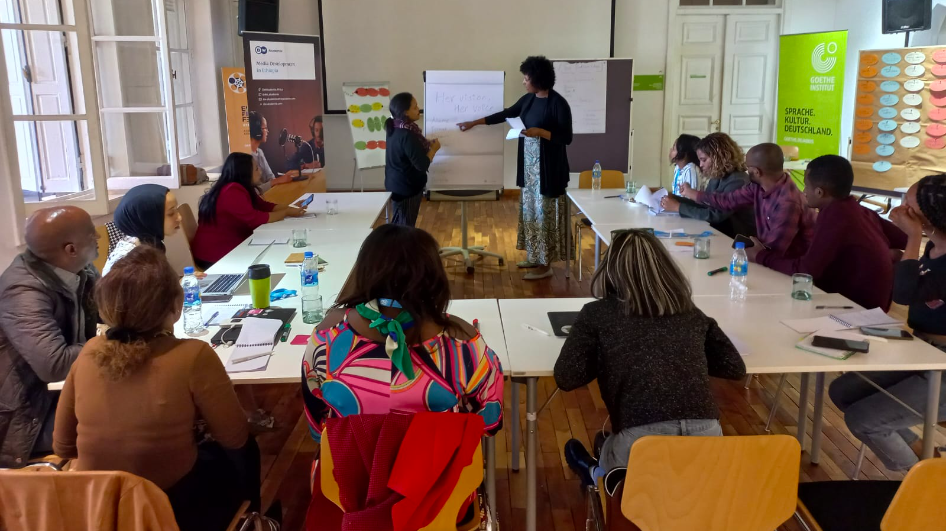
DW Akademie website on February 15 2024. Image credit: DW Akademie Africa via Facebook
- Log in to post comments