










































Promoting Science in Schools: Research Institutes Play their Part
KEMRI-Wellcome Trust Programme (Davies, Mbete, Kinyanjui), Ministry of Education, Science and Technology, Kenya (Ole Keis)
This article discusses the potential role of research institutes to enrich school science, demystify health research in the communities in which they work, and encourage future generations of scientists and health workers. It focuses on the work of the Kenya Medical Research Institute (KEMRI)-Wellcome Trust programme (KEMRI-WTP) in Kilifi, Kenya.
Knowledge of science and research in Kilifi district is limited, in part due to poor access to educational and health resources, despite a large amount of interdisciplinary research being done there. As described here: "To address this, in September 2008 we piloted a schools engagement programme in collaboration with the District Education Office, head-teachers and science teachers of three secondary schools in Kilifi. The aim of the pilot was to determine, through experience, the best approaches for engagement between the research centre and schools, and secondly to see if the interventions would affect attitudes toward science education, KEMRI-WTP activities and health research in general, in the target schools. The interventions included:
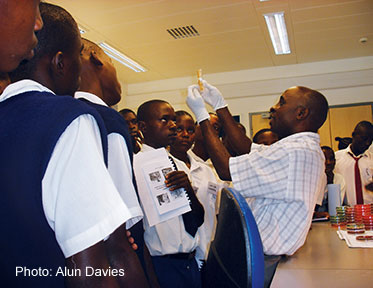
- Visits to KEMRI-WTP research facilities by students and teachers who engaged in interactive learning activities with scientists and health workers.
- A student’s competition, where students presented songs, dramas and presentations about health, research and science topics
- Scientist/health worker visits to schools to give short talks about careers and health.
- Provision of science teaching aids, including textbooks, subscription to 'Scientific American' magazine, a laptop computer and a projector.
- Making of a virtual tour of KEMRI-WTP centre film by students and KEMRI staff for use with broader audiences."
Researchers in the project allayed parent fears of their children being subjects of experiments by holding a series of meetings in which teachers helped to achieve community buy-in. Results include the following:
- "Following the intervention, both students and teachers expressed a better understanding of KEMRI-WTP activities and of health research in general. Some students described challenging the rumours and misconceptions concerning research they encountered in the community.
- The students’ attitudes towards science also improved. They felt that seeing science being applied in day-to-day lives made them understand it better and hence they enjoyed learning it more.
- The teachers reported that learning about potential careers in research, motivated the students to work harder in science, to respond to questions more confidently and to achieve better test grades. In two schools the students became more likely to pursue biology as a subject option. The value of young local scientists as role models for students, and in motivating the students to believe that despite difficult circumstances it is possible to succeed in pursuing science-related, careers was highlighted."
The authors conclude that: "The pilot indicates that it is possible to exploit the resources available at KEMRI-WTP to improve science education in schools in Kilifi district....Taking health research and scientific knowledge and practice into schools has clear motivational and educational benefits. It also helps raise awareness about health issues and promotes positive healthy behaviour, both directly and indirectly."
Health Exchange - Summer 2010, June 23 2010, emails from Samson Kinyanjui and Alun Davis to The Communication Initiative on July 29 2010.

- Log in to post comments