










































Promoting Handwashing and Sanitation: An Impact Evaluation of Two Large-Scale Campaigns in Rural Tanzania
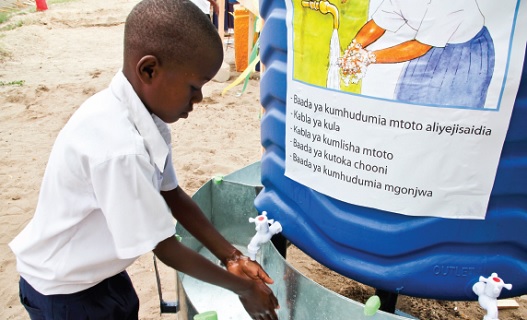
This 8-page research brief discusses the challenges of poor sanitation and hygiene in rural Tanzania, provides an overview of two large-scale campaigns that sought to address these problems, and shares key results of an evaluation to assess the impact of these two campaigns. The campaigns - the Handwashing with Soap programme and the Rural Sanitation programme - were designed to promote access to proper sanitation and encourage handwashing with soap by influencing people’s behaviour, changing marketplace dynamics, and strengthening the role of local government in service delivery. The two projects were led by the Government of Tanzania, with the support of the Scaling Up Rural Sanitation Program and Global Scaling Up Handwashing Project of the World Bank's Water and Sanitation Program.
The brief explains how the Handwashing with Soap (HWWS) programme engaged community members to work as "front-line activators" to educate caregivers with young children about proper handwashing. This community level action was complemented by radio commercials, a radio soap opera, printed materials such as posters, and roadshows. The second campaign, the Rural Sanitation programme, sought to create demand among households for upgrading latrines and stopping open defecation. As part of this, local masons were trained to build and market latrine sanplats to contain faeces, and the project worked with local supply chains to provide material. Some communities received one of the interventions, while others received both, and control communities received none.
The evaluation revealed the following key results, as outlined in the research brief:
- "More than half the households in sanitation program communities built a new latrine, 15 percentage points higher than non-program households.
- The number of households that usually resort to defecating in the open was cut in half.
- The handwashing campaign had limited and mixed results: more people washed their hands before preparing or eating food, but not after contact with feces.
- 16.8 percent of children under age five in control communities had diarrhea in the two weeks prior to the survey, while only 14.7 percent of children in combined handwashing and sanitation program communities had diarrhea.
- Surprisingly, slightly higher levels of anemia, often the result of fecal-borne illness, were detected in an additional 6 percent of children in program communities."
The brief discusses the findings above in greater detail, as well as lessons learned. One key lesson was that in some instances better knowledge did not always result in behaviour changes, and greater impact was observed in communities that received both programmes. "In communities that received both the sanitation and handwashing programs, there was a 12.5 percent reduction in diarrhea symptoms in children under age five." However, "neither the Rural Sanitation nor the HWWS program alone was able to reduce the prevalence of diarrhea among children. This suggests that a combination of sanitation and handwashing promotion activities was needed to inspire the behavioral changes that protect children's health."
Overall, the evaluation suggests that "a large-scale sanitation campaign can be effective in promoting latrine construction and reducing open defecation — important intermediate steps toward the end goal of positive health outcomes, especially for children." Large scale handwashing campaigns can increase people's knowledge but unfortunately not always without affect behaviour change. "Future programs could explore how to create handwashing behavior change and how to amplify the intermediate effects of sanitation campaigns." As well, "future programs could examine whether integrating, not just colocating, the handwashing and sanitation activities would create a larger impact."
Water and Sanitation Program website on July 16 2015.
- Log in to post comments