











































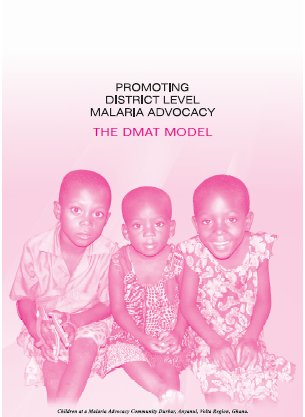
Promoting District Level Malaria Advocacy - The DMAT Model
Johns Hopkins University, Bloomberg School of Public Health, Centre for
Communication Programmes, (JHU/CCP) Ministry of Health, Ghana Health Service, (MOH/GHS) National Malaria Control Programme
This handbook has been developed to serve as a guide to government/political leaders, Members of Parliament, District Assembly Members, Malaria Programme Managers, District Health Management Teams (DHMT) and all engaged in local government leadership and development in their efforts to achieve malaria-free communities.
The District level Malaria Advocacy process, referred to as the District Level Malaria Advocacy Team (DMAT) Model, is a leadership mobilisation tool for enhancing the commitment, participation, and support of all leaders in a district or municipality in the fight against malaria. The DMAT Model aims at achieving increased involvement of all stakeholders, increased community participation and improved mobilisation and judicious use of donor and locally generated resources for successful application of approved malaria interventions.
The goals of a DMAT are to promote effective programming for malaria control, advocate for increased resources for malaria control activities and mobilise support from all types and levels of leadership in the district. These goals provide the focus for the advocacy actions developed and undertaken by the malaria advocacy team.
Important communication related strategies are key to meeting these goals. These include a Nine Steps process including a participatory process for selecting members of the District Malaria Advocacy Team based on encouraging participation of leaders from different sectors, public and private, in carrying out advocacy for malaria control. This makes it possible for malaria to truly become a development issue instead of remaining a problem to be resolved by the health sector alone.
The following outline the steps taken in applying the DMAT model:
- General Leadership Consultation – consultative meetings with key leaders to discuss the need to strengthen advocacy for malaria control and involving leaders from all sectors;
- Start-up Forum – a meeting of selected leaders from public, private, and traditional institutions to update them on malaria control efforts and motivate them to develop interest in supporting malaria programming.
- DMAT Formation – the core group responsible for the promotion of malaria advocacy activities, made up of selected leaders who are prepared and committed to influencing decisions affecting malaria programming and control in the district.
- Advocacy Skills Training – three tools (Ghana Malaria Advocacy Handbook, Nine Steps District Malaria Advocacy Model, and One Percent District Assemblies Common Fund Guide) are tools used to train team members.
- Malaria Advocacy Needs Assessment – to gain accurate information for fact-based advocacy.
- Action Plan Development – developed by the DMAT using information from the assessment, the action plan details specific activities, responsible parties and a budget and is divided into five sections: 1) malaria-free families, 2) malaria-free schools, 3) malaria-free health facilities, 4) malaria-free workplaces, and 5) malaria-free district.
- Special District Assembly Meeting – a mandatory meeting of all leaders to present assessment findings and the action plan for approval.
- Advocacy Programmes Implementation
- Monitoring and Evaluation
In conclusion, improving partnerships for effective programming is possible, based on five years of implementing the DMAT model in 19 districts in Ghana, three in Tanzania and two in Uganda. The model helps to mobilise partners for the effective promotion of malaria advocacy. It is important, however, to maintain an active and respectful learning and working relationship among partners to avoid conflicts and turf wars. Coordination and active participation of all team members is essential. Experience in implementing the DMAT Model has demonstrated the following benefits: transparency and accountability in managing resources meant for malaria programming, effective supply chain management, resolution of bottlenecks in distribution of commodities such as treated mosquito nets and malaria medicines and finally, maintenance of malaria as a development issue.
The document concludes with several appendixes including: case studies, the district malaria advocacy needs assessment questionnaire, and references.
C-Hub website on on January 10 2012.
- Log in to post comments