










































Preparing the Next Generation of Community Health Workers: The Power of Technology for Training
Dalberg Global Development Advisors
"...while mHealth applications proliferate, technology has not been greatly deployed in the training of community health workers, whose work is essential to reaching Millennium Development Goals (MDGs) 4, 5, and 6 as well as to reducing the associated burdens of child and maternal mortality and HIV/AIDS."
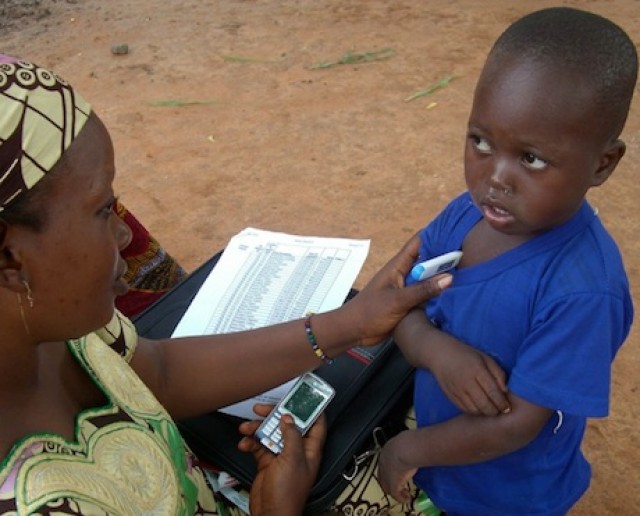
Can mobile technologies, such as handheld devices that assist with data collection and medical assessments, be leveraged to efficiently scale training for community health workers (CHWs), improving the quality and reach of care? To explore this question, the Dalberg Global Development Advisors interviewed experts from more than 30 organisations, including leaders in the field of mobile health (mHealth), experts in technology and media, ministries of health, and training implementers who, collectively, have trained more than 378,000 CHWs across Sub-Saharan Africa. As noted here, CHWs deliver low-cost, life-saving interventions in areas such as child and maternal health, vaccinations, and basic health education. Overcoming persistent health challenges will require scaling the number of CHWs and improving the effectiveness of existing CHWs. In addition to the interviews, the report draws from a literature review of CHW training programmes, mostly in Sub-Saharan Africa, with a focus on the use of mobile and multimedia applications. The report was commissioned by the iheed Institute, the Barr Foundation, the mHealth Alliance, and the MDG Health Alliance.
This study identifies opportunities to train CHWs more cost effectively through technology-enabled multimedia content that leverages visuals, videos, or audio. It also highlights the potential to create open, easily sharable digital content that could act as a crucial ingredient for new approaches to training and learning in the future. The report walks through existing approaches to CHW training and content development, current uses of mobile technology, and emerging evidence on effective approaches to training, highlighting advantages of digital and multimedia content for scale.
Although both CHWs and the organisations that train them are "hungry" for technological applications, including new media and methods such as video and animation, 90% of organisations studied in this report continue to use paper-based training content, cumulatively training 341,800 CHWs with materials such as flipcharts, handouts, and textbooks. With mobile phone access as high as 80% among CHWs in some countries, it is noted here that mobile technology could do much more for training and informal learning.
In contrast to the 90% in this study who are still using printed materials, only 7% of the CHWs trained by surveyed organisations, or 27,000 CHWs, were trained using multimedia content as part of a "blended" approach. [The remaining 3%, or 10,000 CHWs, were trained with electronic content.] Blended approaches combine live training with multimedia applications to training. These approaches complement and facilitate paedagogies that foster interaction, repetitive learning, and supervision and monitoring. According to the report, these blended approaches can be more appropriate and adaptable to rural settings because they allow for onsite learning while CHWs are in the field and can be useful for engaging CHWs who have received limited if any education and have limited levels of literacy. Multimedia can also enable faster and better training, according to studies cited in this report.
In addition to their effectiveness and appropriateness, according to the report, the use of blended approaches to training would require less time and personnel than conventional approaches, and are more cost-efficient to scale: the projected cost of content and instruction necessary to meet the demand of one million trained CHWs in sub-Saharan Africa would be approximately 75% less using a blended approach than the cost to scale using traditional methods. The report also found that an estimated 80% of training content is transferable between countries, suggesting that customising training content to local contexts - including adjustments for language, culture, and literacy - may not be as big a barrier as perceived.
The blended training model is not without challenges. For instance, not much digital training content exists in readily sharable, open-source form. Thus, sharing content will require adjusting donors' incentives in grant proposals, decoupling existing content from the underlying technology, as well as promoting platforms that aggregate and ease the sharing of open, digital content. Also, there is limited experimentation with training approaches that incorporate multimedia and technology for CHWs, specifically, and limited comprehensive and comparative effectiveness evaluation of such training approaches to inform ongoing learning and improvement.
According to the report, "capturing the opportunities unleashed by technology will require a variety of stakeholders to consider and invest in the following:
- Digital content development that focuses on addressing the needs of CHWs and the gaps in their performance in fresh, engaging ways. Such content might include, for instance, videos that demonstrate clinical procedures or educate patients on sensitive topics. One way to generate this content is to crowd source through competitions that engage digital designers.
- Greater collaboration in content creation and training implementation, supported by funders who commission open, sharable content, and incentives which promote sharing and collaboration on content development and use, rather than focusing on content generation alone...
- Experimentation with blended approaches and recommended pedagogies that leverage digital content for instruction, and mobile technology for continuous learning, building on what has been shown to be effective with other cadres of health workers.
- More, and more comprehensive, evaluation of blended approaches used with CHWs to inform training strategies going forward...
- Innovation that supports continuous learning and uses the widening sweep of mobile technology and increasing volume of digital content to create new models that support informal CHW learning...
- Continued advocacy and support for the overall enabling environment to improve the effectiveness of community health workers, recognizing that training is one component of the complex ecosystem in which CHWs operate."
D. Blog post, "Using Mobile Technology to Train Community Health Workers", by Lucy Mele, June 15 2012 - accessed on August 3 2012. Image credit: Alex Harsha, Medic Mobile
- Log in to post comments