










































People-Powered Media Innovation in West Africa: Accelerating Development and Good Governance in the New Media Landscape
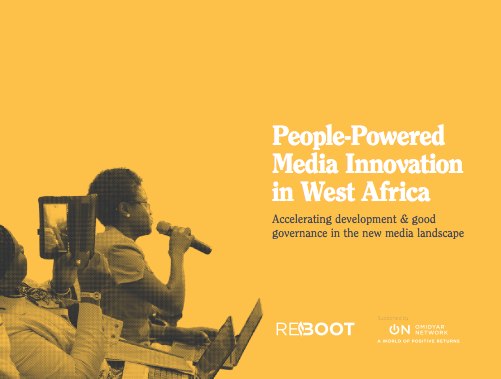
“Innovations in new and social media have opened up new possibilities for how we understand and contribute to the world around us. Embracing these channels, citizens in West Africa have won historic victories, both in major elections and in smaller stories of corruption scandals uncovered and political accountability increased.”
Media ecosystems in West Africa have diversified and opened up after decades of state control - much of this due to the impact of social media, which provides more opportunities for citizen involvement. This has great potential for advancing government transparency and accountability, and generally in reshaping the dynamics between citizens, media, and government. This, in turn, is opening up new opportunities for funders, with potential for both social and economic impact. To explore these opportunities, the Omidyar Network partnered with Reboot, a social impact firm dedicated to inclusive development and accountable governance, to undertake a research project identifying the constraints and opportunities that drive media innovation in West Africa today. This report shares the findings of this research, providing insights into the local media landscape in the region - particularly in Nigeria and Ghana, which were chosen as focal countries for their vibrant media ecosystems - and highlighting specific opportunities and actions for funders to explore.
Over four months, from July to October 2015, the Reboot team conducted in-depth interviews in Nigeria and Ghana with 58 respondents, including those representing media, government, civil society organisations, and citizens across focal countries.
In exploring the media landscape, research findings show that, traditionally, the region's trust in the media is low. “Citizens view most media as political instruments, frequently biased and easily corruptible. Many media organizations, for their part, compromise editorial independence to survive, and resort to lowest-common-denominator content to drive traffic. This mistrust has led to a wholehearted embrace of new and social media tools. Citizens are seeking alternative views, contributing their perspectives, and redefining popular media narratives on platforms which are not beholden to elites.”
Their participation has led to a dramatic reshaping of the dynamics between citizens, media, and government, which the report explains as a cyclical process involving the following processes:
- Citizen voices on social media are reshaping media - As social media places competitive pressure on the media, the media is more likely to deliver critical examinations of official narratives.
- Media is influencing politics and government - Spurred by audience demand and contributions, media is increasingly uncovering corruption and holding leaders accountable to their promises.
- Government response is driving more citizen engagement - Citizens continue to contribute to the media dialogue as they see governments being held accountable by the media.
The report cites the historic 2015 Nigerian general election as an example of this “virtuous cycle”. Citizens photographed polling results, compared them to the official government results, and discussed them on social media. Their evidence spread across new and traditional media, giving their contributions an audience and influence, which in turn incentivised more citizen participation.
However, as stated in the report, “despite citizens’ critical role in reshaping media and improving governance, few organizations are leveraging them for both social impact and financial sustainability. Beyond the low-hanging fruit of elections and major corruption scandals, citizen energy remains largely untapped.”
The report’s findings reveal two key opportunity areas for funders: activating audiences and providing sustainable funding. The two areas of opportunity are explained in detail in the report, together with case studies that represent examples of what can be done, as well as concrete project ideas.
1. Activated audiences as the key leverage point - Media’s impact on both governance and financial stability hinges on audience engagement. As people seldom leap straight from reading the news to taking political action, the report proposes a model to increase engagement at three levels: acquisition, activation, and action. Acquisition refers to creating niche news markets for audiences in order to win audiences (examples cited include Newsdeeply, which develops deep, single subject information hubs); activation refers to targeting editorial content better towards audiences in order to get audiences talking; and action is about pegging content to political opportunities. For each of these, the report offers opportunities and recommendations for funders. For example, for Action, the report suggests that funders help encourage collaboration between media and civil society to support in-depth reporting on timely political events. As a project idea, the report proposes a way to incorporate armies of fact-checkers to ensure high-quality content to engage readers.
2. Sequenced, creative investments for sustainable media development - Independent finance is a prerequisite for independent editorial. To encourage the development of sustainable business models, the report proposes that funders look at opportunities to provide new financial pathways for media to grow and experiment, which are at three levels:
- Individual level: Support journalists - Recognising that some of the most productive independent media voices are individuals who share critical information through social media, the report recommends providing funding, journalism training, and business guidance to these individuals. A project idea offered here is a freelance platform for journalists.
- Organisational level: Improve investment approaches - As donor funding is usually tied to reporting on specific sectors or issues, there is a greater need for core operating funds that allow media organisations to set their own agenda and editorial strategy. The report recommends designing responsive funding mechanisms that provide greater agency.
- Field level: Innovate financing - In order to deal with the tension between editorial independence and operational sustainability, the report recommends that philanthropic and private sector funders look into more flexible and innovative solutions. The report recommends that more creative financing, such as supporting media loan funds, can “incubate” organisations through long-term, supportive relationships. It also offers examples of media organisations that have tried to diversify their revenue streams to win or maintain greater editorial independence. These include leveraging an umbrella structure that is not just media focused, and organising sponsored media events.
The report ends by making the point that in the current digital age, “the most successful and impactful media entities will be not just delivery channels to the people, but platforms for the people. There are exciting opportunities for funders to support media organizations in making this shift, and to increase their agency and power by winning and engaging audiences.”
This report emerged out of Reboot's Amplifying Accountability programme and Omidyar Network's Governance and Citizen Engagement initiative.
Click here to access this report online.
The following blogs also provide more information about the report:
Innovation in the Face of Corruption: The Critical Role of Independent Media in West Africa (Reboot)
Keeping the “Interest” in Public Interest Journalism (Reboot)
Omidyar Network on the Value of Investing in Media (Omidyar)
Editorial Decisions, Economic Decisions: The Funders’ Role in West African Media (World Bank)
Omidyar Network website on September 23 2016.
- Log in to post comments