











































Partnering with Women's Associations to Advocate for Stronger Infant and Young Child Feeding Policies and Programs: Lessons Learned From Alive & Thrive
"In many countries throughout the developing world, women’s associations can be influential advocacy and education organizations that represent the voices of mothers to government and legislative bodies, while also providing a key communications channel to reach mothers in local communities….When the capacity of women and mothers is leveraged through credible organizations that represent them, it can be a powerful tool to drive dialogue, awareness, and action on key policy issues that affect IYCF practices at the community level."
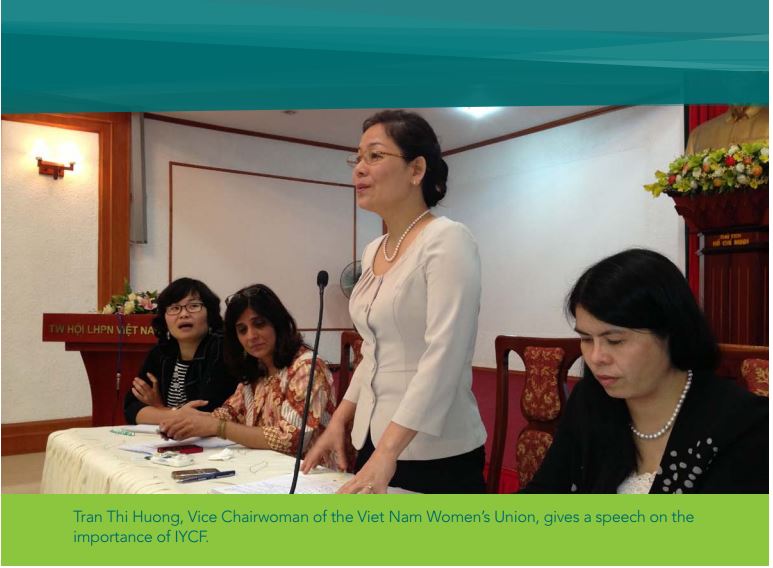
From Alive & Thrive's 2010-2014 work in Bangladesh, Ethiopia, and Viet Nam to reduce undernutrition and death caused by sub-optimal infant and young child feeding (IYCF) practices, this document describes working with women’s associations, both formal or informal, which can range from independent civil society organisations to para-statal organisations. The Viet Nam Women's Union (WU), for example, has nearly 15 million members with networks at central, provincial, district, and commune levels. In Ethiopia, Women's Associations are regional NGOs collectively involving between 700,000 and 1.5 million women. This description of IYCF's relationships with the organisations is part of a series of documents on best practices and lessons learned in policy advocacy in the three country contexts. (See related summaries below.)
The following were the broad goals that IYCF sought in partnering with women's associations:
- "Publicly affirm the associations’ commitments to child nutrition, and related laws and policies that support optimal IYCF - like paid maternity leave, and tighter restrictions on the promotion of breastmilk substitutes.
- Elevate the voice of the women’s associations, and key spokespeople in support of IYCF and related policies with both the media, and with policy-makers.
- Leverage the associations' vast networks of women and advocates to support adoption and implementation of IYCF policies."
The initiative found that:
- "Partnerships should be established with realistic and adaptable goals", beginning with activities with attainable goals and building to those requiring more robust management and commitment.
- "Women's associations can have critical relationships and representation in government bodies", for example, involving the Viet Nam Women’s Union is a compulsory step in the legislation development process.
- "Effective engagement requires continuous support and follow-up"...regular and day-to-day collaboration, starting with a memo of understanding (MOU), through trainings and strategy implementation and developing funding and reporting processes, means that capacity building and communications must be continuous.
- "Women's associations should be considered for their influence respective to other major national associations", the hierarchy of influence varying by country.
- "The comparative advantages of sub-national chapters should be leveraged"...some have the capacity to influence the community, and others can advocate effectively within the political system.
- "Effective training and capacity-building for association members is needed at both the national and provincial level.... Rather than organizing a training at a fixed time and location, one recommendation is to develop additional tools and materials (such as a training video, or more informal trainings in different regions) that can be quickly shared throughout the national WU network."
- "Developing advocacy partnerships with mass organizations like women’s associations can also support community-level and behavior change interventions", as, for example, a "Breastfeeding Club" at commune levels in Ethiopia where WU community staff meet with local women every month. This improved demand for IYCF services. “In addition, Ethiopia has a Women’s Development Army that aims to reach every woman throughout the country...[and] supports efforts to reach every household with IYCF promotional messages and materials."
The document concludes that women's associations can be key to IYCF advocacy efforts at national and sub-national levels.
Alive and Thrive website, May 24 2017. Image caption: Tran Thi Huong, Vice Chairwoman of the Viet Nam Women’s Union, gives a speech on the importance of IYCF.
- Log in to post comments