










































Missing the Mark? People in Eastern DRC Need Information on Ebola in a Language They Understand
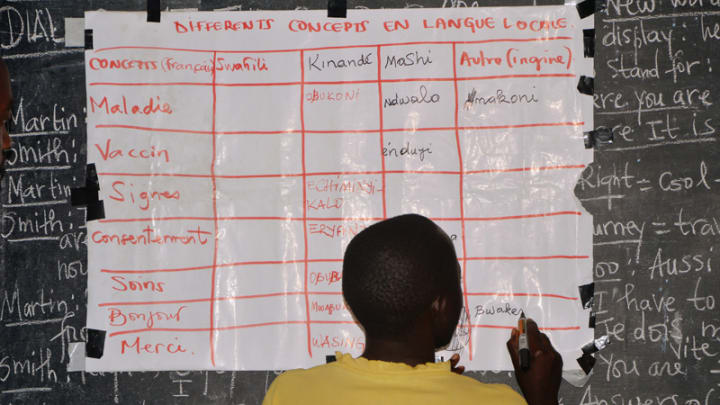
Translators without Borders (TWB)
"The local form of Swahili is the most effective language for risk communication and community engagement for the Ebola response in Goma."
Insights on the language people use and in what format they most effectively receive information are crucial for the Ebola response. This is a central conclusion of a report from Translators without Borders (TWB) that assesses whether the information provided by aid organisations on Ebola prevention is understood. In acknowledgement of the centrality of community engagement to resolving the epidemic, the assessment was made in support of the ministry of health's campaign to ensure the effectiveness of Ebola prevention and preparedness in Goma, North Kivu Province, Democratic Republic of the Congo (DRC).
Reportedly, looking at the importance of language for effective risk communication is still quite new in the humanitarian sector. During the Ebola outbreak in West Africa, the language used was mostly in English and French across Liberia, Sierra Leone, and Guinea. But only 13% of women in Sierra Leone spoke English, and literacy rates were below 50% across the region. In addition, there were over 90 languages spoken across the 3 countries.
Between February 14 and 20 2019, TWB surveyed 216 individuals and conducted 6 focus groups with 75 adults in Goma. The researchers took a quota approach to sampling, to ensure even representation between women and men across the 4 main ethnic groups present. They gave respondents simple spoken, written, and pictorial materials and asked them to explain the key messages of each. They scored respondents "correct" when they identified the key message of each piece of content.
Most written communication materials used in the Ebola response are in Congolese Swahili or French. Common written communication channels include posters, brochures, and consent forms for the Ebola vaccine. While the only official health promotion materials endorsed by the Beni-based coordination group are in Congolese Swahili, French materials were also seen in Goma. Vaccine consent forms are available in both Swahili and French.
The researchers tested 2 posters in the focus groups. One was a French-language poster that described Ebola symptoms and gave instructions for seeking help. The other relayed a range of Ebola messages in Congolese Swahili, including points on prevention, symptoms, treatment, and burials. Participants who could read French and Congolese Swahili generally understood the key messages from these posters, if with some difficulty. The presence of technical or unfamiliar words in both French and Swahili added complexity and contributed to some confusion of key messages. For example, words some people did not understand were "sanglant" (bloody) and "gencives" (gums), which, in the poster, were referring to bloody diarrhoea, vomiting blood, and bleeding nose and gums. When asked how they refer to gums, participants used the Congolese Swahili phrase "nyama za mumeno", which means "meat of the teeth", or "bihanga".
Researchers also tested comprehension of the first page of the vaccine informed-consent form for adults in Swahili and French in the focus groups. TWB assessed the Swahili form as being written in a mix of high-register Congolese Swahili and standard Swahili; it also contained words in French and English. All participants had difficulty understanding these forms, especially where they contained technical or unfamiliar words in standard Swahili, French, or English. Some respondents - in particular, women over 35 years old - don't know the word for "vaccine" in Congolese Swahili, "chanjo". They only know "ndui", a term commonly used for prenatal vaccines. "Someone needs to change these messages [in the vaccine form] into [local] Swahili so that everyone can understand and not be confused by standard Swahili." - Woman, 35-45 years of age.
The report found disparities in language between demographics, reiterating the importance of targeted communication. (See the full report for details on which groups prefer which specific languages.) In the individual surveys, for example, 21% of respondents prefer information spoken in French. However, only 48% of women understand spoken French-language messages related to Ebola. Many of them prefer Congolese Swahili. Comprehension testing revealed that a higher proportion of women understood spoken Ebola messages in the language associated with their ethnic group (Hutu, Nande, or Shi) than in spoken French. Only 48% of youth participants ages 18-34 can understand spoken French. Reading comprehension in French was even lower, with just 32% of people aged 18-34 understanding written Ebola messages in that language.
Some participants also did not fully grasp the meaning of some of the illustrations in the information poster. For example, one or two people in each focus group misinterpreted an illustration that was meaning to direct people to visit the nearest health centre if they experienced one of the symptoms of Ebola. One participant's reading was: "The doctor in this picture is telling the sick person that he is not welcome here....This means that when someone is sick, they have nowhere to go and are just waiting for death." Some participants encouraged the use of photos instead of drawings. Another poster using Congolese Swahili and endorsed by the ministry of health and several aid agencies was widely understood by focus group participants.
TWB also asked respondents to rank up to 3 communication channels in order of preference. The response options included word-of-mouth, megaphone, community theatre or mobile cinema, phone call, brochure or leaflet, poster or banner, health centres, radio, television, and SMS. Respondents prefer to receive spoken information. The single most preferred channel is radio, followed by word-of-mouth, then television. The preference for spoken information highlights the importance of community health workers in Goma being able to communicate in local Swahili. While spoken communication is preferred, other channels can still be effective. For example, discussions with key informants suggest that community theatre and mobile cinema are an entertaining format for bringing information to communities. Screening films in places where women tend to congregate, such as health clinics, could be effective.
Ninety-eight percent of respondents said that doctors and medical staff are the most trusted sources of information on Ebola. No other group of people comes close, although government officials and representatives of the Ministry of Health receive relatively high marks: 84% of respondents trust these institutions.
Seven recommendations for more effective Ebola communication offered in the report include:
- Use local Swahili as the spoken and written language of risk communication on Ebola in Goma.
- Test comprehension and communication preferences in other areas affected by or at risk of Ebola (Education levels in Goma are relatively high and language diversity low compared to other affected areas.)
- Develop information materials in plain language, ensuring content is field-tested, appropriate, and addresses key community concerns.
- Use terms consistently.
- Localise Swahili at the micro level.
- Make audio formats central to communication strategies.
- Use audiovisual formats to further aid comprehension, developing and pretesting it with local residents to confirm that they understand the intended messages.
The report concludes by highlighting the need for more research to improve Ebola communication in DRC. Within eastern DRC, Congolese Swahili is spoken differently from city to city, territory to territory, and between urban and rural areas. Further research into dialectical differences and the use of loan words from various local languages could support plain language efforts to simplify and hyperlocalise Ebola messages.
A one-page summary of key findings is also available here.
"'Chanjo'? Ebola warnings puzzle communities in Goma", by Jenny Lei Ravelo, Devex, March 27 2019; and emails from Krissy Welle to The Communication Initiative on April 8 2019 and April 10 2019. Image credit: Translators without Borders
- Log in to post comments