










































Media Futures East Africa Project
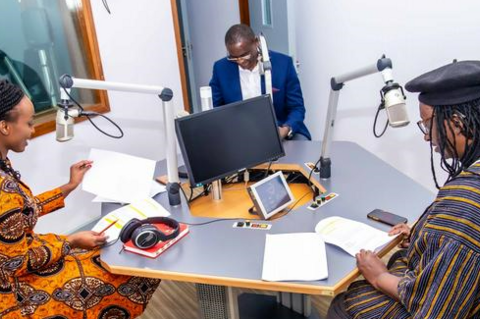
The Media Futures East Africa Project is an intervention seeking to support media outlets in Kenya, Uganda, and Tanzania in strengthening quality journalism and fostering media innovations that ensure sustainability. Work entails training, mentoring, and workshops made possible through online platforms, events, information sharing, and the development of in-house viability consultants. The project is being implemented by the Aga Khan University Graduate School of Media and Communications (GSMC) in Nairobi, Kenya, in partnership with Deutsche Welle Akademie.
The project defines media viability as "the ability of any media organisation to survive, adapt, develop and thrive by producing high-quality journalism in a fast-changing world. Whether it is print media evolving into online publications or radio stations live streaming their content on social media, the aim is to embrace the future with openness, innovation and professionalism. To achieve this, potential and existing media practitioners need to take a holistic approach which encompasses not just the business model but also takes into consideration the political situation, content creation, technology, economics and the wider community. The key to Media Viability is finding a stable balance amongst these aspects thus creating room for growth and success."
In order to build media viability that incorporates all of the above considerations, the project engages in a number of activities:
Innovator-in-Residence programme of the Media Innovation Centre (MiC): This 12-month incubation and acceleration programme, which is held at the Aga Khan University's Media Innovation Centre (MiC), provides mentoring, training, and coaching to selected media innovators from the region. The innovators-in-residence also have access to a startup grant and monthly stipends to help them steer through the programme.
Specifically, coaches guide them through the early stages of their startup and assist them in working on prototypes and, finally, a minimum viable product. The innovators participate in various trainings in journalism and storytelling, business planning, taxation, and entrepreneurship. Following the 12 months, they take part in a Demo Day where they present their final product before a panel of potential investors and mentors.
The East Africa Storytelling (EAST) website: An initiative of the MiC, DW Akademie, the Media Challenge Initiative, and Tanzania Media Foundation, the EAST site is designed to be a virtual meet-up space for media innovators and storytellers in East Africa to accelerate the development of a new generation of media practitioners and innovators. The virtual platform also seeks to bring together and showcase the latest content and learning resources on innovation for media viability in the region. EAST offers a broad range of online-sessions and audio and visual content, and it works with East African partners and experts to explore new journalistic approaches. Topics have included human-centred design in media innovation, among others. The EAST Library has been set up to archive and present all the results of the project alongside other research from the region concerning media viability, technology, innovation, quality journalism, and economic, legal, and political factors.
EAST also organised the EAST Festival in 2021, a regional partner-centred conference that provided an opportunity for media innovators in the sub-region to meet, exchange ideas, and explore new ways of storytelling in a face-to-face setting. Click here to find out more.
Media Viability Consultants and training: The project works with a pool of Media Viability Consultants (MVCs) who receive training in various aspects of media viability (political and economic landscapes, content production, community engagement, business models, and governance), as well as related knowledge, skills, and tools. Consultants then go out to small and medium-sized media outlets across East Africa, including those selected for the innovators-in-residence programme, and support them in identifying their own path towards sustainability.
In addition, the project, through the support of its partners, provides direct training to media houses in fields such as gender-sensitive reporting, fact-checking, and social media optimisation.
Media Development
Even prior to the coronavirus pandemic, many media organisations across the African continent were struggling to provide unbiased, accurate, and up-to-date news while at the same time remaining profitable. The rapid changes brought on by digitisation have added to these challenges, forcing media houses to either reduce output or go out of business.
Aga Khan University Graduate School of Media and Communications (GSMC), Deutsche Welle Akademie, Media Challenge Initiative, Tanzania Media Foundation, Media Focus on Africa, and Media Council of Kenya. Funded by the German Development Bank KfW.
Media Innovation Network website and Deutsche Welle Akademie website on January 14 2022. Image credit: Benson Githaiga, GSMC Media Innovation Centre
- Log in to post comments