










































Mama Ushauri (Mama Advice)
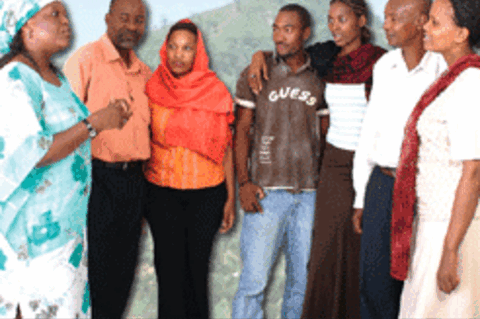
In March 2008, T-MARC launched the 4th season of the Mama Ushauri radio serial drama. The reproductive health behavior change communication initiative was expanded from 10-minute radio serial drama into a 15 minute radio serial drama. The serial drama airs 8 times weekly on 4 radio stations: Radio Tanzania, Radio Free Africa, Radio One, and Zenji FM. After every 3 episodes, T-MARC sponsors a 10-minute "question and answer" show to allow listeners to ask questions about family planning and to reinforce key messages.
In 2008, T-MARC expanded the focus of the Mama Ushauri radio serial drama to include other issues of importance to women of reproductive age. While continuing to promote reproductive health and the use of modern contraceptive methods, the new storylines address the use of zinc therapy for the treatment of childhood diarrhoea and low-osmolarity Oral Rehydration Solution (ORS) to decrease chances of dehydration, twice-yearly Vitamin A supplementation and de-worming pills for children under 5, prevention of mother-to-child transmission of HIV, and preventive treatment of malaria in pregnant women.
Each storyline focuses on families that face challenges related to their reproductive health as well as child health issues: a young couple contemplating their first pregnancy; a middle-aged couple losing their child due to severe dehydration as a result of diarrhoea; an HIV discordant couple expecting their first child and hoping that the child is born HIV-free; and a councilor who is challenged by one of his wives to provide more funds for purchasing Zinc and Lo-ORS and providing long lasting insecticide treated nets (LLITNs). Mama Ushauri, the central character, is not a health expert" but is wise and bold and uses her life experiences to promote modern family planning methods, the use of Zinc and Lo-ORS for treating childhood diarrhoea, LLITNs, malaria prevention for pregnant women, vitamin A supplementation, and the prevention of mother to child transmission. She also encourages women and their partners to discuss reproductive and child health issues at home and encourages visits to their family planning health providers for more information and services, whilst encouraging regular visits to ante-natal clinics for expectant mothers.
HIV/AIDS, Reproductive Health, Maternal Health and Child Health
According to organisers, while the number of children dying from preventable causes has slowly been dropping, Tanzania's modern contraceptive prevalence remains low at 22%, and the number of maternal deaths has increased over the last 10 years from 529 to 578 for every 100,000 births. A large number of these deaths would be preventable if women visited health clinics during their pregnancy, if skilled providers attended their delivery, and if simple, inexpensive medicines and medical devices were available.
T-MARC is a five-year United States Agency for International Development (USAID) Private Sector Project (PSP) managed by the Academy for Educational Development (AED)'s Center for Private Sector Health Initiatives.
Tanzania Marketing and Communication (T-MARC) Project; Tanzanian Ministry of Health and Social Welfares departments including the Reproductive and Child Health Section (RCHS); National Aids Control Program (NACP); National Malaria Control Program (NMCP); Jhpiego; Hellen Keller International (HKI); Elizabeth Glazier Pediatric Aids Foundation (EGPAF); Engenderhealth; Family Planning Association of Tanzania (UMATI); Academy for Education Development/POUZN project
Center for Private Sector Health Initiatives website and Tanzanian Embassy website on December 1 2008 and email received from Nelson Karanja on May 25 2009.

- Log in to post comments