











































Male Involvement Interventions and Improved Couples' Emotional Relationships in Tanzania and Zimbabwe: 'When We Are Walking Together, I Feel Happy'
Burnet Institute (Comrie-Thomson, Davis, Luchters); Monash University (Comrie-Thomson, Luchters); Ghent University (Comrie-Thomson, Luchters); Centre for Sexual Health & HIV/AIDS Research (Mavhu); Liverpool School of Tropical Medicine (Mavhu); Ifakara Health Institute (Makungu); International Centre for Diarrhoeal Disease Research, Bangladesh (Nahar, Khan); Plan International Canada (Stillo, Hamdani); Aga Khan University (Luchters); University of Melbourne (Vaughan)
"Male involvement in maternal and child health is recognised as a valuable strategy to improve care-seeking and uptake of optimal home care practices for women and children in low- and middle-income settings. However, the specific mechanisms by which involving men can lead to observed behaviour change are not well substantiated."
This article uses qualitative data from Zimbabwe and Tanzania to explore the role of love within couple relationships as an important aspect of how and why male involvement interventions can be effective - a feature of these interventions that is largely invisible in current research and programming. The premise is that examining emotional experiences could support a more complete understanding of how couple relationship dynamics influence outcomes for women and men and, thus, inform communication strategies to promote male involvement in maternal and child health, especially in underserved locations in resource-constrained countries.
Data were collected as part of a wider 3-country study that also included Bangladesh. Interventions promoting male involvement had been implemented in study sites for at least 3 years at the time of data collection and were nearing completion. The interventions were implemented between 2011 and 2015 by Plan International offices in Tanzania and Zimbabwe with support from Plan International Canada. Specifically, Women and their Children's Health (WATCH) was implemented in 180 rural and remote villages across 3 districts in Zimbabwe, and Wazazi na Mwana was implemented in 511 rural, remote. and peri-urban villages across 5 districts in Tanzania.
The purpose of these interventions was to increase men's overall support for maternal and child health, including financial, emotional and physical support, and to promote equitable couple communication and joint decision-making, while at the same time engaging men as change agents in addressing gender inequality and gendered determinants of poor health outcomes.
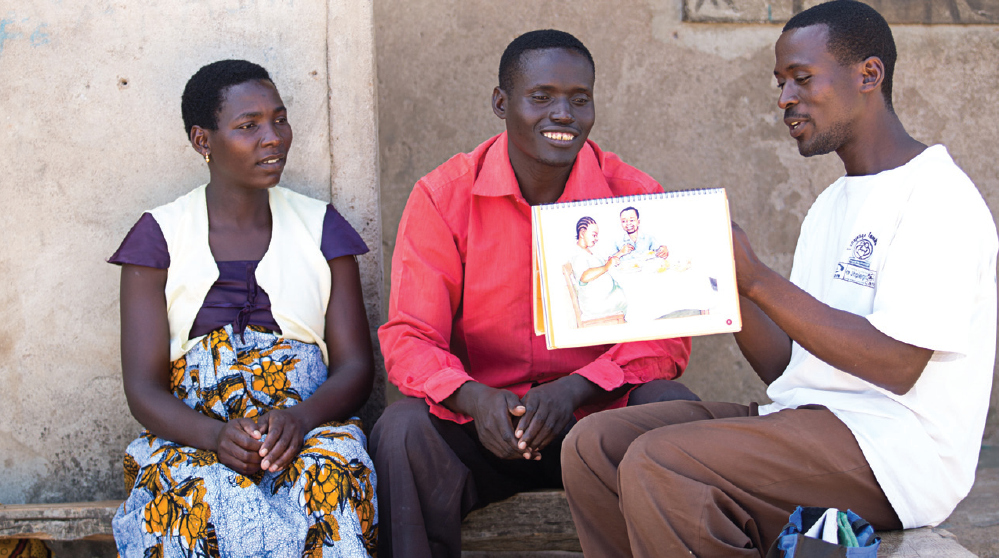
Components common to both interventions included community-based men's discussion groups designed to foster reflection on negative masculinities, peer outreach by male role models, couple counselling, and education led by traditional and religious leaders. While couple relationship dynamics were not the main focus of the interventions, intervention messages promoted mutually respectful, equitable couple relationships.
Data were collected in October and November 2014 in Zimbabwe, and December 2014 in Tanzania. Maximum diversity sampling was used to purposively select 2 project villages per country. In each site, focus group discussions (FDGs) and in-depth interviews (IDIs) were conducted separately with adult women, adult men, adolescent girls, and adolescent boys, totalling 4 FGDs and 4 IDIs in each of the 4 study sites. FGD guides comprised 8-10 broad questions exploring community norms and normative behaviour, and how the interventions had influenced these, while IDIs were used to provide participants with an opportunity to describe their reasons for participating in male involvement interventions, their experience of the interventions, and how participation had affected their households.
Selected findings:
- Participants (90 women and 81 men) in both countries reported highly differentiated gender roles, underpinned by unequal gender norms and relations that allocate domestic work, pregnancy-related tasks, and childcare exclusively to women. Men providing practical support and their female partners were frequently stigmatised by family and community members, while women were accused of disrespecting their male partners and not fulfilling their normative role.
- Many women and men in both countries reported that men's practical support for maternal and child health had increased in their communities following the interventions, although change was not consistent across all households.
- Adolescent and adult women and men across all study sites reported their relationships had become happier, more loving, more peaceful, and more mutually supportive following increased male partner practical support. Multiple women described how practical support had increased their personal comfort and dignity - for example, by enabling rest and self-care and increasing their capacity to make minor decisions about daily life.
- Women, and some men, recognised that men's increased understanding of maternal and child health made it easier to complete tasks such as testing male partners for HIV during pregnancy, which is recommended in both countries, as well as preparing for childbirth, arranging emergency transport, and discussing family planning.
- Some women and men also reported that emotional intimacy had supported them and their partner to overcome the stigma associated with men's practical support.
- Women and men valued improvements in their couple relationships that followed men's increased practical support for maternal and child health, and some men explained that these relationship changes motivated them to keep providing practical support. These findings suggest a positive feedback loop.
Reflecting on the findings, the researchers suggest that, in settings "where hardship and vulnerability are exacerbated for women by unequal gender roles, male partners' practical support can have profoundly positive impacts on couple relationships. Happy, peaceful and mutually supportive couple relationships are valued by women and men and are therefore a wellbeing outcome in their own right." Furthermore, because the data indicate that improvements in couple relationships may contribute to increases in men's practical support, "love and emotional intimacy in couple relationships emerge as important to understanding how interventions can effectively promote men's behaviour change for improved health outcomes".
The report elucidates several broader conceptual implications of an increased focus on love and couple relationships in male involvement interactions, leading to this conclusion: "Extending the established approach to male involvement interventions to include an enhanced focus on love and emotional intimacy can be expected to strengthen the explanatory power of research and the effectiveness of policy and programming, as well as advancing conceptual approaches to male involvement in maternal and child health."
Culture, Health & Sexuality, DOI: 10.1080/13691058.2019.1630564 - sourced from emails from Liz Comrie-Thomson to The Communication Initiative on March 7 2018 and September 9 2019. Image credit: Plan International Inc.
- Log in to post comments