










































Malaria No More - Make Your Mark
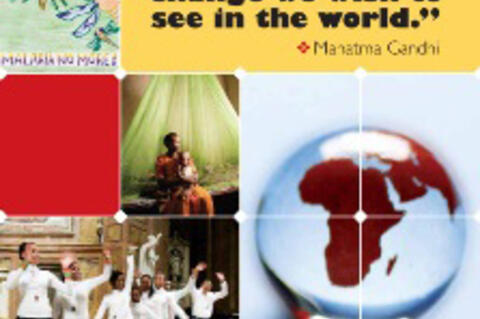
Along with work to raise awareness and distribute nets in Africa, the project was designed to raise awareness about the disease among US citizens, specifically school-age youth, and to encourage them to raise funds for or donate to the initiative. The key strategy for raising awareness among young people in the USA is an educational component that, in partnership with Scholastic Books, provides free materials for students and teachers to use in the classroom. The materials are designed for Grades 1, 5, and 6, and focus on how children can help children in Africa fight to control malaria. The materials include lesson plans, family activities, posters, storybooks, and fact sheets. Intended to be engaging and easy to use, these materials address real-world issues and focus on improving students' skills in reading, writing, science, and geography. All of the Make Your Mark educational materials are free to download from the Scholastic Books website.
The Malaria No More website, designed for teachers, parents, and students - among others - also provides information and statistics about malaria, simple ways to prevent it, and personal stories from African students that visitors can read about or watch on video. The site also encourages schools to take action in their own communities, such as by joining a country-wide (USA) initiative whereby schools hold a "Stayin' Alive" dance or series of dances, dedicating a portion of the proceeds to Malaria No More. The website also details other partnerships and ways that those in the US can get involved in the fight against malaria, through, for example, swim competitions, fun runs, walks, or music concerts. In addition, the website provides information and resources on planning events or activities, including public service announcements, movies, PowerPoint presentations, and a fundraising toolkit.
Malaria, Children, Education, Development Assistance.
Malaria No More was founded by seven multinational organisations: the American Red Cross; the Global Business Coalition on HIV/AIDS, Tuberculosis and Malaria; the United Way; the United Nations Children's Fund (UNICEF); Millennium Promise; The Global Fund to Fight AIDS, Tuberculosis and Malaria; and the United Nations Foundation. At least 20 other network members help carry out the initiative's work. Malaria No More aims to eradicate malaria through a multifaceted approach that spans Africa and the US which includes raising awareness about malaria and how to prevent it in Africa, and that supports bed net distribution and other malaria prevention programmes across the continent.
Malaria No More, Scholastic Books.
Malaria No More website on July 24 2008; and Scholastic Books website, December 4 2009.
Comments

Malaria Observatories: Bridge to Comprehensive Policies
Framework for evidence-based strategies: good news from Congo-Brazzaville… In Central Africa, the response to malaria stands at a cross-roads. For example, Congo-Brazzaville is likely to become the world’s first country to establish a Malaria Observatory (1,2,3). What does it mean in practical terms?
Preparing the ground for Timely Public Health Intelligence… For the first time ever, the multisectoral response to malaria is expected to be optimized and institutionalized (Malaria Coordinating Authority). The chief challenge associated with the Congolese project (1,2) is to begin to reverse a human development issue of the highest priority and, therefore, make substantial progress towards most of the 2015 Millenium Development Goals (MDGs) (4,5). However…
Breaking new ground: old partners, new partnerships… However significant progress in rolling back malaria, notably in terms of mortality ratios (6,7,8), will require unprecedented willingness on the part of complementary actors – i.e. health professionals, environmentalists, NGOs, research centres, etc. – in the multisectoral response to fulfill their potential, to embrace new ways of working with each other and, above all, to sustain a full-scale response over the long-term…
Towards a strong sense of preparedness for what lies ahead… Defeating malaria must be a shared, global and nonpartisan agenda. To move forward, the Congolese will have to demand that commitment from their leaders, their institutions and, not least, themselves…
Crucial necessity for building a critical mass of capacity for positive change… The goals have been agreed upon (9) and the road map on how to achieve those goals has been painstakingly developed. What remains to be done, in the final analysis, is for the Congolese citizens to recognize that being a citizen in a malaria-endemic country requires being a citizen actively engaged in defeating… malaria. Only then can progress on key fronts (10) – e.g. hygiene, sanitation, prevention, care and research – be in sight…
Doctor Michel ODIKA (Project coordinator, Congo-Brazzaville)
1. Observatoire du Paludisme: projet de souveraineté sanitaire.
2. Advocacy for a Malaria Observatory in Congo-Brazzaville.
3. Malaria Observatories: MDGs-based Perspectives for Africa.
4. For the most part, Malaria Observatories, once fully established in the worst-affected countries, could, and should, be viewed as innovative and comprehensive platforms for making progress towards most of the Millenium Development Goals (MDGs).
5. Malaria Observatories: Focus on the Millenium Development Goals.
6. It bears reminding that Congo-Brazzaville is still off-track on most of the 2015 Millenium Development Goals (MDGs). To date, for example, malaria remains the leading cause of under-five mortality, making it difficult for this malaria-endemic country to achieve the health-related goals (MDGs IV,V,VI) set out in the Millenium Declaration (United Nations, September 2000).
7. Ending Malaria Deaths in Africa.
8. WHO/World Malaria Report 2010.
9. These goals are primarily aimed at providing the basis for a Malaria Action Plan (MAP) prioritized and fully budgeted…
Eradication of malaria
See www.eradication-of-malaria.com in which you may be interested and also very surprised. Without reliance on bednets, and without vaccines, malaria was eradicated.


- Log in to post comments