










































Les Gestes qui Sauvent (Life Savers) Project
The initiative is based on 5 main strategic areas of focus:
Advocacy with Government and Religious Leaders: The initial contact was made through personal meetings of the UNICEF representative with the Minister of Health and with religious leaders of the 10 main religions of Congo. The meetings served to explain the possible impact of the initiative on reducing infant mortality and to get their commitment. Advocacy efforts with the government have continued throughout the process to strengthen its leadership and ensure the sustainability of the initiative.
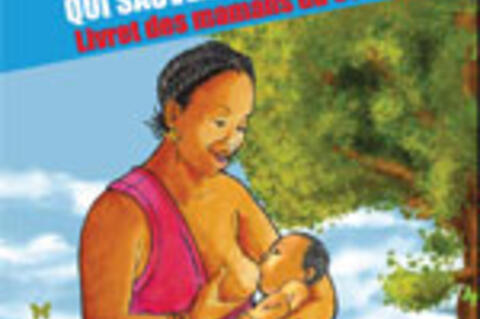
Participatory Message Design: In order to ensure quality, culturally-sensitive messages that are tailored to the reality of Congo, in terms of content and format, the 4 communication tools (a Mothers’ Booklet, an Aide Memoire, a Training manual, and an Animators Guide) were developed by involving women representatives of different religions and from different parts of Congo, people directly involved in education and training, religious leaders, and government specialists from the Integrated Management of Childhood Illness (IMCI) and communication departments of the Ministry of Health. So far, the project has developed, tested, and produced 450,000 mother's booklets, 15,000 training guides, 30,000 aide memoirs, and 15,000 guides for trainers and facilitators.
Click here to download the Manuel du formateur/Trainers manual (French) in PDF format.
Click here to download the Guide de l'animateur/Animator's Guide (French) in PDF format.
Click here to download the Livret des mamans/Mother's Booklet (French) in PDF format.
Strengthening the Capacity of Actors to Take Ownership of the Initiative: This has taken place at all stages of the process through strategic planning, participatory workshops, the development of monitoring and evaluation tools, and the decentralised, cascade training within religious groups. The telephone interview protocols for the hot-line and the training of operators is being done by the IMCI department of the MOH.
Resources Mobilisation: The 10 main religious groups have pledged to finance the implementation of the educational campaign at community level (training of facilitators and dissemination of messages) through their regular worship practices and community work. The private sector (Warid Congo) has committed to finance the operation of the "life-saving telephone" (with 10 operators) as well as the printing of 200,000 mothers booklets. All the training materials are financed by Burotop, a local retailer.
South-South collaboration: The manual for "the life-saving telephone" was adapted from a model developed in Algeria, with technical support from its designer.
Click here to watch Part 1 of a short film about the project.
Click here to watch Part 2 of a short film about the project.
Children, Health
In Congo, 1 child in 8 dies before reaching age 5, 80% because of problems that can be prevented or treated like malaria, diarrhoea, respiratory infections, malnutrition, and neonatal infections. “Les Gestes qui Sauvent” is geared to accelerate child mortality reduction in the context of Accelerated Child Survival and Development (ACSD).
While access to health services and essential commodities are critical for child survival, many effective life saving behaviours can be implemented by the caregivers themselves. For example, exclusive breastfeeding for 6 months, sleeping under an insecticide treated mosquito net or hand washing can reduce child mortality in Congo by 13%, 7% and 3% respectively, thereby saving more than 4,000 lives per year.
Religious groups are key partners for reaching mothers and caregivers, because in Congo 95% of the population is practicing a faith. Thus, according to the project organisers, working in partnership with faith-based organisations will not only ensure excellent geographical coverage, but also good credibility. It also keeps costs low as religious groups use their own channels (parishes’, preachers, and religious leaders) and networks (women's prayer groups, learning groups, social assistance groups, choir, drama groups, etc.) to ensure this training.
Les Gestes qui Sauvent is expected to save between 16,000 and 20,000 children’s lives by 2013.
The implementation of the initiative began in January 2009 and will continue until 2015. The planned activities for 2010-2011 are:
- Updating the macro plan strategy to include other potential partners (media, NGOs, local associations, etc.) and results from project monitoring;
- Documentation of the implementation process for the initiative;
- Resource mobilization; and
- Second distribution of additional 250,000 mothers booklets and 40,000 posters for health centres and primary schools.
United Nations Children's Fund (UNICEF), the Ministry of Health, religious groups, Burotop, and WARID.
UNICEF website and UNICEF website on October 13 2010 and email from Hector Calderon on October 18 2010.


- Log in to post comments