










































Fighting Fear and Stigma with Accurate Information
Internews Media Development Consultant
"As someone who has worked with and in the media, I ...know that lack of accurate information is a big driver of fear and trauma, which in turn can easily translate into stigma and a withholding of sympathy for those affected by the traumatic events, driven by a compulsion to exclude them as 'other'." Callie Long
This Health Communication Capacity Collaborative (HC3) blog and interview of Ida Jooste, Internews' health journalism advisor, discusses the analysis of HC3 partner Internews of Ebola social mobilisation and messaging systems in the three worst-affected countries: Liberia, Guinea, and Sierra Leone, where messaging began with first listening to affected people in communities. Alison Campbell, Senior Director of Global Initiatives at Internews, described working with Liberian journalists as key to Internews' approach to ensure that "people had access not only to a wide range of information from trusted sources, but also to channels for questioning and discussing that information."
In a prior article, Alison Campbell listed the following five "takeaways" or lessons learned for the international development community:
- "Form genuine partnerships with local media.
- Build capacity rather than paying to disseminate prepared messages.
- Deliver consistent messages and don’t oversimplify.
- Encourage two-way communication with community audiences.
- Help local media realize their full potential as a platform for accountability."
Ida Jooste spoke about how working with journalists can address the stigma related to Ebola and sustain their commitment and community engagement when there may be messaging fatigue. "Community radio journalists have continued to be actively involved in Ebola-related programming..." Internews and HC3 invested in those journalists who had already taken leadership positions, using training and follow-up mentorship, including five-day training workshops to provide resources and discussion points related to:
- "The fact that neighbouring countries still have Ebola cases; and
- Stigma against survivors and survivors’ integration into society."
A weeklong workshop was held in May 2015 on mental health and the Ebola crisis, with a Carter Center country representative bringing mental health expertise on stigma, depression, and mental health approaches to create family and community acceptance and a supportive environment. "All of this information and accounts of these experiences were passed on to the journalists, who are planning to use the material in their radio talk shows, or radio, TV and print feature stories."
"Internews also developed a Rumor Tracker (DeySay - a reference to how people speak about rumors in Liberia), which responds to rumors and debunks myths picked up through the extensive rumor tracking system. These (rumors and factual corrections) are then disseminated to partners through a humanitarian info newsletter, intended for dissemination amongst those who communicate with communities. 'DeySay' uses dedicated outreach workers from local partner organizations, as well as local journalists who report rumors through SMS [text] messages to a hotline, where these rumors are categorized by topic and regional scope. Sources include Facebook groups, hashtags on Twitter, influential bloggers, and local media including those from the diaspora, mapping online conversations and triangulating with SMS information from outreach workers. The Rumor Tracker's information is then fed back to the community of social mobilizers, local media, public officials, and faith-based organizations, as well as to the international humanitarian community in a weekly newsletter that highlights trending issues by community or area."
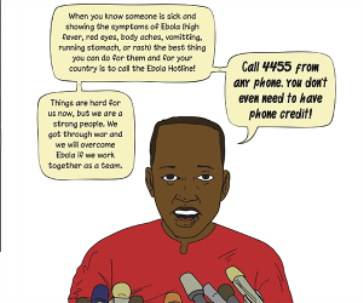
Jooste reviewed the use of a comic book produced by HC3 and billboard messages as training tools for aligning journalist training on issues that HC3 "identified as pertinent for its communications strategy" so that journalists learned to respond to the current information needs of the country. (The comic book, the Ebola edition of "Tabella Tee - International Soccer Star", was distributed in schools along with a teacher guide, as well as selling it commercially.) Jooste described the need of journalists and communicators to work on reasons that survivors and families are being stigmatised - including impoverishment from missing a harvest and perceived economic well-being from rumoured cash benefit payouts.
HC3 website, September 7 2015.
- Log in to post comments