










































Fight Against Malaria in Shibinga
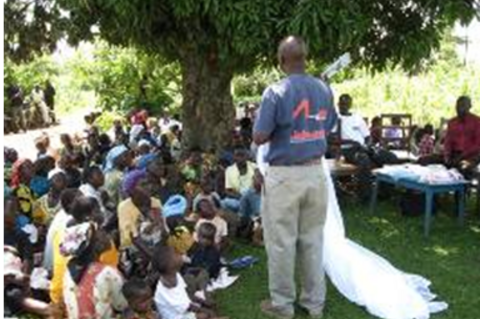
From 2009 to 2011 Malaria No More! supported a project implemented by Pioneer Group Bulechia to eradicate malaria in the Shibinga region of West Kenya, with the goal of reducing childhood deaths by 100% and cases of the disease by more than 95%. In addition to providing preventive and curative treatment by handing out mosquito nets and medicines, the project also worked to educate all village elders and women in the region about malaria and the use and maintenance of mosquito nets.
The project was initiated when members of a church in The Netherlands raised funds on consecutive occasions to purchase insecticide-treated mosquito nets for villages in the Shibinga region of West Kenya. According to Malaria No More!, positive results from the first distributions resulted in the same methodology being applied in 16 villages in the region of Shibinga, reaching about 15,000 inhabitants.
Assessment: With the help of the women in the villages, the "Pioneer Group" of the project group assessed the composition of each village's population. They determined that a household had an average of three children under the age of five and, because each man has two wives, that every family had an average of six children under the age of five.
Education: Before distributing the mosquito nets, a project leader organised meetings in every village where all of the inhabitants were educated on malaria and the use and maintenance of mosquito nets. The subsequent assessment ensured that each household received the right number of mosquito nets.
Distribution of mosquito nets: Although the Kenyan government instructs that mosquito nets be given to pregnant women and children under the age of five who visit a health clinic, the Pioneer Group decided to visit all of the households and hand out mosquito nets because many people don't go to a health clinic but consult traditional healers instead. A total of 10,639 insecticide-treated mosquito nets were procured and distributed in 10 villages in Malaha and in 1 village in Khaunga.
Breeding grounds: The Pioneer Group also tackled the mosquito's breeding grounds with neem cake, an organic product from a local tree that is made from neem seed.
Diagnostic tests: Three months after distributing the mosquito nets, the Pioneer Group organised a week of malaria diagnosis days in the health centres of Khaunga and Malaha. Of the 500 people tested in each sublocation, only 36 people, or 7.2%, tested positive. The reports from the Ministry of Public Health, which are based on data provided by the Pioneer Group, showed a reduced occurrence of malaria. People who were diagnosed with malaria were prescribed drugs. The monitoring and evaluation team found out that some people who had contracted malaria had stopped using their mosquito nets because they thought the malaria season was over.
Micro-credit: In the Mung’ang’a sublocation, 1,567 "second generation" mosquito nets were distributed as part of a micro-credit system in which a micro-credit is granted to women's groups so they can buy new insecticide-treated mosquito nets after five years.
Training the project coordinators: A two-year Community Development and Social Work training is currently underway. This training will enable the project leaders to ensure that project activities run effectively. The group members will also attend courses that will help them solve problems that can occur in a rural community and that include a participatory approach.
Malaria prevention and treatment
According to Malaria No More!, the project faced various challenges, which included the following:
- Getting people to collaborate was not always easy. Village elders were reluctant to collaborate: they wanted to be paid. It took a while for them and the families to realise that it was in their best interest to cooperate.
- Some politicians used the project to bind voters, which led to many families turning down the mosquito nets. The Pioneer Group invited all of the local leaders to distance themselves from politics during the distribution of the mosquito nets and convinced the local population that the project had nothing to do with politics.
- Rectangular nets proved difficult to hand out. Because people associated the shape of the net with graves, the project bought and distributed round mosquito nets instead.
- Some families are so poor that they don't have enough to eat. As a result, they sold the mosquito net they were given in exchange for food. For this reason an agreement was made that penalises the reselling of mosquito nets. A weekly (social) control was carried out to make sure no mosquito nets were being sold.
The government office that issues death certificates reported that the number of deaths had decreased by 95 to 98% and local health centres reported that the number of people infected with malaria had decreased by 90 to 95% in the villages where the pioneer group educated the people and handed out mosquito nets. According to the project, these positive results can be ascribed to the participatory approach: representatives of the Pioneer Group, members, village elders, the provincial administration, and people in the community working together. By participating, the project beneficiaries also become the owners of the project and are able to take responsibility.
Malaria No More!, Pioneer Group Bulechia
Malaria No More! website on January 22 2012.
- Log in to post comments