










































Empowering Women's Voices on Reproductive Health in the Media; and Taking Stock of Reproductive Health and the Media
Population Reference Bureau (PRB)
(Editor's note: the article summarised below was adapted from the PRB website and was originally written by Eric Zuehlke, but not in the below format - which has been created by The Communication Initiative.)
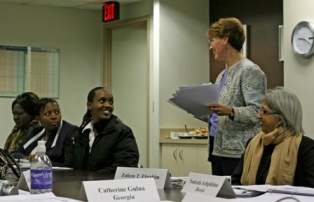
A week-long seminar in November 2008 at the Population Reference Bureau (PRB) covered topics in reproductive health as part of PRB's Women's Edition project. Twelve editors, reporters, and correspondents from print and radio outlets attended from Georgia, Russia, Guatemala, Yemen, Nepal, Pakistan, Rwanda, Nigeria, Uganda, Kenya, Liberia, and Ethiopia. Women's Edition is a United States Agency for International Development (USAID)-funded project at PRB that brings together senior-level women journalists from influential media organisations in different countries to examine and report on pressing issues affecting women's health and status in the developing world.
According to the first of these documents, PRB staff members briefed the group on world population trends, contraceptive policy, education and fertility, male engagement, and the dangers of childbirth and pregnancy in developing countries. According to this report, "[e]xperts from the Global Health Council, the Center for Strategic and International Studies, and Webbmedia also participated in training sessions ranging from reproductive health, new media technologies, and gender and HIV/AIDS. These sessions were designed to strengthen the journalists' knowledge of the reproductive health policy landscape as well as train the participants in new media outreach methods." In informal discussion, as stated here, "[p]ersonal stories showed that strengthening public understanding of reproductive health issues is not a theoretical exercise, but a crucial pursuit that can save lives. The lack of access to information and knowledge among women of reproductive health options emerged as a major issue, common across all countries. Even when health care is available, many women in rural areas don't want to be screened either out of fear or distrust of outsiders. The participants saw their role as journalists as integral to educating women and addressing their concerns."
Participants reported that being a woman journalist brings with it unique obstacles and opportunities. For example, in Uganda the readership is primarily men because they are the literate who can afford print media. This affects the gendered balance of coverage on issues. Additionally, the challenge, according to participants, is how to communicate health issues to the public at the grassroots level rather than just to the elite. Sessions on new media training were designed to address this issue.
In the second document, interviews with the participants address the question of major challenges involved with reproductive health in their countries. Responses from the participants by country include the following:
- "Pakistan: The lack of political will, not the lack of resources...
- Russia: The health care system is destroyed with the collapse of the Soviet Union and the transformation of the economy....The lack of political will and lack of public awareness are other problems.
- Nigeria: ...lack of infrastructure. The public health care system has virtually broken down... Some of the challenges women face are a lack of awareness and a lack of knowledge of the things they need to do to access good health care delivery.
- Uganda: ...A poor and under-resourced primary health care system, the issue of HIV/AIDS, ...women cannot access basic emergency obstetric care..."
Participants were asked what they had gained from the training session. Their answers included: gaining knowledge of new media; marketing one’s news stories; confirming that women's education and empowerment really lead to improvement of women's health; establishing a future network among women journalists; and gaining empowerment to enable discussion and to write on issues with better clarity through briefings on the issues.
Participants were asked about the media's role in improving women’s health. Answers included:
- "I think the media is partly to blame for not having shows or programs on reproductive health or women health care. I think the media can have a leading role to make health care one of the priorities in life...
- The media has a very big role, but it has to be a media that is informed. Once the media highlights the problems, any listening government would take action. So many people will get involved - [non-governmental organisations] NGOs, the international community, etc. - but it has to get out to the media first...
- I think that it's a very interesting time for the media in Pakistan, especially for electronic media. We've seen a mushrooming of private television channels and FM radio. For a country that doesn't have a high literacy rate, the media is influencing the general population. I think the media will play a very vital role in whatever issue that is taken up. The problem is that somehow the media has to get interested in reproductive health. But it seems it can be because journalism used to be a very male-dominated area but not any more...."
The PRB enewsletter on December 18 2008; and email from Eric Zuehlke to The Communication Initiative on July 22 2009.
- Log in to post comments