










































Did the Call for Boycott by the Catholic Bishops Affect the Polio Vaccination Coverage in Kenya in 2015? A Cross-Sectional Study
Ministry of Health, Nairobi (Njeru, Ajack, Onyango, Musyoka, Kioko, Muraguri); World Health Organization, or WHO (Muitherero, Onuekusi); American Red Cross (Davis)
Religious opposition to polio vaccination has been associated with failure of immunisation programmes in Afghanistan, Pakistan, and Nigeria. Although polio campaigns in Kenya have previously been successful, religious resistance to mass vaccinations is beginning to take root. Two preventive vaccination campaigns were planned for April and May 2015 targeting 32 and 11 counties, respectively; they were postponed after the Catholic bishops objected to the campaigns and demanded that the vaccines be tested first. The government engaged the bishops and formed a committee to address the issues raised, but the Catholic bishops were not fully satisfied with the process and hence called on all their faithful to boycott the August 2015 polio campaign. The researchers conducted a survey immediately after the August 2015 campaign in order to find out if the call for boycott by the Catholic bishops did affect the polio vaccination coverage. The survey also aimed at determining the reasons for non-vaccination.
This was a cross-sectional study that was conducted for 2 days following the polio campaign that was conducted in 32 counties from August 1-5 2015. A total of 90,157 children were sampled in the August 2015 post-polio campaign survey that was done in 32 counties, compared to 163,056 children that were sampled in 47 counties during the November 2014 post-campaign survey. This represented a small decline of 1% but which was statistically significant (p value <0.0001). However, the coverage varied by county in all the 32 counties that conducted the campaign in August 2015 with 13 (41%) counties having statistically significant decline in performance compared to the November 2014 campaign.
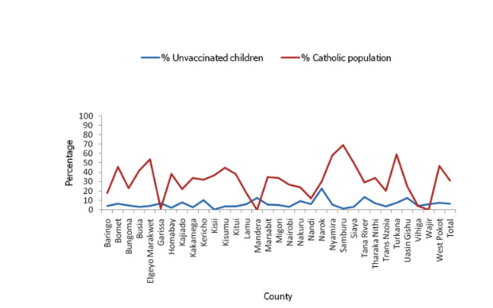
A total of 37,732 parents/guardians of targeted children were sampled during the August 2015 post-campaign survey. Thirty-one percent of the sampled parents/guardians were Catholic, but only 7% of the children were not vaccinated. Overall, 44% of the children who were not vaccinated were missed because their houses were not visited by the vaccinators. Another 38% were missed because they were not at home at the time of the visit, 12% because their parents declined vaccination, 1% because the children were asleep, and 5% due to other reasons. Compared to the November 2014 campaign, the proportion of children who were not vaccinated due to parents refusal significantly increased from 6% in November 2014 to 12% in August 2015 (p value <0.0001).
Analysis of the county results did not establish any relationship between the decline in performance and the proportion of the population that was Catholic in the counties. The reasons for missed children varied by county, but generally religion was not a major contributing factor. Based on the above findings, the call for boycott of the vaccination campaign by the Catholic bishops in Kenya can therefore be regarded as largely unsuccessful. This in contrast to a similar call for boycott of the polio vaccination by the Muslim leaders in Northern Nigeria in 2003 that led to a complete boycott of the campaigns in 3 northern states of Kano, Kaduna, and Zamfara for close to a year.
In both Kenya and Nigeria, the main reason for boycott was the belief that the polio vaccine was contaminated with anti-fertility agents (estrogens). The Kenyan boycott could be tied to the tetanus vaccine controversy in 2014, when the Catholic bishops had opposed the vaccination campaign on the argument that the tetanus vaccine had been laced with an anti-fertility drug, Human Chorionic Gonadotrophin (HCG). Though this issue was resolved after joint testing of vaccines, the bishops had demanded that testing of all vaccines used for future mass vaccination must be done. Even though the government accepted to test the polio vaccines, there was a disagreement on the methodology to be used and therefore the bishops called for a total boycott of the August 2015 campaign. The controversy was resolved through dialogue and testing of the polio vaccine which indicated that the vaccine was safe, so the Catholic bishops did not call for boycott during the subsequent September and December 2015 polio vaccination campaigns. However, according to the researchers, more consultations with the bishops and other stakeholders are needed in order to resolve the differences once and for all in order to avoid a long-term negative effect like the one seen in Nigeria.
In conclusion: "An analysis of the vaccination coverage revealed that the call for boycott did not affect the campaign significantly. However, there was a slight increase in the number of parents and guardians who refused their children to be vaccinated compared to other campaigns in the past. Therefore, if this call for boycott is repeated in future it could have some significant negative implication to polio eradication as well as other vaccination programs in the country. It is therefore important to ensure that any vaccine safety issues are addressed accordingly."
The Pan African Medical Journal. 2016;24:120. doi:10.11604/pamj.2016.24.120.8986.
- Log in to post comments