










































Detoxing Information Ecosystems: A Proactive Strategy for Tackling Disinformation
"Disinformation is for the information ecosystem what pollution is for nature."
This paper, published by Deutsche Welle (DW) Akademie, presents what DW Akademie refers to as a "novel approach to the challenges associated with disinformation". Noting a tendency towards standalone solutions in most current media development strategies in this realm, the paper calls for a holistic approach towards tackling disinformation that combines short- and medium-term methods for detecting and preventing disinformation, innovative support for public interest media, and media education, as well as advocacy for public trust in independent, reliable journalism.
The paper highlights the complexity of disinformation within the overall information ecosystem and draws attention to the unintended effects of possible solutions to a "vague, complex problem" such as disinformation. "To be effective, strategies need to take the consequences of individual actions into account. For example, fostering a critical attitude amongst media consumers can reduce general trust in media (Maksl et al 2015) and invite overbearance of regulatory interventions, to the detriment of freedom of expression (Jungherr / Rauschfleisch 2022). Or fact-checking initiatives might contribute to the spread of conspiracy theories by making people aware of them (Nyhan/Reifler 2010) and contribute to the lack of trust that established media outlets are experiencing (Gwen Lister/Toivo Njabela 2021). These unintended negative consequences need to be factored in when developing a strategy against disinformation. And evidence needs to be collected to make sure that both positive and negative effects of interventions are appraised and fed into a learning process, to make sure approaches improve over time."
Eight guiding principles for anti-disinformation strategies are therefore proposed that are intended to help boost the effectiveness of media development intervention while safeguarding against the harmful effects for local media markets and the information ecosystem as a whole. The guiding principles are:
- A human-rights-based approach: Media development strategies should be based on human rights and aim to strengthen freedom of the media and freedom of expression.
- Consumer and localised orientation: Projects should take into account that media use, especially the use of social media platforms, varies depending on the country and/or population group and/or language. This user behaviour must be understood thoroughly from inside the country or region.
- Conflict and context sensitivity: Interventions in conflict-ridden or polarised contexts can put organisations conducting fact-checking and verification at risk. It is therefore necessary to conduct a thorough risk assessment before launching disinformation projects.
- Political sensitivity: Fact-checking may constitute a felony if it makes disinformation public that is prohibited by law. Therefore, the political and legal context needs to be analysed diligently before planning interventions.
- Transparency and independence: Media development organisations should not take on the role of judging right or wrong. Political discourse thrives on the diversity of opinions; politically unpopular statements are not automatically disinformation just because they do not suit one party.
- Do no harm: Disinformation projects can put the safety of participants or employees at risk.
- Tech sensitivity: Projects should always take into account the impact that the introduction or prioritisation of technological solutions can have on democratic processes and independent media in a country.
- Open source and digital security: If technological solutions are adopted, it is important to allow for the continuation of usage by partners after termination of the intervention.
Acknowledging the complexity of public interest information ecosystems and the problem of disinformation and the related risks, the paper calls for a holistic approach instead of linear solutions that merely address the most obvious symptoms of the problem rather than its root causes. These solutions should be designed to simultaneously (i) reduce the pollution or misinformation in the information ecosystems, (ii) safeguard diversity and freedom of expression, and (iii) provide the fertile ground on which relevant and reliable information can prosper.
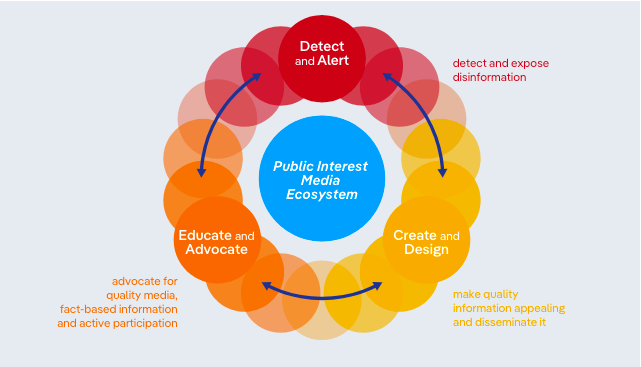
DW Akademie proposes a three-pronged approach, which is designed to tackle disinformation in three distinct spheres. These spheres are explained in the report and include information on specific media development activities that are appropriate in each sphere. In brief, they are:
Sphere 1: Detect and Alert (short-term): This first sphere seeks to identify and expose actors, methods, and systems of disinformation. The focus here is primarily on acute, deliberate disruptions to the information ecosystem. Approaches in this sphere include: fact-checking, verification, content moderation, investigative reporting, Open Source Intelligence (OSINT), digital forensics, and social listening/network analysis.
Sphere 2: Design and Create (medium- to long-term): This sphere involves making quality and engaging information available to act as a counterbalance to misinformation and to enhance possibilities for dialogue and the spread of public interest content in media ecosystems. Approaches in this sphere include: Explainer journalism, data journalism, podcasting, gamification, artificial intelligence (AI), video storytelling, and influencers.
Sphere 3: Educate and Advocate (long-term): This sphere involves educating citizens and advocating for information integrity to (re-)establish trust in the institutions people depend on for their well-being. This action includes establishing the value of quality media and fact-based information as an important factor for the prosperity of communities and the advancement of active democratic participation. Approaches in this sphere include: community-driven journalism, media and information literacy (MIL), policy/regulation, constructive/solutions journalism, campaigns, advocacy, and social network engagement.
DW Akademie website on May 22 2024. Image credit: DW Akademie
- Log in to post comments