










































COVID-19 Vaccine Acceptance and Hesitancy in Low- and Middle-Income Countries
Berlin Social Science Center, or WZB (Arce); Innovations for Poverty Action, or IPA (Warren); International Growth Centre, or IGC (Meriggi) - plus see below for full authors' affiliations
"Evidence from this sample of LMICs suggests that prioritizing vaccine distribution to the Global South should yield high returns in advancing global immunization coverage."
Acceptance of childhood vaccination for common diseases is generally high in low- and middle-income countries (LMICs), providing grounds for optimism about the prospects for COVID-19 vaccine uptake. However, at the time of this writing, large-scale COVID-19 vaccination was just beginning in LMICs, and few studies had yet investigated COVID-19-specific vaccination attitudes there. The present study not only documents vaccine acceptance rates in LMICs, comparing them to higher-income countries, but also collects and analyses data on the reasons for acceptance and hesitancy. The researchers suggest that these data are critical for informing the design of effective vaccine messaging.
To select studies to include in the sample, the researchers conducted an internal search within Innovations for Poverty Action (IPA), the International Growth Center (IGC), and the Berlin Social Science Center (WZB) for projects with plans to collect survey data in the second half of 2020. IPA, IGC, and WZB investigators agreed to include a set of common questions about COVID-19 vaccine attitudes in their own studies. The 15 survey samples that made up the final review included 44,260 individuals within 10 LMICs in Africa, Asia, and Latin America, as well as Russia (upper-middle income) and the United States (US - high income).
The researchers found considerably higher willingness to take a COVID-19 vaccine in the LMIC samples (mean 80.3%; median 78%; range 30.1 percentage points - pp) compared with the US (mean 64.6%) and Russia (mean 30.4%). Reported acceptance is lowest in Burkina Faso (66.5%, confidence interval (CI) 63.5-69.5%) and Pakistan (66.5%, CI 64.1-68.9%). Pakistan's relatively low acceptance rate could be linked to negative historical experiences with foreign-led vaccination campaigns (e.g., polio). This hesitancy may be particularly problematic given the magnitude of the second wave in neighbouring India and the acceleration of cases across South Asia. The relatively low acceptance rate in Burkina Faso might reflect general vaccine hesitancy: Fewer people believe that vaccines in general are safe in Burkina Faso than in any other country included in the study, except Russia.
The reason most commonly given for vaccine acceptance across samples is personal protection against COVID-19 infection. The average across the LMIC samples is 91% (CI 86-96%), with a median of 92.5% and a range of 22 pp. In distant second place in the aggregate LMIC analysis is family protection, with an average of 36% (CI 28-43%), a median of 34.5%, and a range of 39 pp. Protecting one's community does not feature prominently among stated reasons for acceptance. These findings suggest that, rather than appeals to prosocial motivations, messaging focused on vaccination's role in personal protection could be more effective in the countries under study here.
Concern about side effects is the most common reason for hesitancy; this concern is particularly evident among samples from Sub-Saharan Africa. In part, this concern could reflect the rapid pace of vaccine development and the limited information available about potential COVID-19 vaccine safety at the time of data collection. Also, intensive media coverage of adverse events (e.g., associated with the AstraZeneca vaccine, likely to be used in LMICs) could exacerbate concerns. Furthermore, survey samples from Uganda, Mozambique, and Pakistan, as well as Russia and the US, show relatively high levels of skepticism about vaccine effectiveness among hesitant respondents. In addition, some hesitant respondents (especially in the US, Pakistan, and Nepal surveys) cite lack of concern about COVID-19 infection as a reason not to be vaccinated.
"Trust in vaccines as well as the institutions that administer them are key determinants of the success of any vaccination campaign..." In all samples except Rwanda, respondents identify the health system as the most trustworthy source of information to help them decide whether to take the COVID-19 vaccine. The average across LMIC samples is 48.1% (CI 31.6-64.5%), with a median of 44.1% and range of 66.3 pp. In Colombia, Nepal, Russia, and Burkina Faso, the next-most-cited sources are family and friends. By contrast, in Sierra Leone, Uganda, US, and Nigeria surveys, the government is the source that is second most frequently cited.
These findings suggest to the researchers that "prioritizing distribution to LMICs may be an efficient way to achieve immunity on a global scale and prevent novel variants from emerging. Vaccination campaigns should focus on converting positive intentions into uptake", such as through straightforward, low-cost nudges and reminders. Directions for the design and delivery of messaging to address remaining COVID-19 vaccine hesitancy include:
- Due to high levels of trust in health workers, social and behavioural change communication (SBCC) strategies engaging local health workers to deliver vaccine information may be effective. Health workers have also been the first group to receive the COVID-19 vaccine and are therefore well positioned to share locally credible experiences of vaccination.
- Due to hesitant respondents' concern about side effects and vaccine efficacy, proactive messaging should be initiated before large-scale vaccination campaign rollout and highlight efficacy rates and the rarity of severe adverse events.
- Due to the finding, which is consistent with previous studies on COVID-19 vaccination, of lower vaccine acceptance, on average, among women than men, messaging strategies focusing on women may be important in addressing overall hesitancy. More generally, countries may consider tailoring their messaging campaigns to address concerns held by more hesitant subpopulations, which need to be elucidated through additional research.
- Due to the fact that social learning strategies and norm-setting are powerful drivers of behaviour, social signaling of positive attitudes towards vaccines may help shift social norms toward even greater immunisation acceptance and uptake. As with messaging, policymakers should consider designing and evaluating social mobilisation strategies to reach more hesitant subgroups.
In conclusion, the researchers "urge policymakers and stakeholders to utilize country-specific results to develop further strategies that may work best in their particular context...[and] echo calls for integrating rigorous impact evaluation of vaccine hesitancy interventions in all contexts, given limited evidence so far..."
Full list of authors, with affiliations: Julio S. Solís Arce, Berlin Social Science Center (WBZ); Shana S. Warren, Innovations for Poverty Action (IPA); Niccolò F. Meriggi, International Growth Centre (IGC); Alexandra Scacco, WZB; Nina McMurry, WZB; Maarten Voors, Wageningen University & Research; Georgiy Syunyaev, WZB, and HSE University, and Columbia University; Amyn Abdul Malik, Yale Institute for Global Health; Samya Aboutajdine, IGC; Opeyemi Adeojo, Busara Center for Behavioral Economics, and University of Lagos; Deborah Anigo, Busara Nigeria, and Federal Capital Territory Administration, Abuja, Nigeria; Alex Armand, Nova School of Business and Economics, and The Institute for Fiscal Studies; Saher Asad, Lahore University of Management Sciences; Martin Atyera, IPA; Britta Augsburg, The Institute for Fiscal Studies; Manisha Awasthi, Morsel Research & Development; Gloria Eden Ayesiga, IPA; Antonella Bancalari, The Institute for Fiscal Studies, and University of St Andrews, and Redes Peru; Martina Björkman Nyqvist, Stockholm School of Economics and Misum; Ekaterina Borisova, HSE University, and Ghent University; Constantin Manuel Bosancianu, WZB; Magarita Rosa Cabra García, IPA; Ali Cheema, Lahore University of Management Sciences, and Institute of Development and Economic Alternatives; Elliott Collins, IPA; Filippo Cuccaro, IPA; Ahsan Zia Farooqi, Institute of Development and Economic Alternatives; Tatheer Fatima, Morsel Research & Development; Mattia Fracchia, Nova School of Business and Economics, and NOVAFRICA; Mery Len Galindo Soria, IPA; Andrea Guariso, Trinity College Dublin; Ali Hasanain, Lahore University of Management Sciences; Sofía Jaramillo, IPA; Sellu Kallon, Wageningen University & Research, and University of Sierra Leone; Anthony Kamwesigye, IPA; Arjun Kharel, Centre for the Study of Labour and Mobility (CESLAM); Sarah Kreps, Cornell University; Madison Levine, Wageningen University & Research; Rebecca Littman, University of Illinois Chicago; Mohammad Malik, Institute of Development and Economic Alternatives; Gisele Manirabaruta, IPA; Jean Léodomir Habarimana Mfura, IPA; Fatoma Momoh, IPA; Alberto Mucauque, Associação NOVAFRICA para o Desenvolvimento Empresarial e Económico de Moçambique; Imamo Mussa, Associação NOVAFRICA para o Desenvolvimento Empresarial e Económico de Moçambique; Jean Aime Nsabimana, IPA; Isaac Obara, Busara Center for Behavioral Economics; María Juliana Otálora, IPA; Béchir Wendemi Ouédraogo, IPA; Touba Bakary Pare, IPA; Melina R. Platas, NYU Abu Dhabi; Laura Polanco, IPA; Javaeria Ashraf Qureshi, University of Illinois Chicago; Mariam Raheem, Centre for Economic Research in Pakistan (CERP); Vasudha Ramakrishna, Yale Research Initiative on Innovation and Scale (Y-RISE); Ismail Rendrá, Associação NOVAFRICA para o Desenvolvimento Empresarial e Económico de Moçambique; Taimur Shah, CERP; Sarene Eyla Shaked, IPA; Jacob N. Shapiro, Princeton University; Jakob Svensson, Stockholm University; Ahsan Tariq, Institute of Development and Economic Alternatives; Achille Mignondo Tchibozo, IPA; Hamid Ali Tiwana, Institute of Development and Economic Alternatives; Bhartendu Trivedi, Morsel Research & Development; Corey Vernot, Y-RISE; Pedro C. Vicente, Nova School of Business and Economics, and NOVAFRICA; Laurin B. Weissinger, Tufts University; Basit Zafar CERP, and University of Michigan; Baobao Zhang, Cornell University; Dean Karlan, IPA, and Kellogg School of Management at Northwestern University; Michael Callen, London School of Economics and Political Science; Matthieu Teachout, IGC; Macartan Humphreys, WZB, and Columbia University; Ahmed Mushfiq Mobarak, Yale University; Saad B. Omer, Yale Institute for Global Health
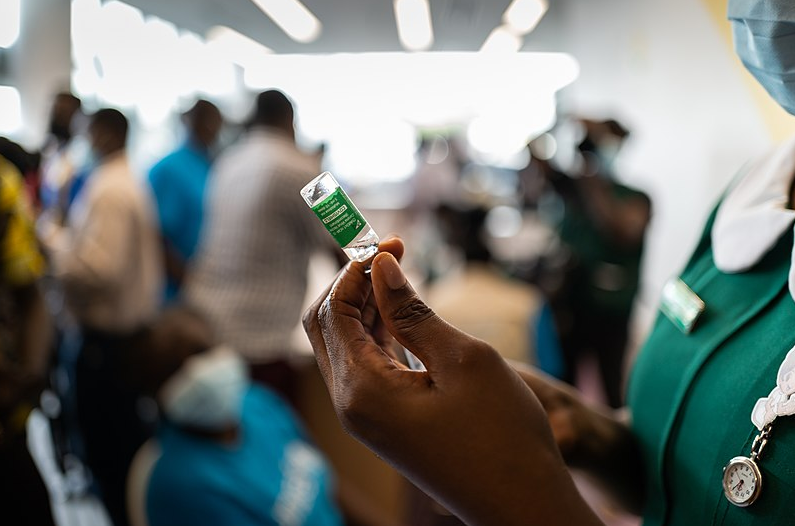
Nature Medicine (2021). https://doi.org/10.1038/s41591-021-01454-y. Image credit: WHO / Blink Media - Nana Kofi Acquah. Attribution: World Health Organization, CC BY-SA 3.0 IGO
- Log in to post comments