










































Constraints and Opportunities: What Role for Media Development in the Countering Violent Extremism Agenda?
"It is imperative that there is consideration of the linkage of media and media development and what role they may play in the prevention of radicalisation and violent extremism."
International Media Support (IMS) reminds us that media developers around the world work with institutions, organisations, and individuals to ensure that reliable and professional information is available to communities and to spark and encourage responsible debate that is key to good governance. By extension, the fight against both terrorism and countering violent extremism (CVE) stresses the importance of media development. This paper seeks to provide initial guidance on the definition of CVE and what it means for the media development sector, its donors, and other organisations that work with media developers.
The opening chapter explores CVE, stressing that violent extremism (VE) is a global phenomenon and exists in a large variety of backgrounds and geographic areas, ranging from domestic and homegrown to international terror groups. (The author, Michelle Betz, also defines related terms, including: extremism, radicalism, radicalisation, counter-radicalisation, de-radicalisation, disengagement, reintegration, and self-radicalisation). One proposed definition of CVE: the use of non-coercive means to delegitimise violent extremist ideologies and thereby reduce the number of terrorist group supporters and recruits. But by what means? What methods? What tools can be and are being used? What does this mean for media development practitioners? The paper provides some answers to these questions.
Betz describes the role of communication in CVE; the field has shifted to now focus predominantly on a broad range of non-coercive and preventative activities, including the use of strategic communications. The latter have largely been based on one of two approaches: behaviour change communication (BCC) and alternative or counter-narratives. Perhaps most relevant to media practitioners and media development specialists is the meso level, where BCC theory and practice are used to either prevent radicalisation or deradicalise. Media may also provide both alternative and counter narratives. Alternative narratives emphasise positive attributes including shared social values, tolerance, openness, freedom, and democracy. Counter-narratives contradict VE messaging by deconstructing, discrediting, and demystifying. Media can also play a key role in diminishing the lure of VE by covering/reporting on terrorist attacks in a manner that is conflict sensitive, avoids stereotyping, and promotes the values of tolerance and cohesion. This can be done in a variety of ways by engaging the media and is discussed further in section 3.2 of the paper.
There are numerous challenges in responding to the CVE agenda for both media developers and press freedom organisations, including:
- The work independent media do can easily be confused (or viewed) as government-sponsored strategic communications, putting their credibility and that of their local partners and media workers at risk. According to the International Crisis Group, for example, "casting 'violent extremism', a term often ill-defined and open to misuse, as a main threat to stability risks downplaying other sources of fragility, delegitimising political grievances and stigmatising communities as potential extremists."
- Betz says, "it is unclear where (and perhaps how) CVE fits into the development agenda." She notes, for example, that one of the pillars of CVE policy and practice is the promotion of cooperative and trust-based relationships between civil society and local police. However, significant risks are associated with this, particularly in fragile states where unreformed security services lack oversight and may persist in violating human rights.
- It is important that interventions be tailored to the specific local context. Betz explains that, if one is to effectively counter current narratives, then it is essential to identify the messages of the VE agenda in that particular context as well as how those messages are being sent out - is it social media, videos, rallies, etc. Are the messages a "call to action" or something else? This will require substantial research, both to design effective interventions and to evaluate their impact. Related to this is the cross-border nature of VE.
- There is growing pressure on sites such as Facebook, YouTube, and Twitter to monitor, and sometimes remove, violent content and propaganda from terror groups. It is unclear how closely each company works with governments, how frequently they remove content, and how it is identified. (Betz discusses the role of "super flaggers".) Governments have called for internet platforms to remove accounts and/or content that promotes or supports extremism; actions of the Erdogan government in Turkey after the July 2016 attempted coup are just one example.
- "Because there is not yet clarity on what works and/or how to measure efficacy of CVE activities, media developers (among others) are unable to cite evidence in their arguments for funding."
These challenges have implications for the media development sector, as Betz next outlines. For example, she reiterates the importance of research: "it is incumbent on those of us working in media development, particularly in conflict and crisis countries to understand how the media are already being used for cVe activities and further to consider how our efforts may have a positive (or negative impact) on VE and cVE. However, there must be great attention paid to ensure that we do not mix strategic communication efforts and independent media." Along those lines, Betz says that the first order of business may need to be the adoption of alternative terminology and separating media development from, among other things, strategic communications. ultimately, she says, we need to consider media as a "change agent" to counter VE effectively. Thus, media developers need to examine more thoroughly the literature regarding media as change agent so as to pursue the argument with donors that independent, professional media is a critical element in societies prone to VE. "Another key component to any CVE programming is the absolute necessity to fully understand the messages that are used to recruit and incite and how these messages are disseminated. One can only counter messaging if we know what the original messaging is. As such, another area media developers have been working in for years is media monitoring. However, one caution here: at what point does monitoring become surveillance (with more sinister objectives?) or have the potential to degenerate into blatant surveillance."
Betz explores other issues relevant to this discussion, including media literacy, how technology is being used, and the connection between a strong, independent media and good governance (e.g., by covering issues of accountability). She underlines the importance of cooperation with civil society and security forces, which might take the shape of facilitated dialogues that bring together media and security forces to promote enhanced relations and joint problem solving and better understanding of the role of media in CVE. Such dialogues can be opened to the broader community: security actors, religious and tribal leaders, government, business members, and the community at large. Betz envisions the media as providing a non-judgmental space for dialogue and debate and to help further understanding of the challenges a particular community may face. Issues related to media safety, including psycho-social aspects of trauma, cannot be ignored.
Because VE is considered a driver of conflict, many of the examples of IMS' best practices with regard to CVE that Betz next offers are aimed at conflict reduction or prevention or at the very least at reducing tensions and increasing understanding of conflict and the role of the media. These examples come out of Togo, Kenya, Afghanistan, Pakistan, Iraq, and Niger. For instance, prior to the 2007 elections in Togo, IMS (based on thorough assessments) conducted a 2-day media safety forum that brought together members of the media, the military, and government authorities, including media regulators. "[T]he relevance of such dialogues to CVE cannot be understated....[T]he work IMS has carried out in conflict sensitive journalism [CSJ], media-security dialogues, safety and content monitoring can all be considered critical in CVE work."
Based on these examples, Betz suggests that media developers:
- Carry out ongoing CSJ work, including curricular work, which includes an examination and discussion of VE and understanding local drivers;
- Strengthen digital literacy and media literacy;
- Continue to build capacity of credible messengers;
- Work to build mutual understanding and respect between security forces and media;
- Ensure safety and protection of media workers;
- Tell the stories of survivors of VE (of returnees);
- Develop holistic strategies that take into account all levels of society: individual, community, and structural causes of VE;
- Continue to include local actors, even those who may espouse radical views outside the "moderate" mainstream but who are anti-violence;
- Strengthen capacity of local partners in areas such as research, peacebuilding, and conflict management;
- Facilitate communication and further understanding between diverse groups through effective and professional reporting and debate;
- Continue to develop, test, and refine tools and adapt to context;
- Consider a transnational approach;
- Pursue solid research and project design to reflect the fact that many drivers of VE are often contextually based; and
- Be careful of adopting a lingo that can lead partners (and staff) into difficulties or danger.
Betz shares some current CVE efforts within the media development community beyond IMS. To cite only one example: The United States (US)-based non-governmental organisation (NGO) Equal Access (EA), in partnership with the US Embassy N'Djamena, is implementing the "Fostering Sustainable CVE messaging strategies through locally-driven community radio" project with the aim to counter extremist messages in Chad. EA describes the project's impetus as follows: The "risk and vulnerability within local communities is exacerbated by lack of credible, community-based local-language information, and a lack of opportunity for moderate leaders and community members to share their opinions. While extremist messaging and recruitment efforts expand and become more sophisticated in the region, communities lack their own communication platforms to provide counter-messaging and express their priorities, grievances, and needs." Thus, EA has created 2 community radio (CR) stations with the skills and technical capacity to counter VE narratives and is strengthening the capacity of 4 existing CR stations to expand and deepen their CVE messaging and pogramming. In addition, EA has been the media partner for the US Agency for International Development (USAID)-funded multi-year regional programme Regional Peace for Development II (PDEV II), which operates in Chad, Niger, and Burkina Faso. According to USAID, PDEV II "uses a community-led approach to foster community harmony and stability with a focus on youth empowerment, vocational training, education, research, information dissemination via various channels including radio and good governance."
Betz concludes with recommendations for non-media development stakeholders, pointing to factors such as an integrated and coordinated approach that includes all stakeholders, the need to engage with Muslim, Arab, and South Asian communities to ensure their voices are heard while protecting their civil rights, and the role of a solid risk assessment to ensure that CVE policies or actions do not foment distrust or hostility to any community.
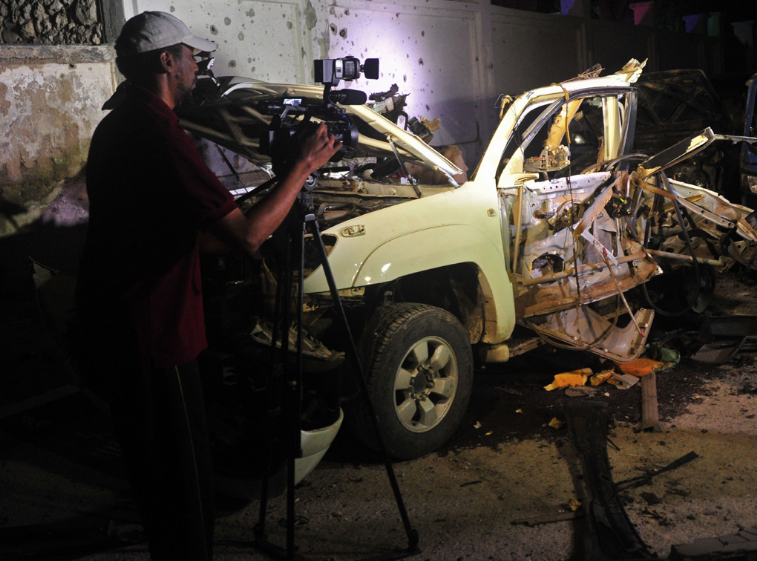
IMS website, October 14 2016. Image caption/credit: "A journalist films the wreckage of a car bomb outside a beach restaurant in the Somali capital Mogadishu on 25 August 2016 after an attack by alleged Al-Qaeda-linked Al Shabaab rebels." Mohamed Abdiwahab/scanpix
- Log in to post comments