










































Community Information Boards (CIB)
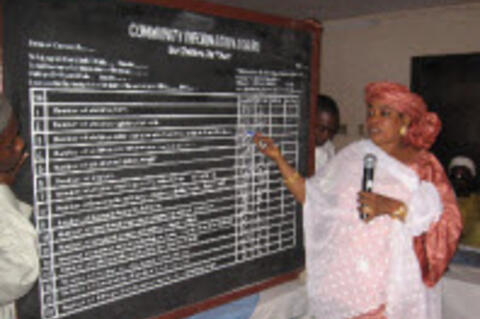
The Community Information Board is designed to capture basic social and development data in the community for tracking the situation of children and women, and to provide the focus for community and peer-group dialogues, local theatre and house-to-house counselling that lead to concrete actions that improve services for and the rights status of children, women, and families. As a community tool, it requires the participation of every segment and group in all stages of its use. The principal moderators of the Board are the traditional leader, the community or village development committee, and the recorder. The audience is the entire community — women, youths, children and men. The board is intended to complement existing community engagement processes such as community dialogues and community theatre.
The boards track 16 indicators on a quarterly basis. These indicators track births and child mortality, immunisations, child health and development, school enrolment, use of bed nets, water and sanitation, and maternal health. Each indicator is recorded on the information board, which is placed in a prominent position within villages, and updated quarterly by a recorder who is generally an assigned member of the community development association. The recorders, several of whom are women, use information from daily and weekly entries in community information notebooks to update the boards. Each recorder has a community information notebook or register into which s/he enters information on each indicator when it is collected. At the end of each quarter the information in the notebook is collated and entered on the Community Information Board.
Information is kept on the CIB for one year when it is ‘archived’ or held in a secure place within the community. Recording of information then begins afresh on the wiped board at the start of another year. The traditional leader and the village/community development committee are principally responsible for maintaining the CIBs and ensuring the involvement of all sections of the community. All groups have a chance to participate in responding to issues that arise from a common analysis of the implications of information on the board and in agreeing ways to address problems and move forward within the community. Participation takes place through one or more local level communication forums such as community and peer group dialogues, local theatre, and home counselling.
According to UNICEF, the CIBs were developed through a process of pre-testing with community leaders and different groups (including women and youth) until it was deemed user-friendly. Boards were then produced for 222 focus communities. Guidelines for use of the boards and a training guide were developed with community leaders and resource persons, with technical support from government officials, academics, and UNICEF staff.
Using a two-tier ‘cascade’ process, UNICEF organised training for recorders and members of the community development committees. First, university lecturers from across the country, together with staff from UNICEF’s non-governmental organisation (NGO) partners, participated in national level training of trainers (TOT) workshops. Following that, training of trainers (TOT) participants, equipped with new levels of confidence, knowledge, and skills, returned home to train local people on the selected indicators. UNICEF also helped to develop a Training Guide to be used primarily by NGOs as a resource for training and monitoring processes within communities.
Organisers say that by the end of 2008, 25 NGOs, government experts, and academics had trained 291 community focal persons and over 3000 members of community development committees on how to consolidate data from local records, update the boards, provide feedback to community members, and moderate community dialogue sessions. In addition, 138 communities in 21 states had updated their Community Information Boards and were using them to monitor indicators of child survival and development in their communities.
Children, Women, Health, Maternal Health, Immunisation, Malaria
According to organisers, the boards have been successfully adopted in over 60% of the focus communities. Evidence suggests that analysis and discussion of information on the boards contributes to:
- increasing the focus on the day-to-day well-being of women and children, and recognition of their rights;
- stimulating communities to discuss the best way of addressing issues on the board;
- encouraging communities to track information on their own development;
- creating a common understanding of development problems; and
- acting as a catalyst for local assessment, planning, and implementation of action plans, thereby building local ownership of services and programmes.
According to UNICEF, the Boards have exposed communities to an organised and standard method of data collection in the community, and communities have learned to interpret data and understand their usefulness. The Boards have also forged a link between data, dialogue, and knowledge of key household practices. Some community leaders confessed that they had never taken the key household practices or record-keeping seriously and were only just beginning to put these into practice now that they have a better understanding of their benefits. In addition, the process has enabled communities to appreciate the need to initiate, own and control the process of development in their localities rather than yielding to the dominant culture of relying on interventions from outside.
The following are some of the lessons learned from the project:
- Maintaining communities’ interest in dialoguing on issues related to the well being of children and their families requires that those issues are kept firmly at the forefront of public attention and on the community’s own development agenda.
- The leadership and support provided by traditional leaders and community development committees is vital to the successful use of the Community Information Boards.
- Using women as Recorders increased openness, encouraged greater cooperation amongst households, and increased their willingness to provide data to the Board.
- Providing communities with incentives for maintaining CIBs to a high standard, such as letters of commendation, should be considered.
UNICEF is planning to scale up the initiative. They say that over 80% of all communities in the country could be reached by 2012 if the capacity of staff from universities with outreach programmes and national and local NGOs is developed.
UNICEF, Nigerian Ministry of Information, Department of Information
UNICEF website on October 29 2010.
- Log in to post comments