










































Communication Challenges During the Development and Introduction of a New Meningococcal Vaccine in Africa
PATH (Berlier, Bouma); World Health Organization, or WHO (Barry, Brunier, Hasan); United Nations Children's Fund, or UNICEF (Shadid); Burness Communications (Coimbra Sirica)
"Communications activities in support of MVP were essential and had to be strategically adapted to the development and introduction cycles of this long-awaited vaccine."
This paper reviews the establishment and evolution of the major strategic communications and advocacy components of the Meningitis Vaccine Project (MVP), which was established in 2001 with the mission of eliminating epidemic meningitis as a public health problem in sub-Saharan Africa. (Additional details on MVP, which grew out of a partnership between the World Health Organization (WHO) and PATH, with support from the Bill & Melinda Gates Foundation, may be found at Related Summaries, below.) As a result of MVP, a new conjugate vaccine, commonly called MenAfriVac, was developed as an affordable, long-term solution.
Some of the key communication activities and approaches included:
- Initial steps focused on developing communication materials and a strategy reaching out to audiences in developing as well as in industrialised countries (decision makers, health officials, organisations and alliances, partners, and the private sector). The foundation of all activities was communication based on scientific evidence, and efforts were made to ensure consistent messaging within the WHO-PATH partnership that constituted MVP.
- Efforts focused on keeping stakeholders and players up to date from the beginning, which meant ensuring ownership while including them as key partners who could engender trust, argue for the project, and defend the project should local opposition arise.
- Communications officers were hired at the project headquarters in Europe and at the WHO Inter-country Support (IST) office in Ouagadougou, Burkina Faso; a logo was designed; a website was created; an in-house scientific library was established; and a variety of fact sheets, question-and-answer documents, and brochures were developed in both French and English.
- Reportedly, "Close collaboration between researchers and the communications team ensured that peer-reviewed findings could be released under embargo, resulting in widespread media coverage of research confirming the impact of the vaccine in respected media worldwide."
- When the project team visited key meningitis belt countries to introduce the vaccine, they learned that many local journalists would benefit from a better scientific grounding to help them understand the aim of the project. To meet this need, MVP and partners organised a series of national workshops in clinical trial countries, inviting 20-30 health communicators and journalists (from TV, radio, and press) to each. Whenever possible, the workshops included a visit to the clinical site. All participants in the MVP workshops became part of the "MVP communication network" and received quarterly newsletters. These journalists were reportedly key in preventing the spread of misinformation throughout the trial.
- All clinical sites had access to "long-distance communication coaching" during the duration of the trials. Both the Europe- and Africa-based communicators provided this assistance, which covered areas such as writing communiqués for local use, developing visual aids for clinical staff and trial participants, and responding to rumours and political events that sometimes threatened the conduct of clinical studies.
As the project matured, the focus shifted to advocacy for stakeholders and potential supporters. Brief highlights:
- In 2006, the results of the first clinical studies confirmed the vaccine's potential, and a new initiative was launched to give visibility to the vaccine and to the project. This effort included the appointment of an African "patron", the President of Burkina Faso, to lead peer-to-peer advocacy with 2 aims: (i) to facilitate acceptance and introduction of the new vaccine; and (ii) to help mobilise sufficient resources to vaccinate all at-risk populations. (The paper describes these efforts, such as a series of meetings with Dr Luis Gomes Sambo, then Regional Director of WHO Regional Office for Africa (AFRO) that served as an opportunity to communicate with the Burkina-Faso-based national and international media.)
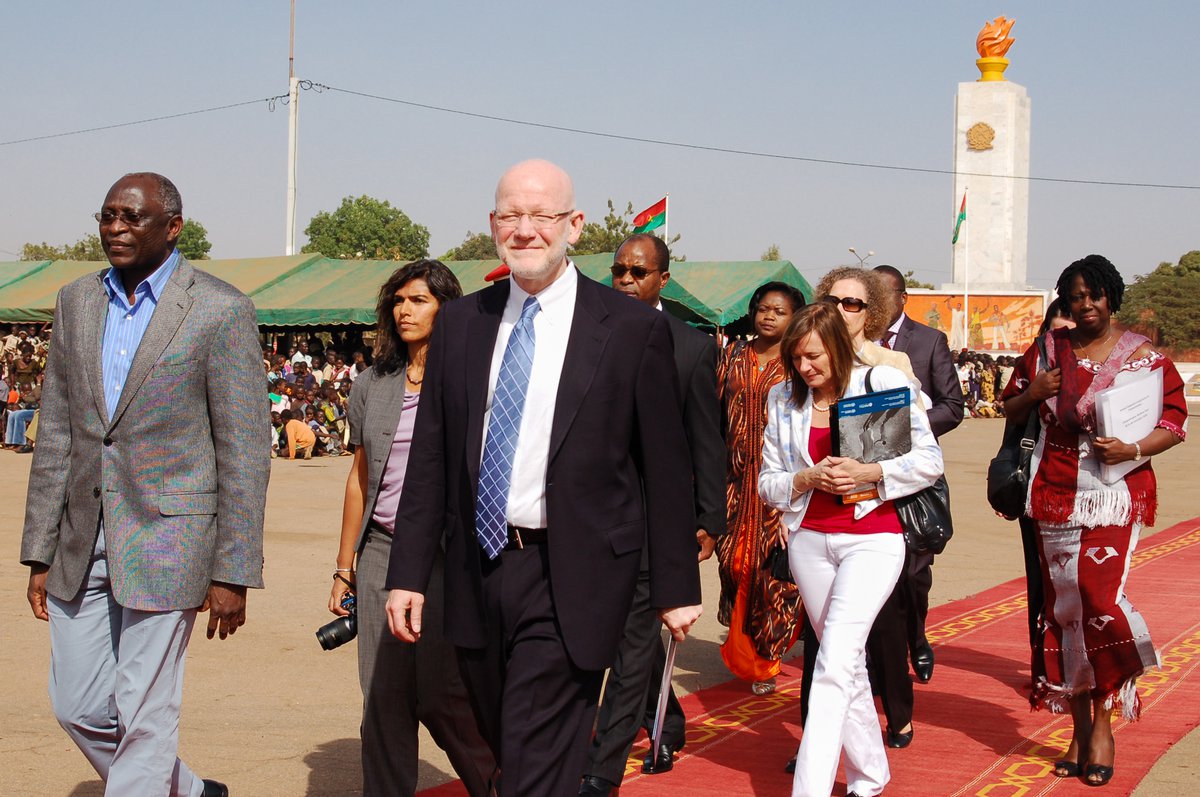
- Presidential support for the initiative culminated in the official MenAfriVac launch on December 6 2010, in Ouagadougou, Burkina Faso's capital. Under the patronage of the President, the launch ceremony was held in the presence of key African political leaders and partners, including high-level representatives from PATH, WHO, Serum Institute of India, Ltd (the manufacturer of the vaccine), the Bill & Melinda Gates Foundation, the United Nations Children's Fund (UNICEF), and Gavi. (See image above.) News of the launch was covered over the next several weeks by major news agencies and media (print, radio, television) around the globe. The authors note that the key messages developed for global media outreach at the launch were different from those created by partnering institutions for social mobilisation and to advocate for the vaccine's introduction in Africa. For example, terms like "first/revolutionary/new/cheap" could have aroused suspicions in African populations, so the terminology was left to the discretion of African stakeholders.
- The communications plan included identification of events that could maintain or renew media interest in the MenAfriVac Project in Africa or globally. For example, on November 15 2012, there was a symbolic celebration of the 100-millionth vaccination in Benin, whose President was also President of the African Union (meaning he would be in a position to promote the vaccine to other African heads of state where MenAfriVac was due to be introduced.) The ceremony was broadcast live throughout Africa, and the event led to several news stories in African media.
During the MenAfriVac campaigns, information on the vaccine and the campaign in Burkina Faso came from a variety of sources. Social and media mobilisers accounted for 65% of the information sources, followed by healthcare agents (24%) and religious leaders (11%). Indeed, 95% of respondents in the survey said they were aware of the campaign, and 98% were able to give the name of the disease they were being immunised against. According to the authors, the survey results suggest that communication efforts played a key role in the success of the vaccination campaigns.
There were, however, some challenges during the process, and the paper outlines them and explains how they were overcome. In brief:
- It was difficult to convince youth, especially males between 15 and 29 years of age, to take part in the vaccination campaigns. MVP employed several new strategies, with the support of local and UNICEF specialists in social mobilisation. Examples include peer education, the participation of celebrities known by young people, community discussions with the aim of engaging tribal and administrative leaders, and the use of public criers before, after, and especially during the official vaccination campaign.
- In December 2010, a crisis developed in Burkina Faso with the death of a child on day 8 of the planned 10-day vaccination campaign. News of the death was published on the front page of a national daily newspaper that linked the child's death to the vaccination. Fortunately, in August 2010, the first crisis communication workshop had been held to train managers and decision makers from health ministries along with communication officers in Burkina Faso, as well as in Niger and Mali. In this case, in addition to a press conference held promptly, special attention was devoted to the social and cultural management of the child's death.
- There was a case of mass psychogenic illness following MenAfriVac introduction in Gouro, Chad. "Suspecting political mischief, members of the government chose to address the situation privately or not to react at all, giving free rein to rumours and exaggeration, especially in the written media, which led to a worsening crisis at the local, national, and international levels. In the end, the daily visits of expert clinicians to hospitalised children in N'djamena, the accessibility of the authorities to local leaders, and discussions with the ministry of health [leading to 2 communiqués bearing his signature] brought a satisfactory outcome to this crisis" - and even created an opportunity to communicate positive messages on the vaccine.
According to the authors, among the key factors for success in this process included good planning, the engagement of stakeholders and potential supporters, and effective promotion of MVP with well-defined targets and objectives accomplished by pooling skills and expertise. They suggest:
- Weaving an advocacy and communication strategy into the fabric of the project that evolves dynamically;
- Developing a culturally appropriate approach;
- Boosting the skills of healthcare teams in community dialogue and other interactive techniques if necessary; and
- Implementing crisis communication training as an integral part of vaccine introduction.
The authors conclude: "The MenAfriVac mass vaccination campaigns in Africa will go down in history as a stunning success.....Findings were confirmed in a major way in Chad in 2012 where researchers reported a dramatic reduction in transmission and incidence of group A meningococcal disease, a drop of >90% following vaccination." That said: "One needs correct strategic communication choices to instill lasting trust within communities."
Clinical Infectious Diseases. 2015 Nov 15;61 Suppl 5:S451-8. doi: 10.1093/cid/civ493. Image credit: PATH/Teresa Guillien
- Log in to post comments