










































CIVICUS State of Civil Society Report 2018
"Each year the CIVICUS State of Civil Society Report examines the major events that involve and affect civil society around the world. Our report is of, from and for civil society, drawing from a wide range of interviews with people close to the major stories of the day, CIVICUS’ ongoing programme of research and analysis, and findings from the CIVICUS Monitor online platform tracking the space for civil society around the world."
The online document, designed to be a yearly report on civil society, gives a timeline of major events and action by civil society in 2017. It then has the year in review by the month. It gives an overview of the top ten trends and then offers a map of countries worldwide that are labelled: closed, repressive, obstructed, narrowed, and open.
The report draws from a range of "interviews with people close to the major stories of the day, CIVICUS’ ongoing programme of research and analysis, and findings from the CIVICUS Monitor online platform tracking the space for civil society around the world."
The report on January 2017, for example, opens with the United States marches to protest the presidential inauguration; The Gambia presidential attempt to stay in office, ended by pressure to stand down; the detaining and torturing of five social media activists for being outspoken campaigners against the Taliban and the military’s human rights abuses; and the Green March Movement in Dominican Republic against corruption. The review describes instances of police abuse and harassment of protestors in Chile, Cuba, Panama, and Gabon. Civil society organisations are under threat in Iraq and Kazakhstan. Newspapers were under threat, as were outspoken activists, in Tanzania, UAE, Republic of Congo, Guatemala, Honduras, and Colombia.
At the international level, the United Nations appointed three women to top positions, fulfilling gender parity and geographic diversity in promotions, "while Vitit Muntarbhorn, the first-ever UN Independent Expert for Protection Against Violence and Discrimination Based on Sexual Orientation and Gender Identity, held a landmark first consultation with civil society." A designated section (on the US Protest Law Tracker) analyses protest in the United States in light of the change of presidents and looks at a possible trend toward increasing criminal sanctions for protest. Another reviews the Gambian civil society pressure to create a newly-democratic Gambia, though "[t]he continued existence of criminal defamation laws was also identified as an enduring constraint on the freedom of expression. " Pakistan and Dominican Republic are also given close scrutiny: Pakistan for a growing online feminist support community - increasingly vulnerable to attack, as well as the abduction and torture of journalists; Dominican Republic for large-scale corruption revealed by the international Odebrecht scandal.
The top ten trends, downloadable in detail here, include the following:
- "Globalised neoliberalism is failing people all around the world;
- Polarising politics are dividing our societies;
- Personal rule by political leaders is undermining democratic institutions;
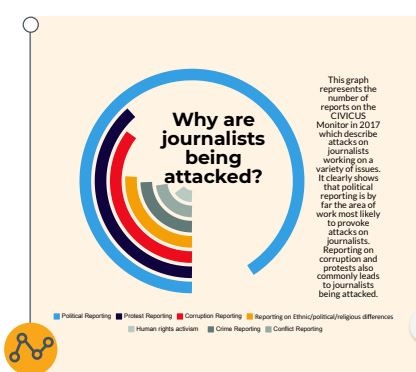
- Attacks are increasing on journalists reporting on corruption and public protests;
- Growing surveillance and manipulation of opinion is betraying the promise of social media;
- Uncivil society is claiming civil society space;
- Multilateralism is in the firing line;
- The private sector's growing role in governance demands more scrutiny;
- Patriarchy is now firmly under the spotlight;
- Civil society is fighting back and building resolute resistance."
Email from CIVICUS: World Alliance to The Communication Initiative on April 5 2018. Image credit: CIVICUS
- Log in to post comments