











































Cameroon Malaria Knowledge, Attitudes, and Practices: Progress from 2011 to 2012
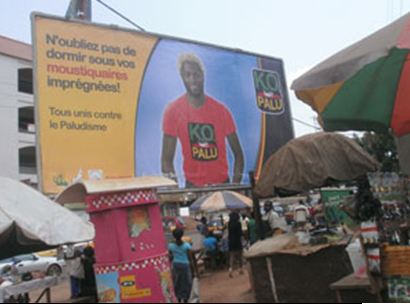
This 17-page report shares findings of progress related to Malaria No More (MNM) work in Cameroon, particularly MNM's contributions to the national K.O. Palu (Knock Out Malaria) campaign. The results of the 2012 Malaria Knowledge, Attitudes, and Practices (KAP) Survey were compared to 2011 baseline indicators in order to track progress over the previous year, measure the impact of malaria control interventions, and identify priorities for future malaria communication campaigns. According to the evaluation, the campaign has successfully impacted on behaviour change related to malaria prevention.
To complement national bed net distribution, a coalition of health partners implemented a national malaria communication campaign under a unified brand, the "K.O. Palu" (Knock Out Malaria) campaign. Centred on the Nightwatch model, which reminds people to sleep under a net every night, activities included a malaria anthem featuring Cameroon's top musicians, radio and television public service announcements (PSAs), roadside billboards, SMS messages, large public events, and press conferences making critical announcements regarding distribution activities. MNM's NightWatch platform, created in partnership with Lalela Project, is grounded in theories of behaviour change and social mobilisation that describe how communication feeds into a process of individuals and communities recognising the importance of malaria control and learning about malaria prevention and treatment, taking action, and thereby reducing malaria deaths.
The assessment found that malaria communications have wide reach and measurable impact on net use.
- Over 60% of all respondents (representing over 6.8 million adults) recalled seeing or hearing malaria communications that used the unified national campaign brand, K.O. Palu. The single component with the largest reach was the Malaria Anthem, at 46%, while the NightWatch PSAs (on either radio or TV) collectively reached 29% of respondents (approximately 3.2 million adults).
- The K.O. Palu Malaria Anthem has been particularly effective at reaching youth and putting malaria in the national spotlight. The anthem has reached 52% of adults aged 15-30, in part because TV stations were so eager to show the music video as part of their programming, and at no cost to MNM or other health partners.
- Knowledge about mosquito nets as a malaria prevention tool has increased from 71% in 2011 to 77% in 2012, in part thanks to the K.O. Palu campaign. In 2012, Cameroonian adults exposed to the campaign were 21% more likely than those not exposed (81% vs. 67%) to spontaneously mention a mosquito net (or specifically mention a LLIN) as a method of preventing malaria.
- K.O. Palu communications intensified the impact of the mass net distribution, helping drive a significant increase in mosquito net use from 2011 to 2012 (from 31% to 52% of adults, and from 41% to 65% of children). Cameroonians exposed to the K.O. Palu campaign were 13% more likely to sleep under a net (55% vs. 48%), and 24% more likely to have their children sleep under a net (71% vs. 57%).
The report outlines the following as considerations for subsequent programming:
- Expand reach in rural areas: some of the most important gaps in malaria control behaviour, such as protecting children under 5 with mosquito nets (even in households that have enough nets), are more concentrated in rural areas. Further efforts to reach a rural audience must remain a top priority.
- Address regional differences in net use: beyond just the urban/rural divide, net use messages are particularly needed in regions with lower net use among individuals with access to nets – especially the Far North, Southwest, North, and Littoral regions. Messaging in both French and Fulfulde can help address the gaps in these regions.
- Focus net messaging on the remaining barriers: most of the individuals who could sleep under a net (have access to one) but do not use it consistently said that the net is uncomfortable, inconvenient, or not necessary because there are too few mosquitoes at times. Messaging should focus on overcoming these attitudinal determinants of net use.
- Expand messaging on case management: building on the K.O. Palu-branded case management PSA's launched in 2012, more efforts are needed to increase prompt treatment-seeking behaviours. In particular, there is a need to introduce Cameroonians to rapid diagnostic tests (RDT): two-thirds of adults have not heard of RDTs, and very few have personal experience with them.
- Encourage men and young adults to take malaria seriously: though the K.O. Palu NightWatch campaign has succeeded in bringing malaria to the attention of a broad audience, men and young adults are still less likely than women or adults over 30 to say that they take malaria seriously. Though they may be at lower risk personally, further messaging can emphasise the role men and youth can play in dramatically reducing malaria cases
- Ensure consistency and frequency of communications: according to the social and behaviour change communication (SBCC) theories underlying NightWatch activities, messages are most impactful when they are on the air frequently and consistently over a long period of time.
Click here to download the evaluation report in English in PDF format.
Email from Hannah Bowen on September 12 2012.
- Log in to post comments