










































C4D Network Country Mapping Study - Key Findings 2016/2017
“C4D [communication for development] is, as many people acknowledge in this study, a burgeoning field of development practice, and still in some quarters misunderstood and underrepresented. But it is also thriving, with an energy in-country that comes through in this Study and mapping process very clearly.”
This study presents a a country snapshot of 'Communications for Development' around the world, from the perspective of the C4D Network, a global community of professionals working in communication for development (C4D). It reflects the views of Network members who are either working in C4D or teaching it, studying it, supporting it, and on occasion commissioning it. The report offers a summary of findings from across the globe, as well as results from individual participating countries.
This mapping was done in the context of the annual C4D Network Challenge organised by the C4D Network. Network members around the world are encouraged to meet-up "where they are", even if it is only a small meeting of a couple of members. The Mapping methodology included information gathered at these meet-ups (discussions were recorded and transcribed) and an online survey. The face-to-face meet-ups were held by members and other interested people in 16 countries between September 2016 and January 2017. These were in Australia, Belgium, Cameroon, Colombia, France, Kenya, Middle East and North Africa region, Nigeria, Papua New Guinea, South Africa, Tanzania, Thailand, Uganda, Ukraine, United Kingdom, and Zimbabwe. The online survey was distributed via email in English, French, and Spanish to all 3,000 C4D Network members in 136 countries.
The questions that were the framework for country chapter discussions, and which were in the online surveys, were as follows:
- What is interesting to know about the communication for development landscape in your country?
- What are the main development themes that communications for development is being used for in your country?
- What are the main communications for development approaches and strategies employed in your country?
- What is the situation with communication for development service providers in your country?
- What is the engagement of donors and government in your country in communications for development as a concept and in practice?
- What is the engagement of international non-governmental organisations (INGOS), non-govermental organisations (NGOs), civil society, community organisations, activists, and others in your country in communications for development as a concept and in practice?
- Can you suggest any C4D projects or initiatives in your country that would be useful to highlight for shared learning on the Network?
The following is a brief summary of the key findings, which are discussed in more detail in the report with the help of charts and visual diagrammes:
- The most significant C4D approaches that are used are behaviour change and advocacy, followed by media development, social change communication, and social mobilisation.
- C4D contributes to many different programme areas or themes in development, as determined by country context; key areas are health, education, and agriculture.
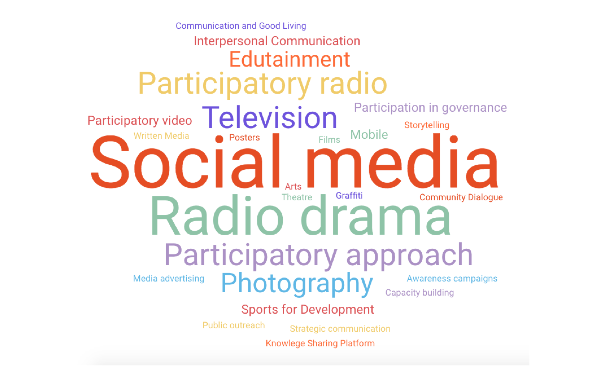
- Many varied C4D areas (strategies, channels, and tools) are used; while social media and broadcasting are dominant channels, approaches and strategies are highly varied, but with a prioritising of participatory and edutainment methods.
- The words ‘communication for development’ are not always useful as a name for this field. There was a recognition by many Network members that the standard C4D language and concepts, as promoted by international organisations and institutions, are not always accessible or useful, and that in practice, different terminology is often used - while the basic principles and practices remain the same.
- The engagement with C4D by donors, government, and organisations is unclear or mixed.
- C4D is often invisible and unnamed but it is present ‘on the ground’.
In conclusion, the report makes the point that “as a community of C4D practitioners, academics and facilitators we have a challenge to better communicate what we do, why it is important and how it is happening every day within projects and initiatives in all programme areas in development across the board. If it is better presented and better understood it has a greater opportunity to be better done and have increased impact.”
C4D Network website on May 30 2017.
- Log in to post comments