











































BridgeIT
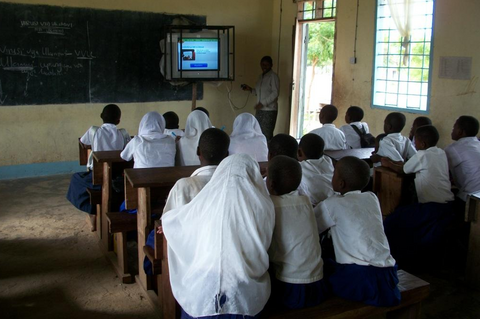
BridgeIT, launched in Tanzania in 2007, is a mobile teaching tool that allows teachers to download educational videos focusing on math, science, and life skills onto mobile phones. The phones are then connected to classroom televisions, which display the videos. Teachers then use BridgeIT-designed lesson plans to build on the ideas outlined in the videos. The programme was launched as a collaboration between the International Youth Foundation and the Tanzania Ministry of Education and Vocational Training, in partnership with Nokia, the Pearson Foundation, the Vodacom Foundation, and the Forum for African Women Educationalists, with funding support from the United States Agency for International Development (USAID).
The objective of the BridgeIT programme, which is being implemented in 17 districts in seven regions of mainland Tanzania, is to help standard five and six students in math, science, and life skills, giving special attention to girl students. According to organisers, the videos often feature women as scientists, leaders, and doctors in order to give female students positive professional role models. In addition to encouraging female students, the videos and lesson plans are also designed to make it easier for teachers to approach sensitive topics such as sexual and reproductive health.
Organisers say the videos focus on ways that math, science, and life skills can be applied to students' everyday lives. For example, science lectures could be on topics such as how to cut grass to reduce the number of malarial mosquitoes, or how and why to treat water to cut down on cholera. Life skills videos might offer a frank discussion on the reality of HIV/AIDS. The videos are short, and as such are a complement to teachers' lesson plans, not a replacement for student/ teacher interaction.
The phones used to download the videos also serve as a link between BridgeIT and teachers, as one of the project's goals if to improve teaching methodologies in the classroom. The continued contact between teachers and organisers means that teaching methods can be adjusted throughout the school year based on the needs of the students and teachers. New educational videos are released every three months, so the content is also continually evolving.
Education, New technology
Originally a two-year pilot project, BridgeIT received additional funding to continue the programme for an additional 15 months. Organisers say the project has benefited over 100,000 students in 150 schools. Also, as a result of the programme, 3,000 trained teachers have gained new teaching strategies and classroom skills. There are currently 146 video clips available for teachers to download.
Organisers explain that the decision to use mobile funds was based on considerations around the project’s long-term sustainability. The programme concentrated on a direct mobile-to-mobile delivery service. The majority of the US$2 million invested in the project went to the purchase and installation of equipment packages (phones, cables, televisions, power strips) for each school, teacher training, video production and development, and teacher monitoring and evaluation.
According to initial research, students who watched the videos showed greater motivation and achieved better test results than those who did not have such access. In addition, anecdotal reports from teachers say that attendance and classroom participation in BridgeIT classrooms is higher than in non-BridgeIT classrooms. According to organisers, one of the benefits of the project has been to facilitate teaching in overcrowded classrooms. In Dar es Salaam, classes of 70 to 80 pupils are common, almost double the recommended class sizes.
International Youth Foundation, Tanzania Ministry of Education and Vocational Training, Nokia, Nokia Siemens Networks, the Nokia Institute for Technology, the Pearson Foundation, the Vodacom Foundation, the Forum for African Women Educationalists, and the United States Agency for International Development (USAID).
MobileActive website, eLearning website, both on June 21 2011, and email from Christy Macy to The Communication Initiative on October 27 2011.
- Log in to post comments