











































Bold female voices: broadcasting under the shadow of Boko Haram
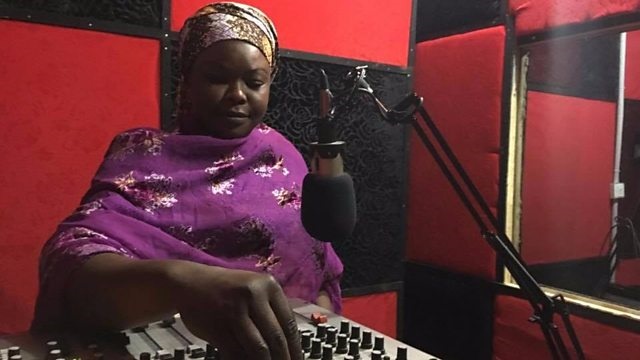
Author: BBC Media Action's Head of Country Programmes, Nigeria, Rachael Borlase, originally posted on April 13 2017 - At the height of the Boko Haram insurgency local radio stations stayed on air. Three years on from the Chibok schoolgirls’ kidnapping, Rachael Borlase profiles the female broadcasters in Northern Nigeria proudly telling their own stories.
“We continued to broadcast during the insurgency. If we didn’t, people would have thought there was chaos,” says Fatima Audu, Station Manager of Peace FM in Maiduguri in Borno State. We’re here to learn more about the media in Borno and to support them to make programmes that address the needs of audiences devastated by conflict. She points to the bullet holes and cracks in the cement walls to show how close Boko Haram’s attacks came to her station.
Peace FM was in a vulnerable location during the height of the North East Nigeria insurgency that forced more than 2 million people to leave their homes . It lies on the outskirts of Maiduguri, on a contentious road that many fighters use to come into town to carry out attacks. The ongoing risks are at the forefront of Fatima’s mind. “We still stop broadcasting by 5:30pm, so [our staff] can get home before dark,” she says.
It’s not surprising to hear people in the media talk defiantly about their responsibility to stay on air during a crisis. What is striking is how many women in the media are leading the charge. Fatima is the north east’s first and only female station manager. She was appointed in 2015, after studying mass communication and climbing the ranks of Borno Radio Television Corporation (BRTV) – the state’s broadcaster. Today, women are producing and presenting some of Peace FM’s most popular health, politics and current affairs programmes. “I give female employees lots of extra opportunities so they feel motivated”, she explains. “If we are invited for training, two out of every three participants sent from Peace FM will be women”. For a change, we heard male employees grumbling about equal opportunities.
As we make our way around other stations in Maiduguri, we encounter the same boldness and vibrancy amongst the female production staff. At Lafia Dole, the community station down the road, Abigail Henry is the Head of News. Her reason for working in the media is simple, even if being a female boss isn’t. “I have a flair for going out and finding out what’s going on in my community. But sometimes people don’t want to do what you ask of them. If you send reporters out to gather news you have to beg, you have to continue asking them to do things.”
Elizabeth Ameh is a reporter for the University of Maiduguri’s campus radio. She was gathering vox pops outside on the day we visited her station. “I am not afraid for now because of the level of peace that has been sustained. Honestly, I don’t have that fear anymore. I can go out and interview people, get information…I’ve been doing that, and I’ll continue.”
Elizabeth Ameh is a reporter for the University of Maiduguri’s campus radio. She was gathering vox pops outside on the day we visited her station. “I am not afraid for now because of the level of peace that has been sustained. Honestly, I don’t have that fear anymore. I can go out and interview people, get information…I’ve been doing that, and I’ll continue.”
It’s true that women continue to face huge challenges in Northern Nigeria. And they’ve been particularly vulnerable in the Boko Haram conflict – subjected to violence and rape and accounting for the highest numbers of displaced people. But just like many places at the centre of conflict or disaster, the richness and complexity of people’s lives often gets lost. Fatima and a lot of the women we spoke to are determined to change that. “We won’t want people telling our stories for us. We have to do this on our own.”
Click here to access this BBC Media Action blog and related links on their work in Nigeria.
Image credit: BBC Media Action, caption: Abigail Henry, head of News, Lafia Dole Community Radio Station
Contact:
BBC Media Action
BBC Media Centre, MC3A, 201 Wood Lane
London
W12 7TQ
United Kingdom (UK)
Phone: 44 (0) 20 8008 0001
Fax: 44 (0) 20 8008 5970
Media.action@bbc.co.uk
- Log in to post comments