











































Automated Phone Call and Text Reminders for Childhood Immunisations (PRIMM): A Randomised Controlled Trial in Nigeria
Indiana University (Ekhaguere); Mother and Child Hospital, Akure (Oluwafemi); Mother and Child Hospital, Ondo Town (Badejoko, Lawal O Oyeneyin); University of Iowa (Butali); Perelman School of Medicine (Lowenthal); The Children's Hospital of Philadelphia (Steenhoff)
"In a semi-rural setting in Nigeria, paired automated voice call and text immunisation reminders significantly improved the completion and timely receipt of immunisations."
A 2017 Nigerian National Immunization Coverage Survey estimated that 37% and 40% of children in Nigeria aged 12-24 months were underimmunised and unimmunised, respectively. Text messaging reminders alone have been found to improve immunisation completion in urban settings in sub-Saharan Africa (SSA) but not in rural areas, where literacy levels are lower. This study sought to assess the feasibility and impact of combined automated voice and text reminders on immunisation completion in rural sub-Saharan Africa.
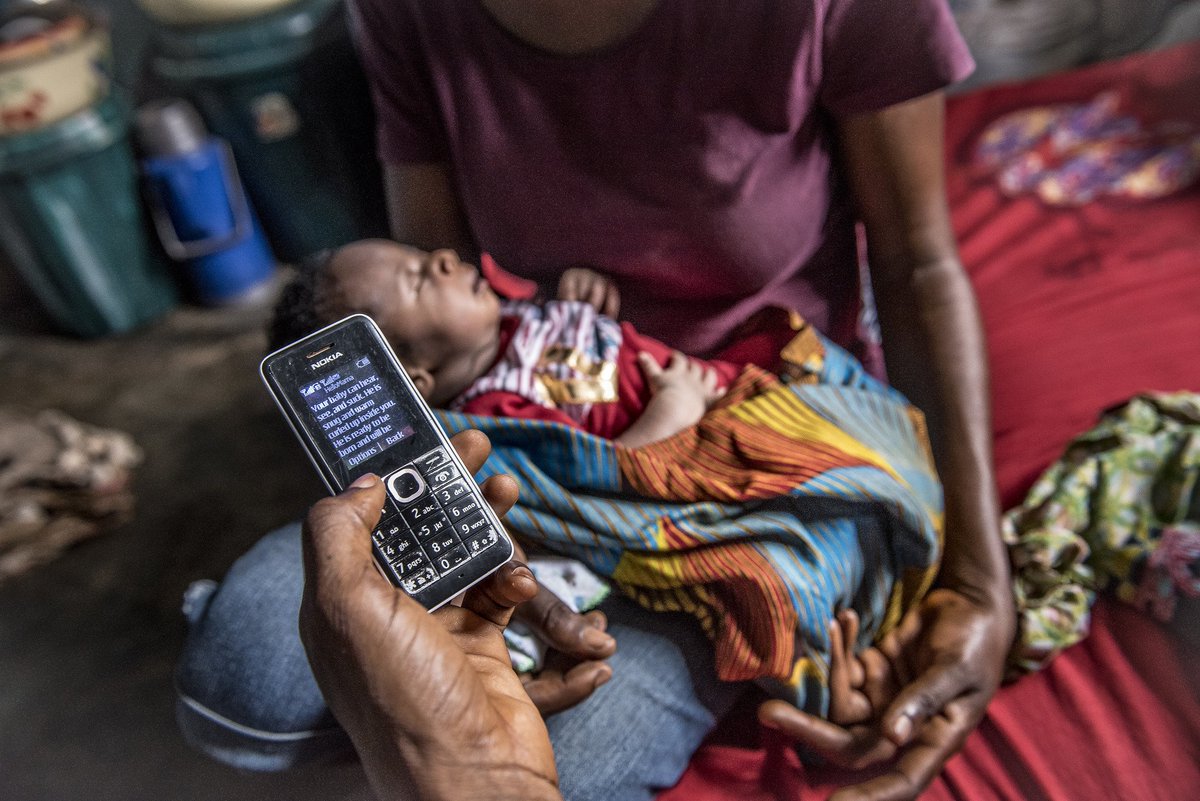
The researchers randomised parturient women at the Mother and Child Hospitals [MCH] Ondo State, Nigeria who owned a mobile phone and planned to attend child immunisation at these sites to receive either standard care (a child-health immunisation card) or automated call and text immunisation reminders. At enrolment, the registered phone number(s) received a verification message. Thereafter, reminders were sent 2 days and the day before the scheduled date of the pentavalent vaccine (Penta) 1, 2, 3 and measles immunisations. Eight sets of reminders were sent to each participant. The delivery of text and call occurred at the same time. The automated text message reminder was in English. The text reminder read, 'Reminder from MCH - Your baby's next immunisation visit is in 2 days [or 1 day, as appropriate]. Immunisation protects your child against killer diseases. Please bring your baby for this visit'. The automated call reminder was in English and Yoruba. In the intervention group, 92% and 86% reported receiving a verification reminder and at least one reminder during the study period, respectively; failed delivery resulted from poor local telecommunication service.
The researchers assessed the completion of Penta-3 at 18 weeks of age, immunisation completion at 12 months, and within 1 week of recommended dates. They assessed selected demographic characteristics associated with completing immunisations at 12 months using a generalised binomial linear model with 'log' link function. Feasibility was assessed as proportion of reminders received.
Each group had 300 mother-baby dyads with similar demographic characteristics. At 18 weeks, 257 (86%) and 244 (81%) (risk ratio (RR) 1.05, 95% confidence interval (CI) 0.98 to 1.13; p=0.15) in the intervention and control groups received Penta-3 vaccine. At 12 months, 220 (74%) and 196 (66%) (RR 1.12, 95% CI 1.01 to 1.25; p=0.04) in the intervention and control groups received the measles vaccine.
Infants in the intervention group were more likely to receive Penta-3 (84% vs 78%, RR 1.09, 95% CI 1.01 to 1.17; p=0.04), measles (73% vs 65%, RR 1.13, 95% CI 1.02 to 1.26; p=0.02), and all scheduled immunisations collectively (57% vs 47%, RR 1.13, 95% CI 1.02 to 1.26; p=0.01) within 1 week of the recommended date. No demographic character predicted immunisation completion.
Based on the survey data, the biggest reported barriers to completing immunisations were long wait times in 308 (55%) and transportation cost in 187 (34%). Forgetfulness (12; 2.2%) was one of the least-reported barriers to completing the routine immunisation series.
In short, the study found that paired automated calls with text immunisation reminders significantly improved the proportion of infants who completed all routine immunisations by 12 months of age and the timeliness of vaccines administered late in the immunisation schedule. For the primary outcome, however, Penta-3 completion rates were higher than anticipated in both groups and not significantly different between groups.
The researchers note the absence of the human element in automated calls, conceding that the ability to empathise, counsel, and reassure mothers during a real-time phone call is lost with automation. However, with current resource and organisational limitations, real-time phone calls plus recalls could be a challenge. Perhaps automated text and/or calls could serve as a first-pass reminder to be followed by real-time phone calls when immunisations are delayed.
Phones that were switched off or had poor reception when messages were sent were the most common reported reasons for not receiving phone reminders. This is a limitation in web-based text and call systems that lack the ability to queue messages until the switched off phone is turned back on or a phone moves to an area with better reception. In addition, voicemail is uncommon in these settings. The researchers speculate that a system that uses the available local telecommunication network, which is usually more redundant, and has the capacity to provide more accurate log data, may yield better results.
BMJ Global Health 2019;4:e001232. doi:10.1136/bmjgh-2018-00123. Image credit: USAID
- Log in to post comments